

The European Union stands at a crucial juncture regarding its future relationship with Ukraine, with recent proposals sparking a significant debate about the pace and nature of Kyiv’s integration. German Chancellor Friedrich Merz has put forward an unprecedented plan to create a new “associate membership” status specifically tailored for Ukraine. This proposal, detailed in a five-page letter to fellow EU leaders, aims to break a two-year political stalemate by offering Ukraine incremental benefits. These would include access to certain EU decision-making bodies—though without voting rights—and participation in select EU-funded programs on a step-by-step basis. Most notably, Merz’s plan invokes Article 42.7 of the EU treaties, suggesting that associate membership could allow Kyiv to request military assistance from member states in the event of armed aggression, thereby creating a “substantial security guarantee” against Russia. The chancellor argues that with the full accession process facing countless hurdles and complex ratifications, such innovative solutions are necessary to provide immediate, tangible progress in Ukraine’s EU integration.
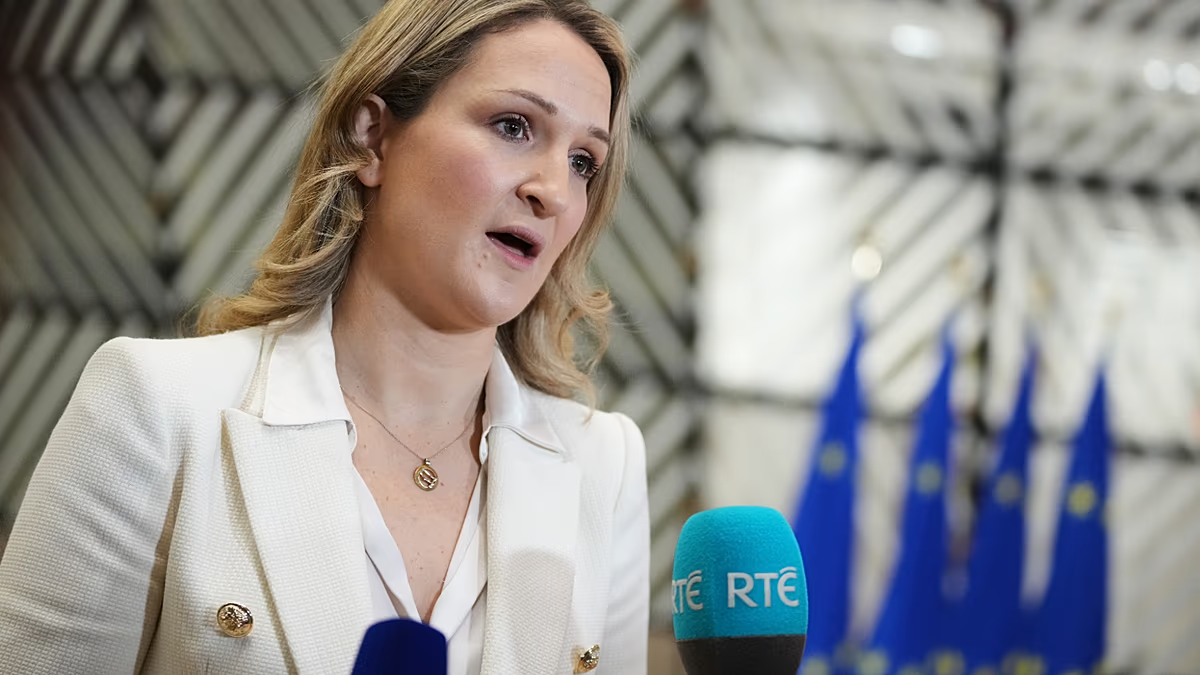
However, this well-intentioned proposal has been met with caution and skepticism from several quarters within the EU, with a central concern being that it might inadvertently sideline Ukraine’s ultimate goal. Irish Foreign Minister Helen McEntee has voiced particularly weighty reservations, warning that creating a special category risks leaving Ukraine in a diplomatic and political limbo. “Do you end up in a situation where associated members find themselves in some kind of a limbo?” she questioned during a recent briefing. McEntee fears that a “two-tiered” membership system could reduce the urgency for candidate countries to complete the difficult legal and institutional reforms required for full membership, particularly in areas like the rule of law and judicial independence. Her perspective carries added significance as Ireland prepares to assume the presidency of the EU Council in July, putting it at the helm of the very negotiations concerning Ukraine’s bid.
The core of McEntee’s argument is a concern over momentum and incentive. The rigorous, merit-based accession process, for all its challenges, applies consistent pressure on candidate nations to modernize and align with EU standards. Introducing an intermediary status, she suggests, might “take a bit of the pressure off,” allowing countries to settle into a comfortable “half position” that does not naturally progress toward full integration. This, she implies, would be a disservice to Ukraine, which has fought so resolutely for its European future. While fully acknowledging Ukraine’s “very difficult situation” and Ireland’s steadfast support, McEntee emphasizes that the EU must apply its rules equally to all candidate countries to preserve the integrity and transformative power of the enlargement process itself.
The European Commission has acknowledged the value of debating “innovative solutions” but has simultaneously underscored the need to respect the established, merit-based logic of enlargement. Brussels has adopted a wait-and-see approach, stating it will only assess the legal merits of the German plan after discussions among national leaders conclude. Behind the scenes, many diplomats express deep skepticism about the feasibility and wisdom of inventing a new membership category, viewing it as a potentially cumbersome legal and political diversion. This sentiment is echoed clearly by Ukraine itself. Foreign Minister Andrii Sybiha has stressed that his country’s strategic goal remains “full-fledged membership,” and while various modalities can be explored, they “cannot replace our strategic position.” President Volodymyr Zelenskyy has historically rebuffed any notion of a merely “symbolic” accession, underscoring that Ukraine’s aspiration is for complete integration, not a halfway house.
The timing of this debate is critical, as a separate but related political blockage may be nearing resolution. For two years, Hungary has used its veto power to paralyze the start of formal accession talks with Ukraine, citing concerns over the rights of the Hungarian minority in Ukraine’s Transcarpathia region. There is now cautious optimism in Brussels that a window is opening. The new government in Budapest has initiated fresh consultations with Kyiv on this sensitive issue, raising hopes that the Hungarian veto could be lifted as early as June. This would allow the EU to finally open the first cluster of membership negotiations—the foundational chapters concerning the rule of law and basic governance—with the ambition of unblocking the remaining five clusters throughout the rest of the year.
Ultimately, the EU finds itself balancing two imperatives: the desire to offer Ukraine concrete support and a tangible path forward in the face of Russian aggression, and the need to uphold the rigorous standards that define the Union. Merz’s associate membership idea is born of a pragmatic desire to act amid deadlock, offering both immediate benefits and enhanced security assurances. Yet, as McEntee and Ukrainian leaders caution, the risk lies in creating a permanent waiting room that dulls the transformative pressure of the accession process. The coming months, under Ireland’s stewardship of the Council presidency, will be pivotal. The bloc must navigate whether to pioneer a novel, tailored partnership or to double down on the traditional accession path while working aggressively to remove the political obstacles—like Hungary’s veto—that have stalled it. The decision will not only shape Ukraine’s future but also define the EU’s own character and capacity for strategic unity in a time of profound geopolitical challenge.