


Paragraph 1
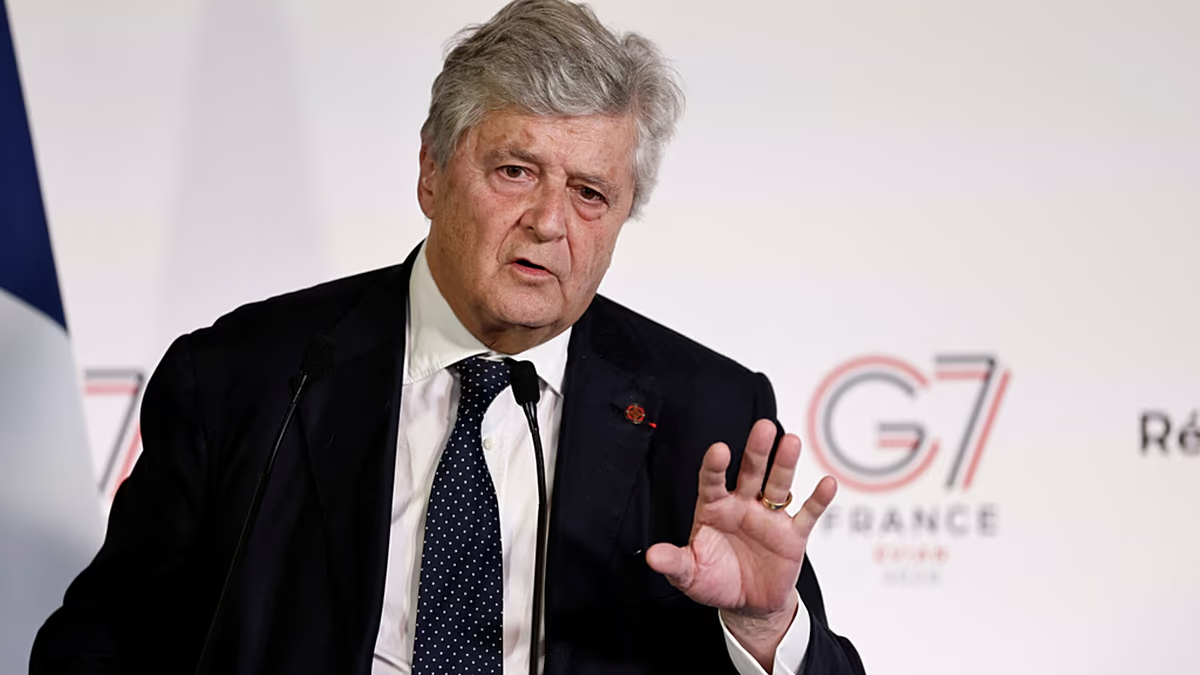
In a significant interview with Euronews, French Minister for Foreign Trade Nicolas Forissier delivered a stark warning to China, signaling a fundamental shift in Europe’s approach to international trade. His core message was direct: China stands to gain nothing from a foreign trade policy that undermines and potentially destroys European industry. Forissier argued that the European market is indispensable for Chinese exports, and jeopardizing its health through unfair practices is ultimately self-defeating. This statement, captured in the program “12 Minutes With,” moves beyond mere trade dispute rhetoric to frame the issue as one of mutual interest and long-term stability. The Minister’s words reflect a growing European consensus that past engagement strategies, perceived by some as overly accommodating, must be reassessed in the face of new economic realities.
Paragraph 2
Central to Forissier’s argument is a call for Europe to shed its “naivety” in dealing not only with China but with any nation that turns commercial interdependence into a strategic weapon. This represents a broader philosophical pivot, acknowledging that global trade is increasingly influenced by geopolitical strategies where economic dependencies can be exploited. By stating, “It’s not a matter of China or not. It’s not only China, it is all the countries,” he universalizes the principle. The goal is to establish a new, more resilient framework for international commerce where trade is balanced and reciprocal, ensuring that no single partner can hold critical supply chains or entire industrial sectors hostage for political or economic gain.
Paragraph 3
The timing of these comments is crucial, as they come just ahead of a pivotal “orientation debate” within the European Commission. President Ursula von der Leyen’s team is preparing to discuss a robust toolkit designed to protect the EU’s economic base from a flood of artificially cheap imports, a problem exemplified by the bloc’s staggering €359.3 billion trade deficit with China in 2025. Forissier explicitly endorsed one of the key proposals under consideration: requiring EU companies to diversify their supply chains by sourcing from at least three different suppliers. This policy aims to build inherent resilience, reducing over-reliance on any single foreign manufacturer and insulating European industry from sudden shocks or coercive tactics.
Paragraph 4
The potential measures on the table extend far beyond supply chain diversification. The European Union is actively considering more direct defensive actions, including the imposition of additional tariffs on strategic sectors like chemicals, and the use of established trade defense instruments such as anti-dumping duties. These tools are designed to level the playing field by correcting for prices that are artificially low due to state subsidies or other market-distorting practices in the exporting country. China has already warned of retaliation, setting the stage for a tense period of negotiation. The debate within the EU institutions, which will continue at a leaders’ summit in June, is therefore about calibrating a response that is firm enough to protect European interests without spiraling into a full-blown trade war.
Paragraph 5
France’s position, as articulated by Forissier, is not merely confrontational but is rooted in a desire for a recalibrated and “frank” dialogue with Beijing. He pointedly referenced France’s “special relationship” with China, built on decades of diplomacy and economic exchange. This history, he suggests, necessitates a foundation of mutual “negotiations” and “respect.” The message is dual in nature: Europe must assertively defend its market and industries, but it must do so from a position that seeks equitable and rules-based engagement. The principle is straightforward—Europe must respect China’s developmental path, and in turn, China must respect Europe’s right to maintain a vibrant, competitive, and sovereign industrial base.
Paragraph 6
Ultimately, Forissier’s interview encapsulates a defining moment for the European Union. It highlights the transition from a period of open-market optimism to an era of “strategic autonomy,” where economic security is inseparable from national and regional security. The EU is grappling with how to respond to practices like heavy state subsidies, industrial overcapacity, and restrictions on critical raw materials—practices that threaten to hollow out its manufacturing core. The coming weeks of debate will determine the precise blend of defensive measures, diversified supply chains, and diplomatic outreach that will shape Europe’s economic future. The goal is not isolation but the construction of a more balanced and sustainable trading system where mutual respect ensures mutual benefit.