
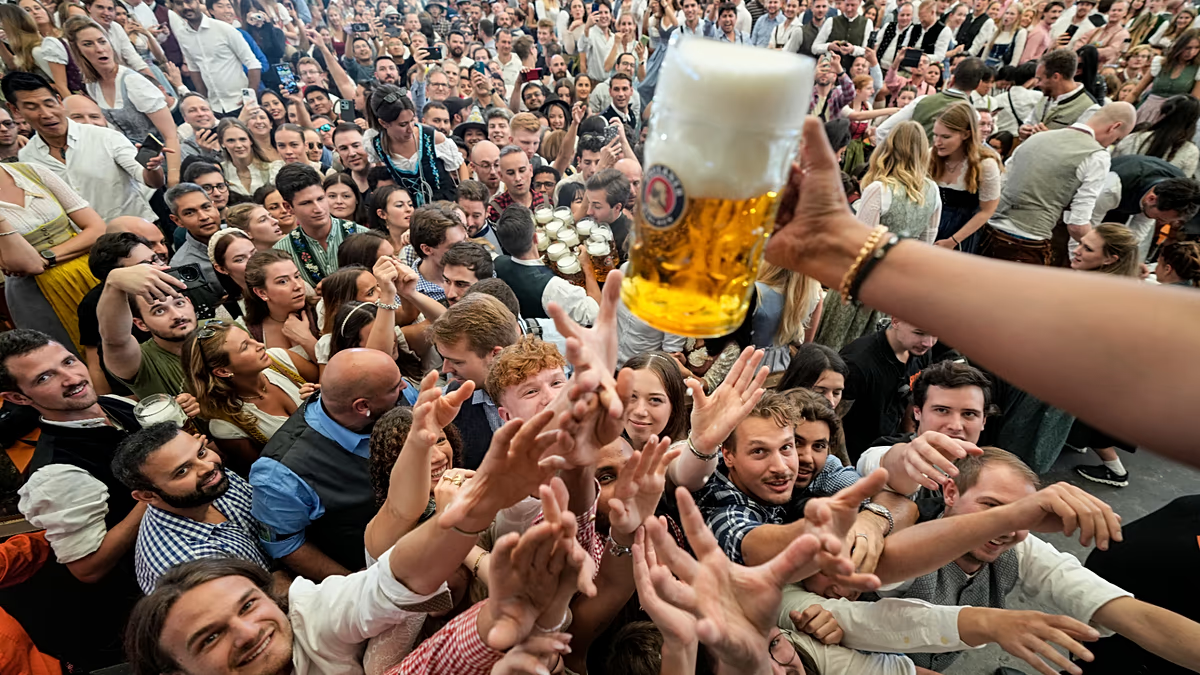



As the seasons turn and the promise of long, warm evenings beckons—perfect for gatherings with friends or celebrations like the World Cup—the question of the ideal drink arises. In Germany, that answer is often, joyfully, beer. This nation’s identity is deeply intertwined with brewing culture, a fact spectacularly showcased by events like Oktoberfest, where millions converge and consume staggering quantities, such as the 6.5 million one-liter maß served last year. Yet beyond the scale of such festivals lies a richer, more nuanced tapestry of beer culture, where tradition meets innovation, and passion flows from monastic cloisters to home kitchens and high-tech stadiums.
The spirit of innovation begins at the most personal level: home brewing. Germany formalizes this passion with a national championship, where enthusiasts like Jan Mordhorst, the 2025 winner, craft exceptional beers like his demanding Altbier. Mordhorst’s victory over roughly 200 competitors highlights the serious artistry involved; his publicly shared recipe and technical advice—such as fermenting in a cask and bottling under counter-pressure for clarity—invite others into the craft. The rewards, including 400 liters of his own beer and equipment upgrades, underscore a community that supports and celebrates mastery. This grassroots movement is ever-evolving, with future competitions, like the 2026 tenth-anniversary focus on wheat bock, ensuring the tradition continues to inspire new generations of brewers exploring beer’s boundless possibilities.
Parallel to this home-grown artistry is the dynamic craft beer revolution, a trend that crossed the Atlantic and firmly rooted itself in Germany during the 2010s. This movement consciously pushes beyond the classic confines of Pilsner, Helles, and wheat beer, seeking to reinvent the beverage through artisanal methods, unconventional hop and malt blends, and smaller, experimental batches. The result is often more intense flavors and higher price points, with some offerings achieving cult status. Examples range from Sapporo’s astronomically expensive “Space Barley”—brewed from grains that orbited Earth—to Bavarian gems like Gänstaller Bräu’s Imperial Stout, described as opulent and oily. These limited-edition creations celebrate beer as an experience, a complex drink worthy of connoisseur discussion and tasting apps, redefining it from a simple staple to a canvas for creativity.
Yet amidst this innovation, Germany’s beer soul remains anchored in centuries-old tradition, most notably within monastic breweries. Sites like the Andechs Monastery trace brewing back to Benedictine monks in 1455, who viewed beer not as a luxury but as a staple food, akin to bread, made from grain, yeast, and water. While most monastic breweries are now commercial enterprises, they preserve a legacy of quality and spiritual connection. These beers, often marketed as premium products, carry the weight of history, and the monasteries themselves remain places of pilgrimage—not just for prayer, but for a contemplative meal and a finely crafted drink. This enduring tradition offers a counterpoint to modern trends, reminding us that beer’s foundational role in German culture is both nutritional and cultural, woven into the fabric of daily life and community.
German ingenuity also applies beer culture to modern logistics and mass celebration, as spectacularly demonstrated by the Veltins-Arena during the 2006 World Cup. Recognizing that football and beer are inseparable for many fans, the brewery engineered a 5,000-meter pipeline directly from the stadium to cooling centers holding 52,000 liters. This system eliminated the chaos of moving thousands of kegs, instead piping beer directly to taps in the stands, enabling the efficient serving of tens of thousands of liters per match day. Once a novel European concept, such centralized tank and pipe systems are now commonplace in large stadiums, illustrating how German engineering optimizes even the joy of a shared pint, ensuring that the communal experience of sport is seamlessly supported by a steady, fresh flow of brew.
At the extreme end of both price and potency lies another Bavarian marvel: Schorschbock 57, arguably Germany’s most expensive bottled beer. This is an Eisbock, a style where the beer is partially frozen to concentrate flavors and alcohol, placing malt aromas at the forefront. The result is a staggering 57% alcohol content, a liqueur-like strength that demands sipping and allows an opened bottle to last weeks. With a price reaching approximately 750 euros per liter, it exists as a luxury curiosity, a testament to brewing’s outer limits. It serves as a reminder, however, that beer’s spectrum is vast—from everyday refreshment to rare, potent art. As we explore these diverse ideas—from homebrew competitions to monastic traditions, craft revolutions to engineering feats and ultra-strong specialties—it is crucial to remember that beer, in all its forms, is best enjoyed responsibly, as part of a balanced and health-conscious life. The true essence of Germany’s beer culture lies not just in the drink itself, but in the shared moments, historical continuity, and innovative spirit it inspires.