



Of course. Here is a humanized and expanded summary, structured into six paragraphs as requested.
Paragraph 1
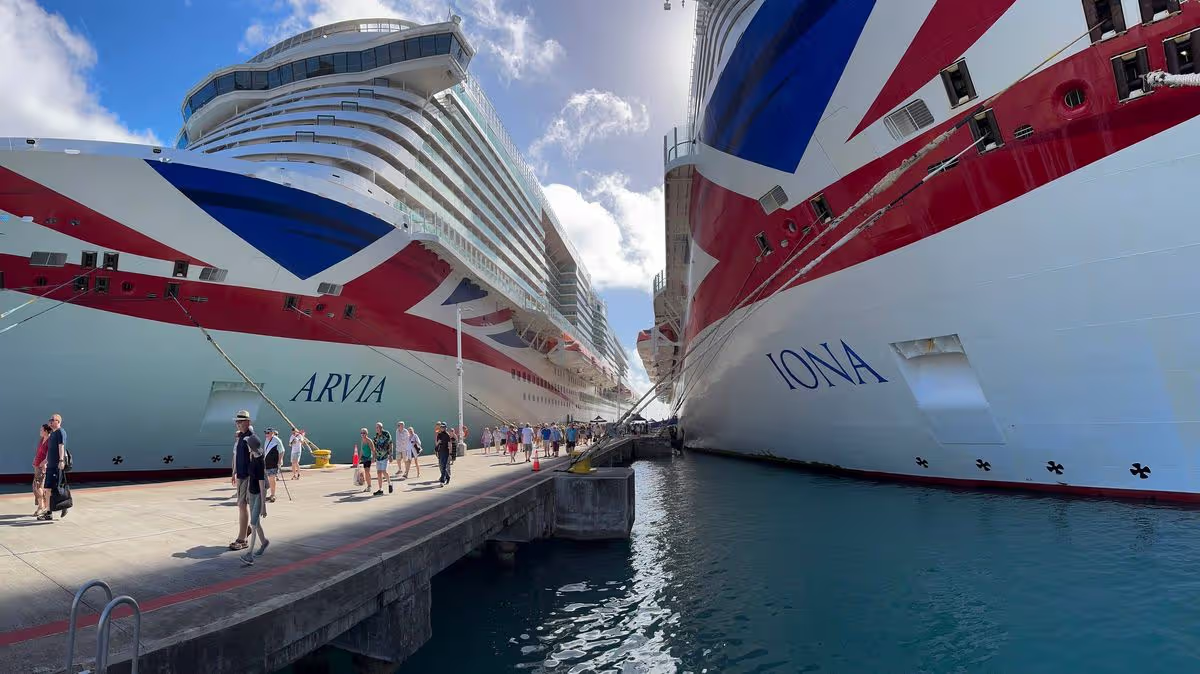
Planning a cruise holiday often revolves around the excitement of destinations, onboard entertainment, and luxurious relaxation. However, a fundamental and less glamorous requirement can be the key to actually setting sail. P&O Cruises, a major UK-based cruise operator, has issued a stark reminder to all prospective passengers: securing comprehensive cruise travel insurance is not merely a recommendation, but a strict mandate. The company explicitly states that without proof of suitable insurance, guests will be denied boarding at the departure terminal. This policy is enforced uniformly across its entire fleet, from the largest family-friendly ships like Arvia and Iona to the adult-only vessels Arcadia and Aurora, all primarily sailing from Southampton. The consequence of non-compliance is severe and personal; travelers turned away would bear all resulting costs and disappointments entirely “at their own expense.”
Paragraph 2
The rationale behind this firm policy stems from the unique and complex nature of cruise travel. P&O Cruises highlights that a standard travel insurance policy, often adequate for a typical hotel-based holiday, may fall critically short when on a cruise. The maritime environment introduces specific risks that require specialized coverage. The most significant of these is the potential need for a medical evacuation at sea, which is a logistically complicated and extraordinarily expensive procedure. A standard policy might not cover such a scenario, leaving a guest in a medical crisis facing astronomical bills or, even more alarmingly, refused treatment. Therefore, the company’s insistence on “suitable cruise travel insurance” is a protective measure, designed to safeguard guests from unforeseen financial ruin due to incidents that are unique to the cruise environment.
Paragraph 3
For guests, meeting this requirement involves careful preparation beyond just purchasing a policy. P&O Cruises advises that passengers must bring tangible proof of their insurance to the embarkation point. This can be in the form of printed documentation or a digital copy accessible on a phone or tablet. Crucially, the insurance must be valid and must honestly declare any pre-existing medical conditions. The cruise line warns that failure to disclose such conditions could render the insurance invalid in a crisis, leading again to “extremely costly” medical bills or denial of necessary care. This step underscores that the responsibility lies with the passenger to not only obtain insurance, but to ensure it is appropriately detailed and readily verifiable.
Paragraph 4
This reminder comes at a pivotal time, as the peak summer travel season approaches. Many Britons have already booked their maritime getaways, and the final stages of preparation are underway. The directive serves as an essential checkpoint in the pre-cruise checklist, alongside packing suits and sunscreen. It is a practical, albeit sobering, note amidst the anticipation. The policy is not new, but its reinforcement is timely, aiming to prevent last-minute disappointments at the Southampton dockside. For the unwary traveler who overlooked this condition, the dream holiday could end before it even begins, transformed into a stressful and costly logistical failure.
Paragraph 5
The broader implication of this policy reflects an evolving industry standard. Cruise lines are increasingly emphasizing the necessity of specialized insurance, recognizing that the safety and financial well-being of passengers—and the operational integrity of the voyage—are interconnected. For P&O, this mandate mitigates the risk of guests becoming stranded in a medical or emergency situation without the means to resolve it. It also clarifies the boundaries of the company’s responsibilities, ensuring that guests are personally prepared for scenarios that extend beyond the ship’s onboard medical facilities. In this sense, the insurance requirement is a cornerstone of a shared responsibility model for modern cruise travel.
Paragraph 6
Ultimately, the message from P&O Cruises is clear: a cruise ticket is not a standalone guarantee of passage. It is part of a package of responsibilities that the passenger must fulfill. The mandatory insurance rule transforms the abstract concept of “risk management” into a concrete, non-negotiable pre-travel action. As passengers finalize their plans, this item on the checklist is as vital as their passport. Ensuring one has suitable, documented cruise insurance is the final, critical step in transitioning from a hopeful traveler to a welcomed guest, ready to embark on the adventure without hidden vulnerabilities looming over the horizon.