


Here is a summary of the provided content, humanized and expanded to meet your requested format.
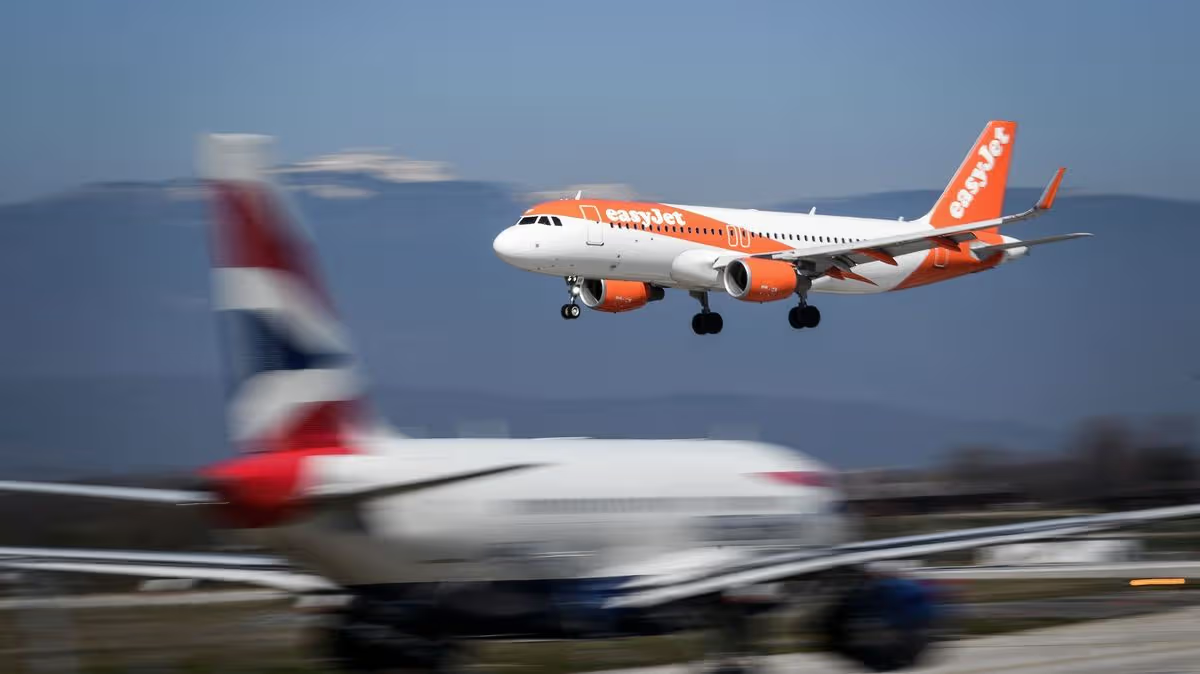
On a routine Thursday, an easyJet flight embarked from Manchester Airport with its passengers anticipating the sun-drenched shores of Sharm El Sheikh, Egypt. However, the familiar routine of takeoff was abruptly shattered shortly after Flight U22253 left the ground. The aircraft, an Airbus A320neo carrying what could have been up to 180 travelers, had barely begun its climb when a serious medical incident involving a passenger unfolded in the cabin. Recognizing the urgency, the flight crew was forced to halt their ascent at a mere 3,700 feet, far short of their planned cruising altitude, and immediately declared a general emergency to air traffic control.
This declaration was made through a critical international protocol: the Squawk 7700 code. By setting their transponder to this distinct signal, the pilots instantly alerted every air traffic control station in the vicinity that their aircraft was in a state of emergency, prioritizing their communications and clearing the path for their next actions. With the well-being of a passenger as their primary focus, the cockpit crew then efficiently ran through a series of emergency checklists to reconfigure the aircraft for a swift and safe return, turning the plane back toward its point of origin even as the English landscape still stretched clearly below them.
The decision to divert is never taken lightly, involving complex considerations of time, distance to adequate medical facilities, and the severity of the situation on board. In this instance, the proximity to a major airport with full emergency services made Manchester the obvious choice. As the Airbus made its approach, local emergency crews and airport fire services, pre-alerted by the squawk code, mobilized to their designated positions alongside the runway. This standby is a standard but vital procedure, ensuring that every possible resource is available the moment the aircraft touches down, regardless of the nature of the emergency.
Thankfully, the precautionary landing back at Manchester Airport was executed smoothly. The airline later confirmed the unscheduled return was due solely to a medical emergency on board, emphasizing that the safety and care of their passengers and crew is their absolute highest priority. Such incidents, while alarming for those involved, underscore the extensive training and rigorous procedures that flight and ground crews undergo to handle in-flight crises calmly and professionally, ensuring that help is brought to the patient as swiftly as modern aviation allows.
This event echoes a separate but equally urgent incident involving the same airline earlier in the week, highlighting the unpredictable nature of air travel. On Tuesday, an easyJet flight from Hurghada to Luton was forced into an unscheduled landing in Rome after the captain announced there was “something we shouldn’t have in the hold.” The source of the concern was a passenger’s powerbank left charging a phone within checked luggage—a significant fire risk. This necessitated an immediate diversion, disrupting the journey for all 180 passengers on board.
While one incident was a medical emergency and the other a potential safety hazard, both flights share a common thread: the paramount importance of precaution in aviation. Whether responding to a human health crisis or a potential technological threat, the protocol is to treat the situation with utmost seriousness. These events serve as a reminder of the complex coordination behind every flight and the built-in safeguards designed to protect lives. For the passengers on the Manchester flight, their holiday was undoubtedly delayed, but the swift response likely provided critical aid, reaffirming that in the skies, caution and care will always take precedence over the schedule.