

Even as the 2028 presidential election remains a distant mark on the political calendar, a quiet but intensely consequential battle is already taking shape within the Republican Party. The central question is not merely who will lead the party next, but what its very soul will be in the post-Trump era. At its heart, this is a struggle over the legacy of “Make America Great Again.” Currently, this contest is crystallizing into a two-man race between Vice President JD Vance and Secretary of State Marco Rubio. Both men stand as loyalists within the Trump administration, yet they embody profoundly different visions for the future, setting the stage for a primary that will be as much about identity as it is about individuals.
JD Vance enters this long-distance race as the apparent frontrunner, possessing the formidable structural advantages that typically make a sitting vice president a formidable candidate. His proximity to power, constant visibility, and his role as Trump’s 2024 running mate grant him an almost automatic claim to continuity. For the MAGA base, perception is reality, and Vance is widely perceived as “the closest thing to Donald Trump.” His confrontational style—leaning into sharp exchanges with the press and defending Trump’s most controversial policies without hesitation—resonates deeply with grassroots activists who see in him an authentic believer, not a mere adapter. This connection was underscored when he decisively won a Conservative Political Action Conference straw poll. Furthermore, his influence extends beyond rhetoric; as finance chair of the Republican National Committee, Vance holds a central role in the party’s financial infrastructure, making him a powerful figure in both political and practical terms.
Yet, the rise of Marco Rubio over the past year has transformed what many assumed would be a Vance coronation into a genuine and compelling contest. As Secretary of State, Rubio has carved out a highly visible and authoritative profile, particularly during international crises, positioning himself as a steady hand in times of tension. This represents a remarkable evolution for the once-fierce 2016 Trump rival, who was famously mocked as “Little Marco.” Having adeptly adapted to the new Republican coalition, Rubio now offers a distinct alternative: Trump-style nationalism presented with a calmer, more polished, and institutionally savvy demeanor. His appeal targets donors, foreign-policy hawks, and those Republicans who supported Trump’s agenda but harbor concerns about perpetual political chaos and electoral fatigue. He represents an attempt to place the MAGA movement on a more mainstream footing without abandoning its core populist priorities.
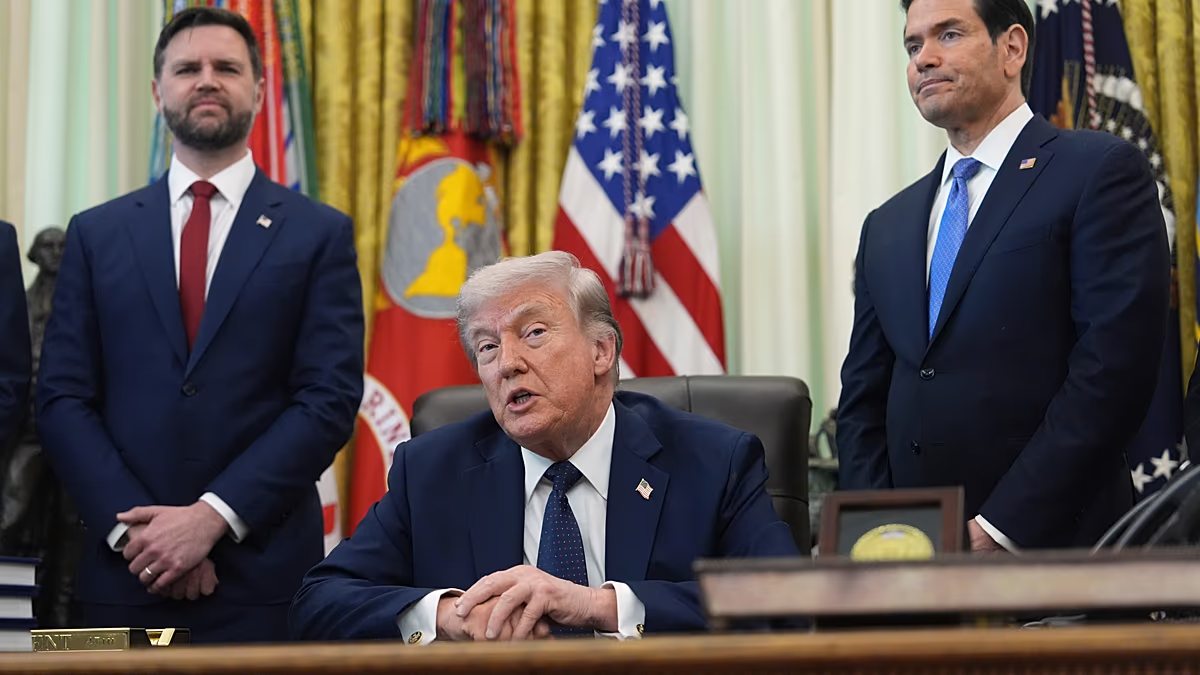
The fundamental choice between Vance and Rubio, therefore, transcends personality. It is a choice between two divergent paths. Vance champions an ideologically pure, culturally confrontational MAGA populism. He speaks fluently the language of grievance, anti-elite sentiment, and populist nationalism, and is closely associated with the energetic, online-driven younger right. Rubio, by contrast, envisions a more disciplined, internationally engaged iteration of Trumpism—one that seeks to preserve its domestic priorities while restoring a mantle of competence and broadening its electoral appeal. Their occasional appearances in the White House briefing room have, at times, felt like informal auditions for these competing futures of the Republican Party.
Ultimately, however, one towering figure outweighs all early calculations: Donald Trump himself. The Republican Party remains intensely personalized around him, and he has shown little interest in clearly anointing a successor. Instead, he appears to relish maintaining his influence by keeping potential heirs in a state of dependence, competing for his favor. He has publicly praised both men, even whimsically floating the idea of a “dream ticket” that combines them, all while ensuring the speculation continues. This strategic ambiguity benefits Trump, preserving his dominance over the movement even as the succession battle quietly unfolds. The coming years of Trump’s final term will serve as the decisive testing ground for these two visions. Should he leave office politically strong, with a vibrant base still energized by cultural fights, Vance’s call for an uncompromising continuation would likely prevail. But a term ending in economic difficulty, foreign policy strain, or voter exhaustion would dramatically strengthen Rubio’s argument for a more stabilizing and electorally mindful stewardship.
Thus, the 2028 primary is slowly taking form as a referendum on the meaning of MAGA after its creator. Will it become a permanent populist revolution under JD Vance, or evolve into a more structured, polished project under Marco Rubio? For now, Vance holds the pole position, but the final answer lies in a volatile mix of world events, economic conditions, and, most unpredictably, the whims of a former president who remains the party’s undisputed center of gravity. The battle for the inheritance has begun, but the true test—and the final judgment from the voters Trump transformed—is still to come.