

The Battle for Artistic Freedom: A Legal Challenge Against Media Power in France
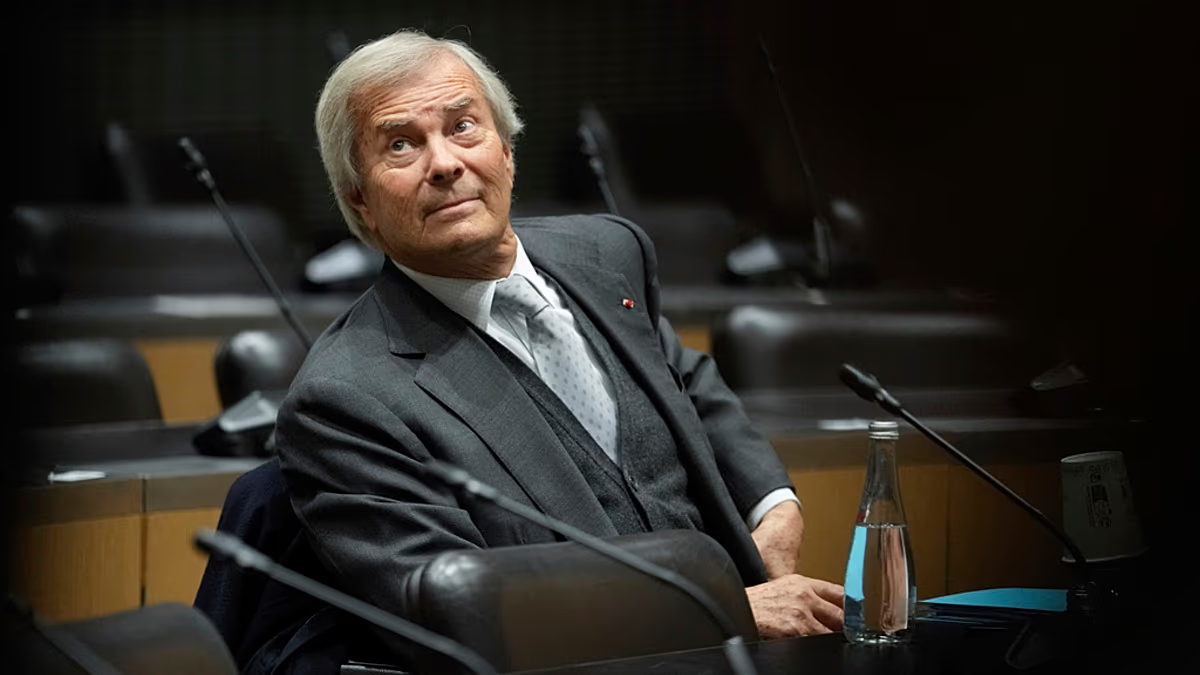
In a move that has sent ripples through the French cultural world, two prominent organizations—the Human Rights League (LDH) and the CGT Spectacle union—have launched a formal legal assault against the media giant Canal+. Announced on a Saturday in late May 2026, their civil action, filed with the Nanterre judicial court, centers on a charge that strikes at the heart of creative industries: discrimination. The groups allege that Canal+ has systematically blacklisted professionals who signed a public critique of Vincent Bolloré, the conservative billionaire whose vast empire controls the network. This is not a minor contractual dispute; it is portrayed as a fight for the soul of French cinema, challenging whether economic power can be used to silence political and trade union expression within the artistic community.
The conflict erupted into the open following a blunt declaration from Maxime Saada, Chairman of Canal+’s executive board. Responding to an op-ed signed by roughly 600 film industry professionals—which criticized Bolloré’s growing dominance over film production and distribution—Saada stated, “If some people go so far as to call Canal+ ‘crypto-fascist’, then I cannot accept working with them.” For the LDH and CGT Spectacle, this was not an offhand remark but a calculated, “unacceptable and brutal decision.” In their formal statement, titled “No discrimination has any place in cinema,” they accuse Saada of leveraging his company’s crucial role in film financing to muzzle dissent. They argue he is fully aware of the sector’s dependence on Canal+, making his refusal to collaborate with critics a potent form of coercion, punishing individuals for their lawful opinions.
The legal petition, spearheaded by lawyer Arié Alimi, seeks two concrete outcomes. First, it aims for a court order to annul Saada’s discriminatory policy, backed by the threat of daily financial penalties for non-compliance. Second, and more innovatively, it requests the appointment of an independent monitor within the Canal+ group. This representative, which could be an employee or an external auditor, would have a “vigilance” mission to document any further instances of discrimination. As LDH president Nathalie Tehio clarified, this mechanism is designed to ensure transparency and prevent retaliation, placing the ultimate structure of this oversight in the hands of the court. This legal strategy frames the issue not as a one-time grievance but as requiring ongoing systemic correction.
However, the implications extend far beyond a single courtroom in Nanterre. The organizations signal that this is merely one front in a broader war, contemplating a parallel complaint to the European Commission. They plan to argue that Canal+ is guilty of an “abuse of economic dependence,” a practice where a dominant player exploits the reliance of smaller entities. This accusation fits into a larger, deeply troubling narrative for the signatories: the accelerating concentration of France’s cultural industries under the Vincent Bolloré umbrella. From television and radio channels to publishing houses, film production, and distribution, Bolloré’s influence is seen as creating a monolithic structure that threatens pluralism and independent thought, making this legal battle a proxy fight against media consolidation itself.
The timing of the announcement was meticulously chosen, landing just hours before the awarding of the 2026 Palme d’Or at the Cannes Film Festival. This was no accident. Saada’s initial comments had been made during Cannes, turning the festival—a global symbol of cinematic artistry and free expression—into a battleground. By acting as the festival reached its climax, the LDH and CGT Spectacle aimed to spotlight the contradiction between the celebration of creative freedom on the Croisette and the alleged suppression of it in corporate boardrooms. Their action has garnered international resonance, with figures like actor Javier Bardem and filmmaker Ken Loach adding their voices to the “Zapper Bolloré” collective, underscoring that the concern over corporate control and artistic integrity transcends national borders.
In conclusion, this lawsuit represents more than a contractual disagreement; it is a fundamental defense of the cultural sector’s right to critique its own benefactors. Nathalie Tehio of the LDH encapsulates the stakes, calling Canal+’s actions “a threat to the profession as a whole.” At its core, the case poses a critical question: in an era of increasing media consolidation, can a private entity that functions as a vital public artery for cultural funding use its financial clout to police political opinion? The outcome will set a significant precedent, determining whether the French cinematic tradition, renowned for its fierce independence and intellectual rigor, can be insulated from the chilling effect of concentrated economic power, or if the industry’s financial dependence will inevitably dictate its silence.