

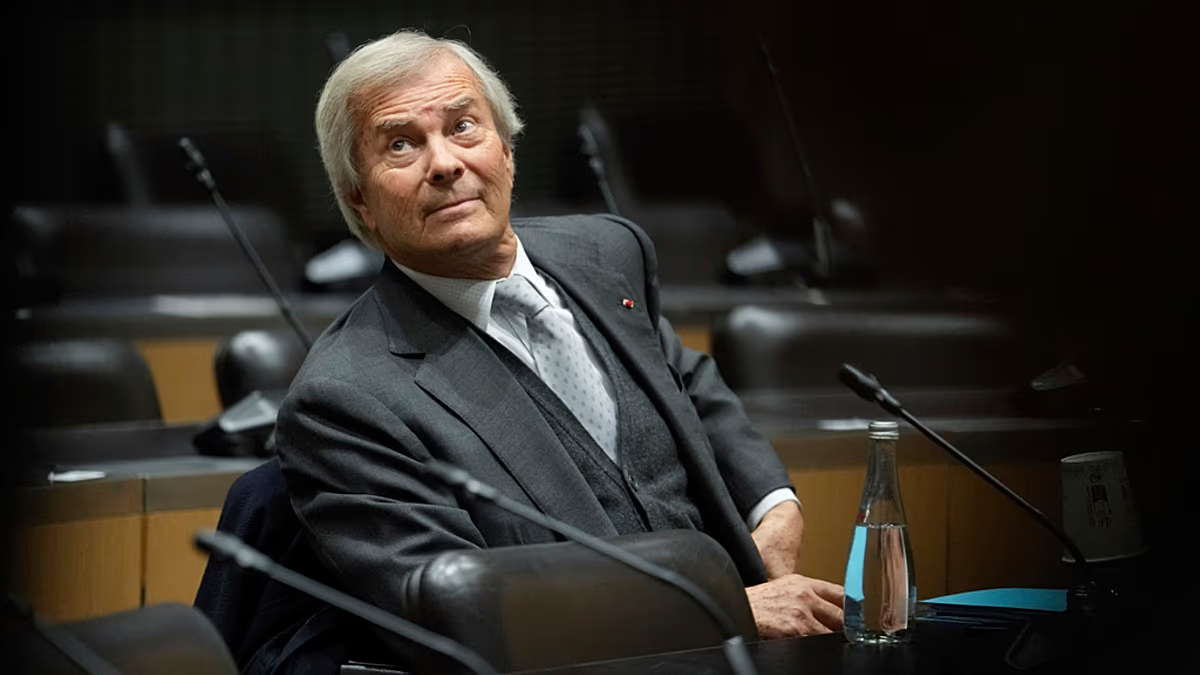
A growing chorus of international cinematic voices is joining a French-led revolt against the increasing concentration of media power. The collective known as “Zapper Bolloré” has announced that prominent global figures, including Spanish actor Javier Bardem, British director Ken Loach, and American actor Mark Ruffalo, have added their names to an open letter expressing profound concern over conservative billionaire Vincent Bolloré’s expanding influence within the film industry. Their involvement signals that what began as a domestic French issue is resonating as a wider international cause, highlighting the borderless nature of cultural anxiety in the face of consolidated ideological control.
The letter’s core accusation is stark: it denounces what signatories describe as Bolloré’s “tentacular, ideological hold” over French cinema, warning of a dangerous convergence of media and cultural power in the hands of a single individual with clear conservative convictions. The movement was ignited by respected French artists like actors Adèle Haenel, Juliette Binoche, and directors such as Arthur Harari. Their ranks have now swelled to include a diverse array of international filmmakers, from Finland’s Aki Kaurismäki and Greece’s Yorgos Lanthimos to Palestine’s Annemarie Jacir and Brazil’s Walter Salles. This coalition paints a picture of a global artistic community unnerved by the potential for one man’s worldview to shape a national cinema renowned for its independence and diversity.
The controversy escalated dramatically following a statement from Canal+ president Maxime Saada, who declared he would no longer work with the letter’s signatories. This reaction to their criticism of “the hold of the far right” on cinema via the Bolloré-controlled channel sent shockwaves through the Cannes Film Festival. Many perceived Saada’s stance as a heavy-handed threat, a punitive measure that seemed to validate the very concerns about stifled expression. Veteran actor Alain Chabat, a symbol of the iconic Canal+ “spirit,” lamented Saada’s approach as a “two-bit pressure tactic,” arguing that while Canal+ teams might feel hurt by the criticism, such a reaction was disproportionate and counterproductive. His co-star Jonathan Cohen echoed a nuanced view, acknowledging the “legitimate fear” of the signatories while also defending the creative plurality he has experienced within Canal+.
This clash unfolds against the backdrop of Bolloré’s vast and sprawling empire, a network of investments that reads like a blueprint for cultural influence. His holding group controls significant stakes in Universal Music Group, the global publishing giant Hachette, the massive communications group Havas, and the media conglomerate Vivendi, in addition to his controlling interest in Canal+. While Canal+ has pledged substantial investment in French cinema—€160 million in 2026, for instance—these figures represent a decrease from previous years and come with the perceived strings of ideological alignment. The sheer scale of his portfolio underscores the letter’s central argument: that Bolloré’s reach is not limited to one studio or channel but constitutes an interconnected web of publishing, music, news, and film, capable of setting a tone across the entire cultural landscape.
The film industry’s anxiety is far from isolated; it follows a near-identical script already played out in French publishing. When Bolloré acquired Hachette in 2023, it triggered an exodus of over a hundred authors from its prestigious Grasset imprint following the dismissal of its chairman. Subsequently, more than 300 writers, including major names like Leïla Slimani and Emmanuel Carrère, demanded a “conscience clause” to protect artistic freedom from commercial and political interference. Bolloré’s response to this earlier rebellion was telling and foreshadows a difficult path ahead for filmmakers. In an opinion piece, he dismissed the discontent as the work of “a small caste” and bluntly promised to find new authors, a statement that revealed little appetite for conciliation and a firm belief in the power of ownership to dictate terms.
Thus, the film industry finds itself at a precarious juncture, dependent on the financial largesse of a magnate who views its concerns with apparent disdain. The influx of major international names like Bardem, Loach, and Ruffalo is not merely symbolic; it applies external pressure and frames the conflict as a global stand for artistic integrity. The question now is whether this united front of filmmakers—from French icons to Hollywood activists—can forge a meaningful dialogue with a media titan who has shown a preference for confrontation over compromise. The battle lines are drawn not just over funding, but over the very soul of cultural production: should it reflect a plurality of voices, or conform to the vision of its deepest pocket? The answer will reverberate far beyond the red carpets of Cannes.