



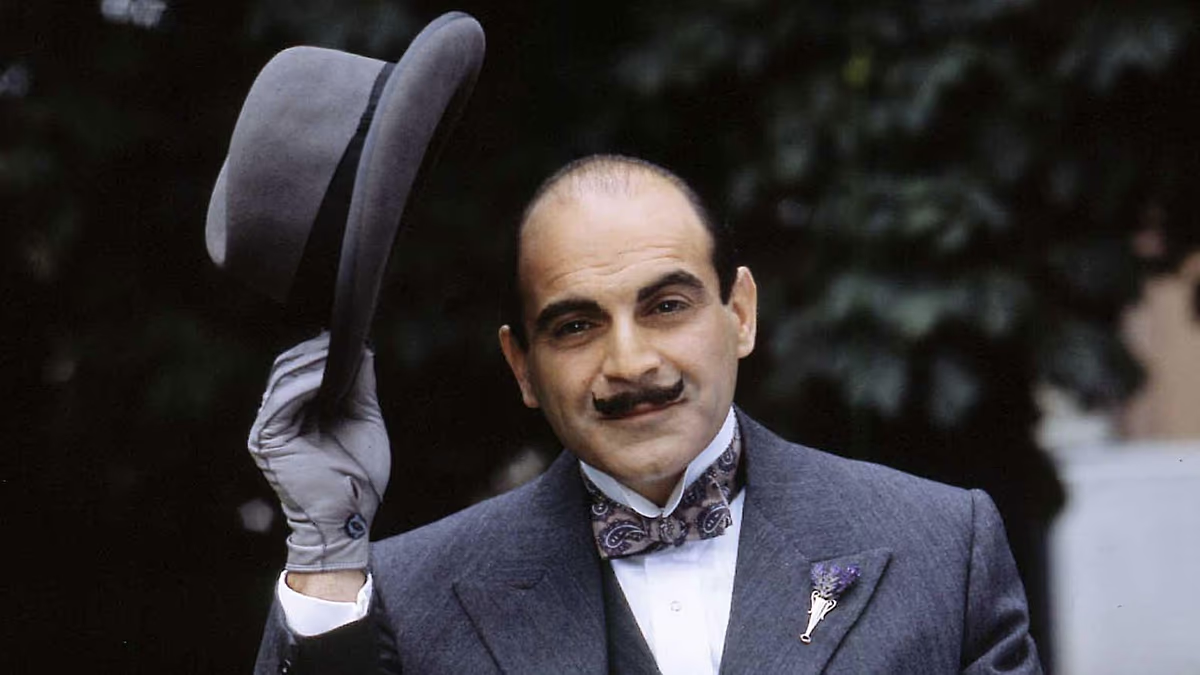
For generations of television viewers, the phrase “the greatest detective in the world” conjures a very specific image: a fastidious Belgian gentleman with a waxed mustache, an egg-shaped head, and an unshakeable faith in the power of the “little grey cells.” This iconic figure, Hercule Poirot, was immortalized over twenty-five years by actor David Suchet in ITV’s landmark adaptation. From 1989 to 2013, Suchet inhabited the role with such precision and depth that his performance became, for many, the definitive portrayal. The series’ remarkable achievement was its comprehensiveness; it adapted every major Poirot story Agatha Christie ever wrote, from full-length novels to short stories, across seventy episodes. While other talented actors, like Peter Ustinov and Kenneth Branagh, have brought Poirot to the screen, Suchet’s tenure stands as a monolithic, complete testament to the character. It is a closed circle, a perfect archive of the detective’s literary life. This is why the recent announcement from Deadline, that the BBC has secured rights to reboot Hercule Poirot for a new television series expected in late 2027, sends such a complex ripple through the world of detective fiction fans.
The news itself is a testament to the enduring, colossal appeal of Agatha Christie’s creation. The BBC’s commitment, won in a “highly competitive situation” against other networks and streamers, underscores Poirot’s status as premium intellectual property. The project is housed at Mammoth Screen, a production company with a strong track record of adapting Christie’s work, and will be produced in partnership with Agatha Christie Limited, the guardians of the author’s legacy. On paper, the foundations are solid. Yet, the overwhelming reaction among devotees is not simple excitement, but a profound sense of trepidation mixed with curiosity. The challenge facing the new creative team is monumental. They are not merely creating a new detective show; they are tasked with reimagining a character whose most celebrated television incarnation is so recent, so complete, and so beloved that it casts a long, intimidating shadow. The question hanging over the reboot is unavoidable: why watch a new series when the older one already exists and is, in the opinion of millions, “so damn good?”
This existential question is rooted in the unique completeness of the Suchet era. Unlike reboots of Sherlock Holmes or James Bond, where gaps in adaptation or the passage of time allow for fresh interpretation, the Suchet series left no Poirot story untold. This means the new series will inevitably retread familiar ground, inviting direct comparison for every plotted murder on the Orient Express or sinister mystery in a country manor. The creative team must therefore find a new angle, a distinct tone, or a contemporary sensibility that justifies revisiting these tales. Their success will depend entirely on the “little grey cells” at their disposal to solve this meta-mystery: how to make something feel new when the source material and its most famous adaptations are so deeply known. Furthermore, they face the perilous task of casting. The search for the new Poirot is underway, and no leaks have yet hinted at a candidate. Whoever steps into those polished shoes must craft a performance that honors the character’s core traits without being a mere imitation of Suchet, a balancing act of immense difficulty.
The casting challenges extend far beyond the detective himself. Poirot’s world is populated by equally cherished secondary characters. Who could possibly embody the loyal, slightly bumbling, and quintessentially English Captain Hastings as perfectly as Hugh Fraser did? The same goes for the efficient Miss Lemon or the skeptical Inspector Japp. These roles are integral to the stories’ charm and rhythm. Even elements like the title sequence pose a hurdle. The original series’ opening—with its artful animation, haunting theme music, and ticking clock—is remembered as a masterpiece of television design, setting the tone for every episode. Creating a new visual and auditory signature that feels equally iconic, without echoing the past, is a subtle but vital artistic challenge. Every detail will be scrutinized. The reboot exists in a landscape of intense, pre-existing affection, where audiences are not just viewers but protective guardians of a cherished memory. A misstep in any of these areas could lead to what might be called “Peril at BBC House.”
To understand the weight of this endeavor, one must appreciate the sheer scale of Agatha Christie’s legacy. She remains the best-selling fiction writer of all time, with estimates of between two and four billion copies sold worldwide. Only William Shakespeare outsells her overall, and her novel And Then There Were None sits among the top five best-selling individual books of all time. Within this phenomenal output, Hercule Poirot is her most famous and longest-running character, appearing in 33 novels and 51 short stories. He is a global cultural touchstone. The BBC reboot is not just a television production; it is an attempt to reconnect a new generation with a pillar of popular literature. The potential is enormous—to introduce Poirot’s methodical genius and moral clarity to viewers who may find the older series’ pacing or style less accessible, or to explore the stories through a modern lens that highlights different social or psychological themes.
Ultimately, the announcement of a new Poirot series is a story about legacy and renewal. It is a gamble on the timelessness of good mysteries and a great character. The path ahead for the producers is daunting, fraught with the risk of comparison and the cry of “déjà-vu.” Yet, it is also an opportunity. If they can find a fresh perspective, a brilliant new actor, and a creative vision that respects the past while boldly claiming its own space, they might create something worthy of standing alongside, not replacing, the classic series. The greatest mystery now is not who killed the millionaire on the Blue Train, but how this new team will solve the puzzle of reinvention itself. The world will be watching, with hope, skepticism, and a deep love for the original, waiting to see if they can craft a compelling answer.