


A Tense Afternoon in Whitefield: A Police Encounter, a Gunshot, and a Community’s Reflection
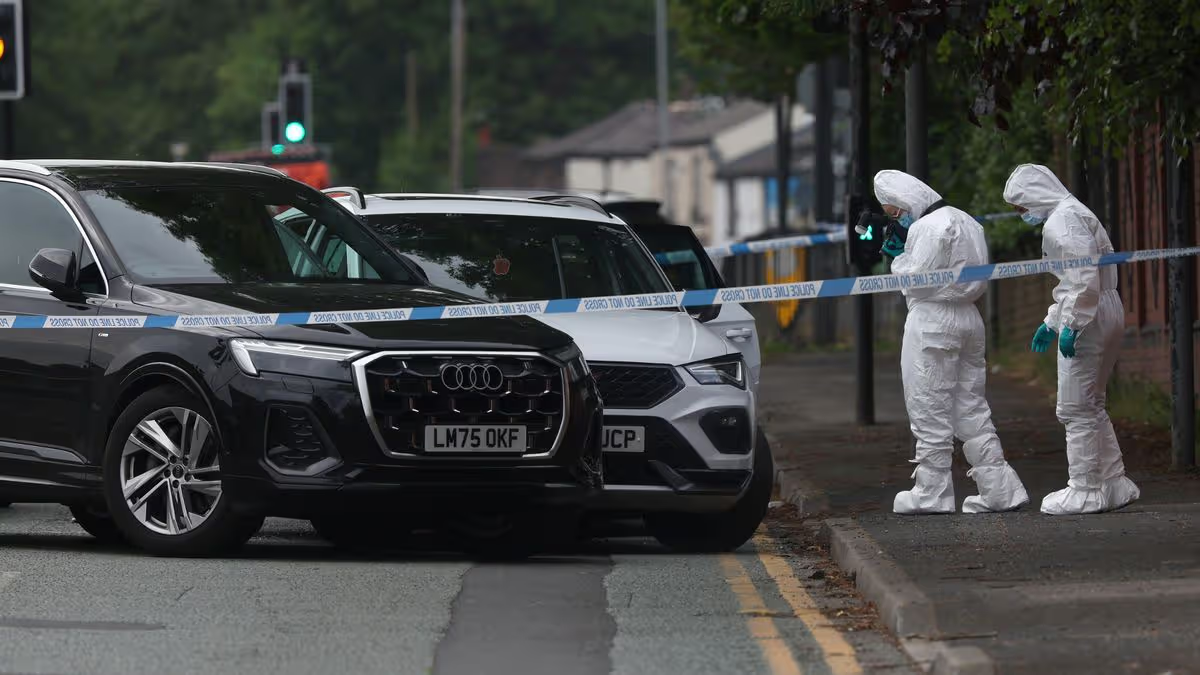
On a Friday afternoon in May, the ordinary rhythm of Bury New Road in Whitefield was shattered by a sudden and violent confrontation. Greater Manchester Police officers, engaged in what might have begun as a routine attempted vehicle stop, found themselves facing an immediate and grave danger. The driver of the targeted car, rather than complying, made a fateful decision to flee, and in doing so, chose a path that escalated the situation dramatically. According to police reports, the vehicle was driven directly at the officers—an act interpreted not merely as evasion but as a potentially lethal assault. In that split-second moment of perceived threat, a firearms officer discharged their weapon, striking the 20-year-old male driver in the arm. The incident, unfolding in a matter of seconds, left a man wounded, armed officers shaken, and a community cordoned off behind forensic tape, grappling with the reality of a police shooting on a local street.
The immediate aftermath was a scene of controlled chaos, blending urgent medical care with meticulous investigative procedure. The injured man was swiftly transported to a local hospital, where his injuries—a suspected broken elbow—were assessed as serious but neither life-threatening nor life-changing. This single fact allowed a collective, if tentative, sigh of relief; the outcome, while severe, had not been a tragedy. Meanwhile, the location transformed into a forensic laboratory under the open sky. Officers in protective suits scoured the vehicle and the surrounding pavement, methodically searching for evidence that could explain the events that led to that single, echoing gunshot. Their work would soon yield alarming results, shifting the narrative from a chaotic traffic stop to a significant criminal investigation.
The discovery was substantial and deeply concerning. Following the initial scene examination, detectives executed a coordinated search at an address in the nearby town of Radcliffe. There, they uncovered what Superintendent Joe Harrop would later describe as a “significant” haul: a firearm and a large quantity of both Class A and Class B drugs. This find fundamentally contextualized the earlier panic and violence on Bury New Road. The driver’s desperate attempt to escape, including the decision to drive at police officers, was now framed not as an isolated act of recklessness, but potentially as the extreme measure of someone deeply involved in serious organized crime. The 20-year-old, from his hospital bed, was formally arrested on suspicion of being concerned in the supply of Class A drugs. The incident had evolved from a moment of acute danger into a major disruption of criminal supply chains, removing a dangerous weapon and a cache of harmful substances from the community’s streets.
In the wake of such events, the mechanisms of accountability and public reassurance begin their parallel processes. Recognising the gravity and rarity of police firearms discharges, Greater Manchester Police made an immediate referral to the Independent Office for Police Conduct (IOPC). The IOPC’s role is to provide transparent, external scrutiny, ensuring that the actions of the officers involved are examined against the strict protocols that govern the use of lethal force. Their investigators arrived promptly, visiting both the scene of the shooting and the police station to begin gathering statements and evidence. This independent investigation is a critical pillar of public trust, seeking to answer the difficult questions about necessity and proportionality that naturally arise whenever an officer’s weapon is fired. It is a sober and necessary process, running alongside the criminal inquiry into the driver’s actions.
For the officers involved, and for the force command, the incident presents a complex mix of professional resolution and personal strain. Detective Superintendent Harrop publicly praised his team’s “swift and professional” response, highlighting the successful recovery of dangerous items as a clear win for community safety. He rightly pointed out the immense relief that no members of the public or other officers were physically harmed during an episode where a car was weaponized. Yet, beneath this official assessment lies the undeniable psychological weight carried by those who must make irreversible, life-altering decisions in fractions of a second. The firearms officer who pulled the trigger, and their colleagues present, will now navigate a rigorous post-incident process, balancing the justification of their actions with the human impact of having shot another person, regardless of the threat he posed.
Ultimately, the story that unfolded on Bury New Road is a stark, multi-layered parable of modern policing and urban crime. It illustrates the suddenness with which routine duties can erupt into life-or-death scenarios, demanding incredible judgment under fire. It reveals the shadowy networks of drugs and weapons that operate in the background of everyday communities, their presence violently exposed by a failed escape attempt. For the residents of Whitefield and Greater Manchester, it is a jarring reminder of the dangers police voluntarily face and the extreme measures sometimes required to confront serious criminality. As the IOPC continues its independent investigation and GMP pursues its criminal case, the community is left to reconcile the relief of a dangerous cache being seized with the unsettling violence of the method of its discovery—a single gunshot on a Friday afternoon that echoed far beyond the forensic tape.