


The Significance of Italy’s Municipal Elections: A Political Turning Point
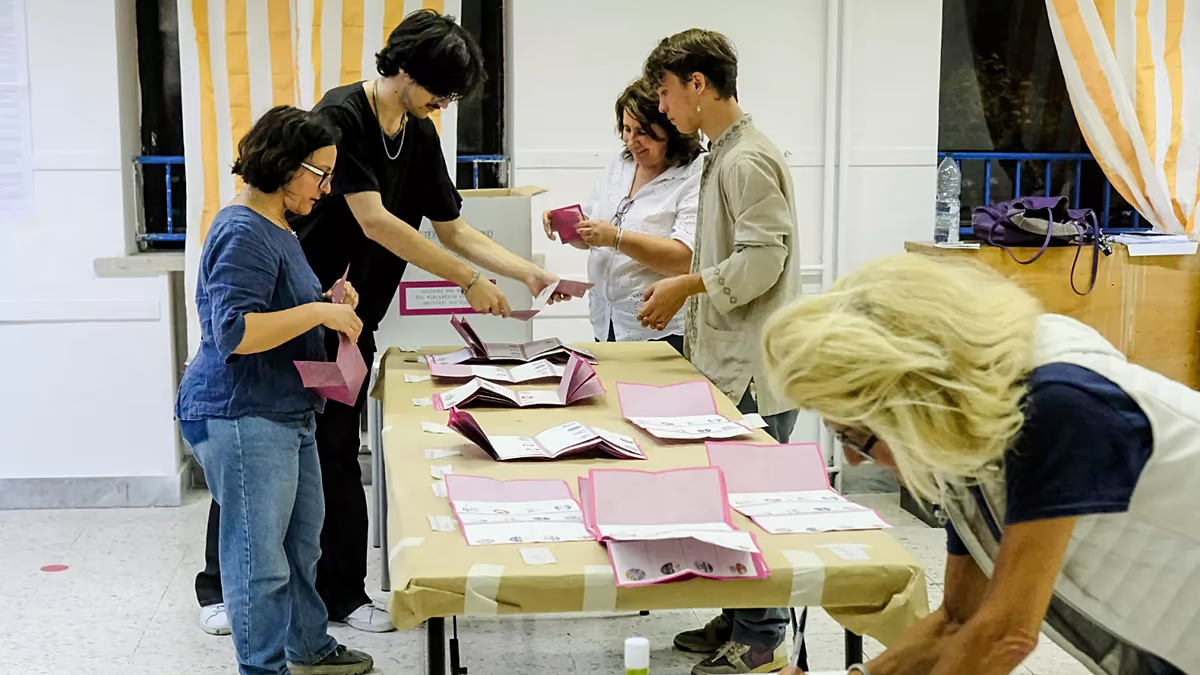
On June 7th and 8th, polling stations across Italy will reopen for a decisive second day of voting in municipal elections, a process that began on Sunday, June 5th. This electoral round, involving 749 municipalities and over six million eligible voters, represents far more than a simple local administrative exercise. It is the final major test of political sentiment before Italy’s next general election in 2027, serving as a crucial barometer for the nation’s shifting political winds. The stakes are particularly high in 118 larger towns and cities with populations exceeding 15,000 inhabitants, where run-off votes will determine the ultimate winners. This includes a regional capital, Venice, and fifteen provincial capitals, from Agrigento in Sicily to Mantua in the north. The relatively modest turnout of around 46.5% on the first day, slightly down from previous elections, hints at a potential voter apathy or disillusionment that parties are keen to understand. In essence, these local ballots are a nationwide dress rehearsal, offering a vivid preview of the alliances, fractures, and public moods that will define the coming national campaign.
A Critical Moment for Prime Minister Giorgia Meloni and Her Government
For Prime Minister Giorgia Meloni and her center-right coalition government, this electoral round carries immense weight. It is the first significant popular vote since her defeat in a major referendum on justice reform in March 2026, an event that punctured her aura of political invincibility. These municipal elections thus present a pivotal opportunity to gauge whether that defeat was a temporary setback or a sign of deeper erosion in her support. The results will either reassure Meloni’s bloc about the stability of its bond with the electorate or sound a fresh alarm bell, forcing a strategic reevaluation ahead of 2027. The campaign has unfolded against a backdrop of local complexities, where her coalition’s unity is not always evident; in some key cities, her ally, the Azione party, has even forged local alliances with the center-left. Therefore, the aggregate outcome across hundreds of towns will provide a nuanced, real-world measure of the government’s standing, revealing whether its nationalist and conservative message still resonates in diverse communities from the industrial north to the rural south.
The Challenge for a Fragmented Progressive Opposition
Conversely, this election is equally consequential for Italy’s fragmented progressive and center-left forces. Their goal is to assess the feasibility of building a united “broad camp” capable of challenging Meloni in the 2027 general election. The current landscape reveals a coalition that is often disjointed, with alliances shifting dramatically from one region to another. In some cities, the center-left is split between competing candidates, while in others, civic lists led by prominent local figures, like former Salerno governor Vincenzo De Luca, operate outside traditional party structures. This inconsistency underscores the difficulty of crafting a coherent national alternative. The municipal votes will measure the raw strength and real scope of this opposition, testing whether their local successes can be woven into a national narrative of renewal. A strong performance in key capitals could energize and unite disparate groups; a poor one might deepen divisions and spark internal recriminations, leaving the progressives without a clear path forward for the national contest.
Key Battlegrounds: Symbolic Cities and Shifting Power
The most intense battles are concentrated in symbolic cities where power may be poised to shift after years of control by one political side. In Venice, a cultural and economic jewel, the center-left is attempting to reclaim the city after a decade of center-right administration under Mayor Luigi Brugnaro. A victory here would be a powerful symbolic win for the progressives. Meanwhile, in Reggio Calabria, in the deep south, the situation is reversed: the center-right seeks a breakthrough after the long tenure of a Democratic Party mayor. Other provincial capitals like Crotone and Salerno present equally complex scenarios, where local personalities and historic rivalries often overshadow national party lines. The outcome in these specific, delicate races is likely to tip the overall balance of the electoral round, determining which political bloc can legitimately claim momentum. These cities are microcosms of national tensions—between north and south, between tradition and change—and their results will be dissected as indicators of broader political trajectories.
The Broader Implications: Governance, Alliances, and the 2027 Landscape
Beyond the immediate winners and losers, these elections will reshape the practical landscape of Italian politics for the next two years. The newly elected mayors and municipal councils will control significant local budgets and policies, influencing daily life for millions. Their political coloration will also affect the implementation of national government programs on the ground, potentially creating friction or cooperation. Furthermore, the alliances formed during these local campaigns—sometimes unconventional and crossing traditional bloc boundaries—could preview the kind of pragmatic, region-specific deals that might emerge in the 2027 general election. The process reveals that Italian politics is not always a clean, two-bloc fight; it is a intricate tapestry of local identities, historic loyalties, and personal ambitions. Understanding this tapestry is essential for any party hoping to govern Italy, a nation where local power often dictates national possibilities.
Conclusion: A Nation Voting for Its Future Direction
As Italians return to the polls to finalize their choices for mayor, they are participating in a decision that extends far beyond city limits. This electoral round is a multifaceted stress test for the entire Italian political system. It measures the resilience of the ruling coalition after a stumble, probes the organizational capacity of a opposition in search of unity, and highlights the enduring power of local identity in a national context. The results will provide the first concrete data points for the 2027 general election, shaping strategies, rallying morale, or forcing painful introspection within every party. Whether the outcome reassures Prime Minister Meloni or energizes her opponents, one thing is clear: the votes cast in Venice, Reggio Calabria, Salerno, and hundreds of other communities are not just about local governance. They are, fundamentally, about Italy’s direction in a pivotal moment, offering a glimpse into the nation’s political heart and its choices for the future.