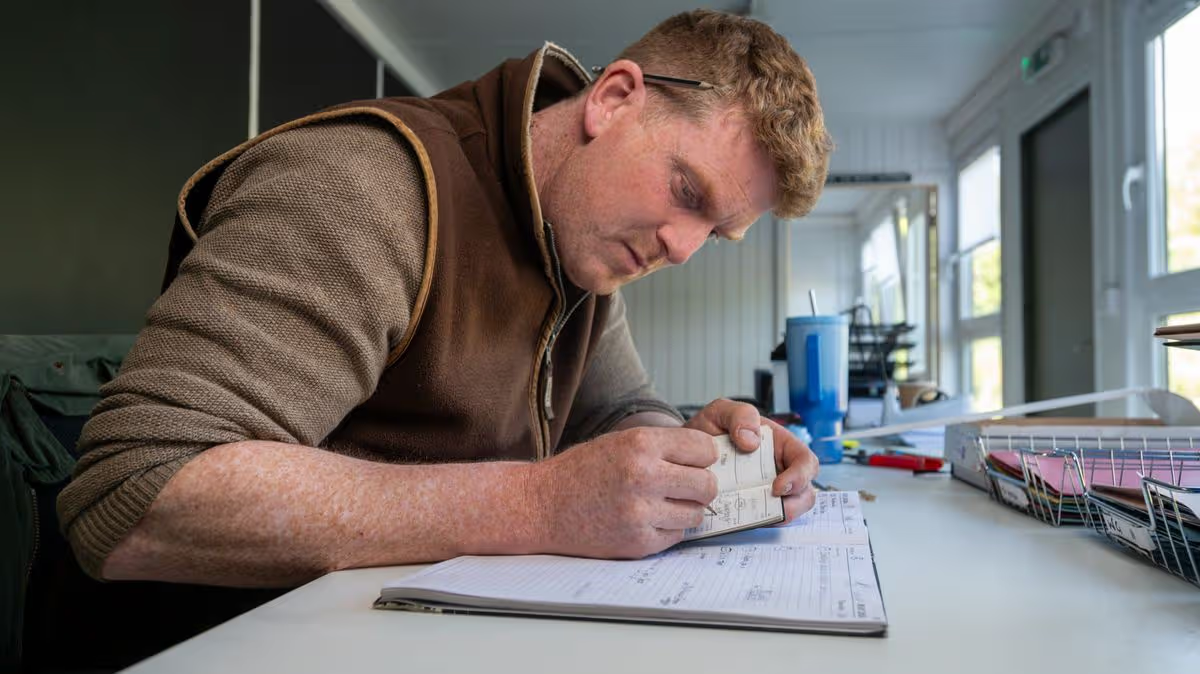




In an era defined by constant connectivity, where the ping of a notification often dictates the rhythm of our days, the story of John Foley stands as a profound and intentional counter-narrative. At 38 years old, this father-of-two and owner of an award-winning plant nursery in Holden has consciously stepped out of the digital stream, embarking on a life that many would consider unthinkable for a modern business owner. Three years ago, he permanently switched off his iPhone 14, setting off a chain reaction that led him to abandon not only his mobile phone but also his computer, internet access, and bank cards. His world now runs on the timeless tools of pen, paper, cash, and face-to-face conversation—a deliberate retreat into what he calls “analogue mode.”
Foley’s journey began with a simple, yet powerful, realisation: he was “constantly distracted.” His daily screen time, while not extraordinary at around five hours and forty minutes, felt like productive work but was, in reality, a fragmented series of interruptions. The final catalyst came during two trips where he accidentally left his phone behind. The first, a business trip to London in May 2023, started with the familiar stress of a forgotten charger and late-night texting, but the following day, he chose to venture out phoneless. He discovered an almost forgotten sense of focus and presence, notably during a visit to the Lambeth Palace Museum. A second, phone-free camping trip to the Yorkshire Dales cemented a growing “overwhelming feeling” that he no longer wanted the device in his life. He gave himself a two-week deadline to quit but ended up powering down his phone for good a week early, stashing it away with a personal challenge to go without it for five years.
The immediate effect of this digital detox was, in his words, “therapeutic and liberating.” He describes reclaiming a sense of control over his life, mind, and achievement. The constant, low-grade anxiety of being perpetually on-call dissipated. His days now feel “four times as long,” not because they contain more hours, but because they are filled with undivided attention and deliberate action. Without a screen to fill every “awkward space of dead time,” his brain is free to simply think, ponder, and exist in the moment. This slowing down has, paradoxically, led to a richer, more engaged experience of daily life, proving that what our hyper-connected culture often labels as efficiency can sometimes be a thief of true presence and depth.
Transitioning his business, an award-winning plant nursery, to this analogue philosophy required significant adaptation and courage. He began by swapping digital calendars for traditional paper diaries and a chalkboard. In September 2024, he took the even more radical step of scrapping his email and internet access entirely. Now, he deals with clients personally, providing beautifully handwritten plans and documents—a tactile touch that he says customers genuinely appreciate. He has phased out his debit card in favour of cash, though he maintains a bank account for automated bills. While the business still maintains a landline and postal address for customer contact, Foley’s ambition is to make the enterprise completely technology-free by the end of 2026, delegating or phasing out any remaining digital tasks.
This path has not been without its difficulties. Foley admits the first winter without a phone was marked by feelings of intense loneliness, a stark reminder of how these devices often serve as a social lifeline. He also had to re-learn the art of organisation and time management without digital crutches. Furthermore, his commitment led to the scrapping of a passion project: an AI-powered garden planning app called “The Wonder Garden.” Yet, in a testament to his philosophy, he transformed the app’s core concept into a successful face-to-face service, promoted through word-of-mouth and the vibrant community gardens he nurtures at his nursery. This pivot from a digital app to a personal, hands-on experience perfectly encapsulates his belief in real-world connection.
Looking to the future, John Foley’s mission extends beyond his own business. He identifies “time poverty” as a defining ailment of our age and sees his lifestyle as a reclaiming of that most precious resource. His vision now is to establish a charity dedicated to creating community green spaces in partnership with local councils. His goal is to give children, in particular, the opportunity he has given himself: to step away from screens and discover the simple, grounding joys of planting a seed and tending to living things. In doing so, Foley is not just running a nursery; he is cultivating a quiet revolution, one handwritten note and one garden bed at a time, offering a tangible blueprint for a more intentional and human-centred way to live and work.