

The Rise of the AI “Influencer”: A New Frontier of Fame and Its Complex Realities
In a striking sign of our rapidly evolving digital landscape, thousands of artificially crafted “personalities” have just competed in what organizers are calling the largest contest of its kind: the AI Personality of the Year Awards. Co-hosted by AI creation platform OpenArt and creator subscription service Fanvue, the competition invited participants to build and grow virtual characters across categories like entertainment, lifestyle, and fantasy. With over 3,300 submissions vying for more than $90,000 in prizes, the event marks a watershed moment. As Chloe Fang of OpenArt notes, this isn’t a niche experiment anymore; it’s a mainstream phenomenon. Over the past year and a half, these synthetic beings have transcended novelty to build genuine fan communities and secure major brand partnerships, cementing their place in our popular culture.
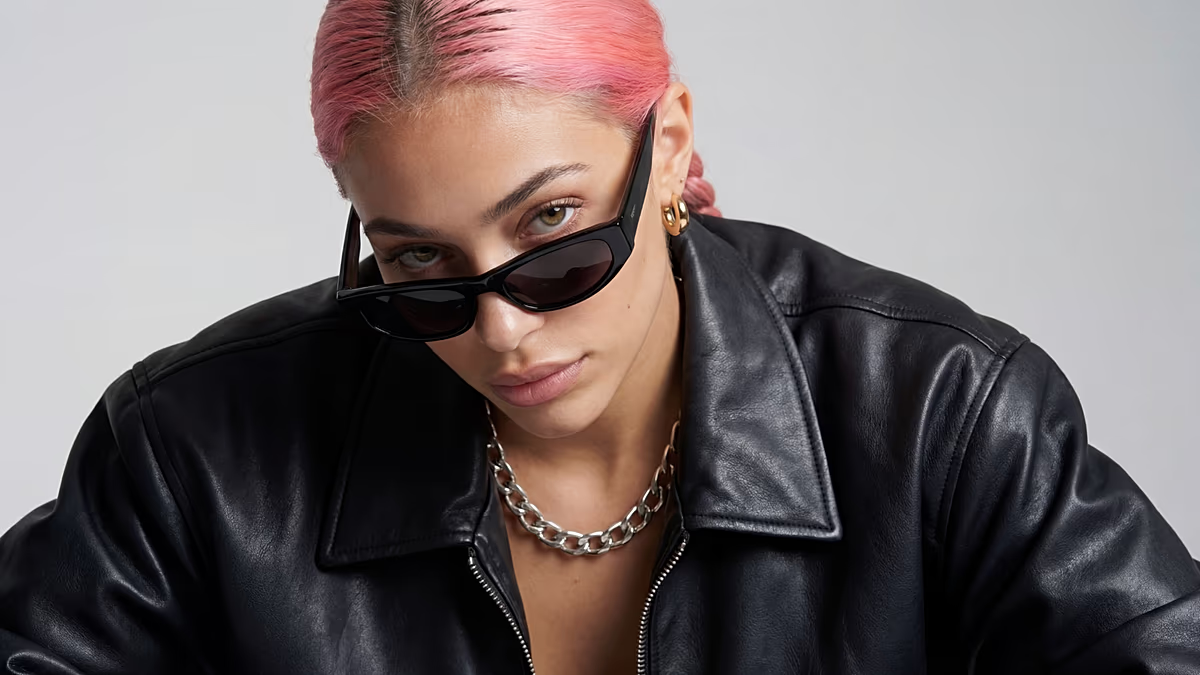
The appeal of these AI personalities lies in their ability to forge surprisingly real connections. Consider one of the contest’s most-followed entrants: Jae Young Joon, an AI-generated Korean male model with a combined following of over 400,000 on Instagram and TikTok. His profile is transparent about his synthetic origins, yet that hasn’t stopped fans from sending heartfelt messages and love letters. As Luc Thierry, the Canadian creator behind Jae, discovered, the audience’s primary concern may not be biological reality, but emotional authenticity. If a persona consistently engages, entertains, and resonates, the line between human and algorithm begins to blur. This profound shift suggests we are entering an era where parasocial relationships—once reserved for human celebrities—can be successfully cultivated with entirely digital entities.
However, this very blurring of reality and fiction is the source of significant ethical unease. The technology that enables charming virtual models also powers darker applications, sparking widespread concern over deepfake pornography, copyright infringement, and job displacement. Incidents like users exploiting Elon Musk’s Grok AI to generate explicit imagery have forced platforms to impose restrictions and highlighted how easily these tools can be weaponized to violate consent. Beyond outright abuse, there is a subtler, pervasive worry: that AI perfection will exacerbate the unrealistic beauty standards long criticized on social media. The “ideal” influencer no longer requires genetics, surgery, or even a physical form—they are conceived in code, often defaulting to homogenized, flawless features that real human diversity cannot match.
Criticism of reinforcing narrow aesthetics is familiar terrain for the organizers. Fanvue previously faced backlash for co-hosting the “Miss AI” beauty pageant, which many argued prioritized synthetic, stereotypical attractiveness over genuine diversity. In response, Fang emphasizes that the current awards are judged on broader criteria like quality, inspiration, and fan engagement, not merely appearance. She points to a positive evolution in the entries themselves, which now include music personas, fantasy characters, and creations centered on LGBTQ+ and cultural representation, moving beyond the early wave of generic “pretty ladies.” To mitigate harm, OpenArt employs both automated tools and human reviewers to screen for copyrighted material, hate speech, and explicit content, attempting to build necessary guardrails in this uncharted territory.
Interestingly, the contest also revealed a geographically diverse pool of human creators behind the avatars, with participants hailing from Europe, North America, Asia, Latin America, Africa, and the Middle East. This suggests a democratization of creative expression, allowing individuals from various backgrounds to project their ideas into a global arena through a digital proxy. Yet this diversity highlights a crucial ambiguity: while the creators come from all over, we have no data on the demographics of the AI personalities they choose to build. This gap raises pointed questions. Are creators using this technology to expand representation, or are they, consciously or not, replicating the same limited, marketable archetypes that dominate traditional media? The tool may be neutral, but human biases and commercial pressures are not.
Ultimately, the AI Personality of the Year Awards are more than just a competition; they are a microcosm of a profound cultural transition. We are learning to connect with, judge, and reward entities that are pure performance, crafted from data and desire. They challenge our definitions of creativity, authenticity, and community. As these digital beings grow in sophistication and influence, the central task will be to navigate their immense potential for innovative storytelling and inclusive representation while rigorously confronting their power to deceive, homogenize, and harm. The future they herald is not one of replacement, but of reflection—forcing us to examine what we value in our connections and what it truly means to be “real” in an increasingly synthetic world.