


Of course, here is the humanized and expanded summary, structured into six paragraphs as requested.
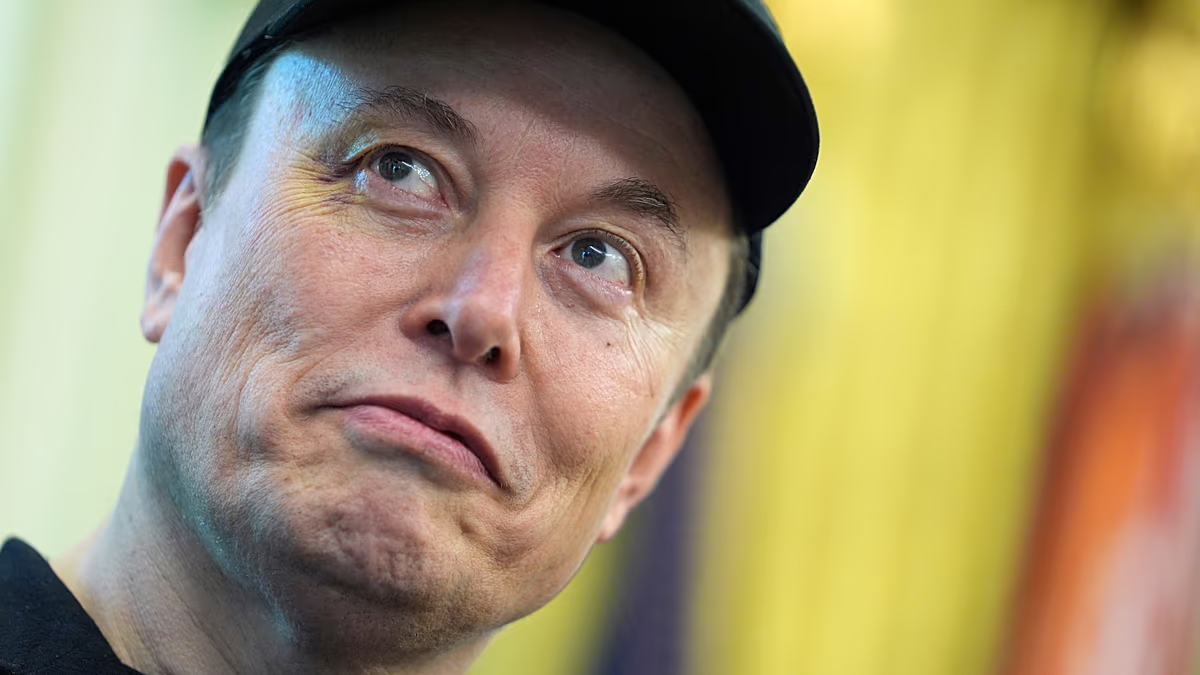
In a recent address at a tech summit in Tel Aviv, Tesla CEO Elon Musk made one of his characteristically bold predictions about the future of transportation. He suggested that within the next five to ten years, self-driving cars could account for a staggering 90% of all distance driven on roads, transforming the act of manually operating a vehicle into a niche hobby. Musk’s vision paints a picture of a near-future dominated by artificial intelligence at the wheel, where human drivers are the exception rather than the rule. However, as with many of Musk’s forward-looking statements, industry experts and current realities suggest we should temper this optimism with a healthy dose of caution. The journey from today’s assisted driving to a fully autonomous future is proving to be far more complex and hurdle-ridden than even the most ambitious timelines might imply.
The primary challenge lies in teaching machines to handle the infinite complexity and unpredictability of the real world. As noted by industry leaders like Nvidia’s Ali Kani, the biggest obstacle for autonomous vehicles in the next decade will be mastering the “long tail scenarios”—those rare, unexpected events a system hasn’t been explicitly trained for. Imagine a sudden power outage that leaves traffic lights dark, or an unusual road obstruction that defies standard programming. We’ve already seen glimpses of this fragility; for instance, Waymo’s robotaxis once froze for hours in San Francisco when they couldn’t interpret malfunctioning traffic signals. These incidents underscore a critical truth: creating an AI that can navigate the orderly rules of the road is one thing, but equipping it with the nuanced, common-sense reasoning of a human driver in chaotic situations is a monumental task that remains largely unsolved.
Adding to the technological hurdles are persistent safety concerns and regulatory mazes. Recent recalls, such as Tesla addressing issues with rearview camera displays or Waymo pulling vehicles for misjudging flooded roads, highlight that the path to perfection is iterative and fraught with setbacks. Furthermore, the legal and regulatory framework for truly driverless cars is still being written. While Europe has cautiously approved Level 3 automation (where the car drives under specific conditions but a human must be ready to take over) and parts of the U.S. and China are pushing ahead with limited robotaxi services, a cohesive global standard is absent. Each city and country is effectively a new test case, and progress depends not just on technological readiness, but on passing rigorous safety audits and winning public trust—a process that inherently moves slower than pure software development.
So, what does a more realistic timeline look like? According to analyses like a 2025 report from the World Economic Forum, a fully driverless world is unlikely before the mid-2030s at the very earliest, and even then, its adoption will be “patchy.” The report suggests that by 2035, full autonomy in personal consumer vehicles will remain a luxury feature, present in perhaps only 4% of new cars. The true vanguard of self-driving technology will not be in our private garages, but in commercial fleets. The most tangible and widespread autonomy we will witness in the coming decade is likely to be in the form of robotaxis and autonomous long-haul trucks operating in geo-fenced areas of major cities. This controlled environment allows for more predictable routes and conditions, making the technological and business case more viable in the near term.
This is not to say that progress has stalled. On the contrary, the acceleration is palpable, just in a more stratified manner. In our present day, Level 2+ systems—where the car can steer, brake, and accelerate on highways while the driver remains actively monitoring—are becoming commonplace. Meanwhile, trials for more advanced robotaxi services are being announced in major European capitals like London. China, with its strong consumer appetite for tech and powerful domestic manufacturers, is predicted to adopt higher levels of automation fastest. The global robotaxi fleet is projected to grow to several million vehicles by 2035, concentrated in dozens of forward-thinking cities. However, experts are unanimous on one point: Level 5 autonomy, the holy grail where a car can drive anywhere, in any condition, without any human intervention, is explicitly “not currently in sight.”
In conclusion, while Elon Musk’s five-year forecast for AI-dominated roads appears overwhelmingly optimistic, it serves to highlight the powerful direction of travel. The future of driving is undoubtedly automated, but it will arrive in stages and in specific lanes. We are moving toward a mixed-transport ecosystem where human-driven cars will share the road with increasingly capable automated vehicles for many years to come. The dream of reading a book or watching a movie while your car whisks you through a bustling cityscape remains compelling, but its universal realization is a longer journey. The next decade will be less about a sudden revolution and more about a steady, careful evolution—one focused on proving safety, scaling commercial services, and gradually expanding the operational domain where machines can reliably take the wheel.