



Of course, here is a humanized and expanded summary of the content, structured into six paragraphs.
In an era where the concept of “home” is becoming increasingly fluid, a significant shift is taking place: millions are choosing to build their lives far from their countries of birth. This movement is more than a fleeting trend; according to the United Nations, over 300 million people now live outside their homeland, a figure that has nearly doubled since 1990. The post-pandemic world has only accelerated this exodus, with remote workers and digital nomads swelling the traditional ranks of retirees and corporate transferees. In response to this growing, globally mobile population, the advisory firm Global Citizen Solutions has conducted a groundbreaking study to determine which cities truly offer the best quality of life for expatriates. Moving beyond superficial allure or tax benefits, their inaugural ranking seeks to answer a more profound question: where can an international resident not just visit, but truly thrive?
The study’s methodology reflects a deep understanding of what matters most when starting a new life abroad. Instead of relying on typical tourist metrics, the firm’s Global Intelligence Unit evaluated 35 cities across six continents using seven carefully chosen indicators. These pillars—cost of living, safety, air quality, healthcare, ease of settling in, English proficiency, and “enhanced mobility” (a measure of passport power and visa freedom)—paint a holistic picture of livability. Crucially, the data, drawn from publicly available sources and scored on a 0-100 scale, was weighted to prioritize long-term stability. Safety and healthcare carried the most combined importance, acknowledging that peace of mind and well-being are non-negotiable foundations for anyone planting roots in foreign soil. This nuanced approach ensures the ranking speaks directly to the practical realities and anxieties of relocation.
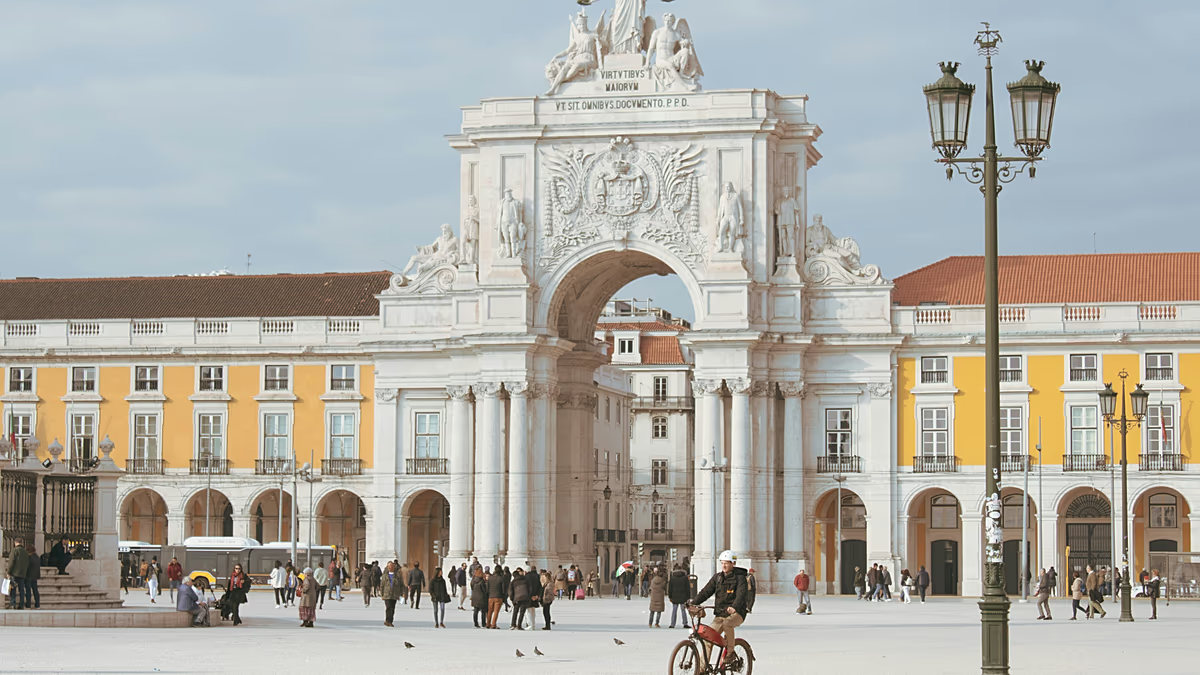
Topping this comprehensive list is Lisbon, Portugal, with a score of 88.49 out of 100. Its victory was not due to a single overwhelming strength, but rather to a remarkably consistent and balanced performance across all categories. Lisbon presents a compelling package: it stands out as one of the most affordable Western European capitals, significantly cheaper than rivals like Vienna or Copenhagen, while also boasting high English proficiency, excellent air quality, and robust safety levels. Furthermore, Portugal has proactively welcomed global residents through clear legal pathways, including residence-by-investment programs and a digital nomad visa. This combination of sunshine, affordability, accessibility, and official welcome makes Lisbon not just a picturesque postcard, but a pragmatic and welcoming home for a diverse array of expats.
Claiming a close second place is Amsterdam, Netherlands, scoring 81.97. The Dutch capital exemplifies high-quality European living, excelling in safety, healthcare, and environmental cleanliness. Its standout feature for internationals is its unparalleled English proficiency among European cities, which dramatically reduces the daily friction of language barriers in everything from bureaucracy to casual conversation. Amsterdam’s famous urban design, prioritizing bicycles, pedestrians, and public transit over cars, offers a uniquely healthy and efficient lifestyle. However, this premium living comes at a cost. Amsterdam is among the more expensive cities in the ranking, which can be a prohibitive barrier. Additionally, while the infrastructure is welcoming, the ease-of-settling-in score hints that forging deep local social connections may take time and effort, presenting a nuanced reality behind its cosmopolitan facade.
The sole non-European city to break into the top five is Melbourne, Australia, in third place with 81.79 points. Melbourne represents the pinnacle of livability in the English-speaking world, sharing the highest proficiency score with cities like Singapore and Auckland. It offers expats, particularly those from other Anglophone nations, a seamless linguistic transition alongside a famously vibrant cultural scene. The city pairs this with pristine air quality, top-tier healthcare, and stable, well-developed urban systems that guarantee a reliable and high standard of living. Its primary relative weakness, as noted in the study, is in the safety category, where it falls slightly behind the top European contenders. Nonetheless, Melbourne’s overall profile is one of robust, well-rounded appeal, cementing its status as a long-standing favourite for those seeking a dynamic yet familiar lifestyle in the Southern Hemisphere.
Rounding out the top ten is a list of global powerhouse cities, including Vienna, Barcelona, Singapore, Auckland, Tokyo, Copenhagen, and Seoul. This geographically diverse lineup underscores that true livability for expats is a global pursuit, found across continents and cultures. The ranking ultimately serves as a vital tool for a generation redefining work and life. It shifts the conversation from vague dreams of abroad to a data-informed discussion about daily reality, weighing the tangible trade-offs between cost and safety, connectivity and community. For the 300 million and counting who call a foreign country home, this list provides a roadmap, confirming that the ideal blend of opportunity, security, and belonging can be found—with careful consideration—in corners of the world both expected and surprising.