



For passengers traveling between the bustling hubs of Newport and Bristol, the coming weeks will require some extra planning and patience. From May 23rd to June 9th, a critical stretch of railway line connecting these two key UK cities will be temporarily closed. This shutdown is not for routine maintenance but for an ambitious, large-scale engineering project taking place deep beneath the Severn Estuary. Network Rail, the organisation responsible for the UK’s railway infrastructure, is undertaking a pioneering upgrade of the historic Severn Tunnel’s overhead electrical system. This essential work, while disruptive in the short term, is a vital investment aimed at securing the tunnel’s future and ensuring reliable journeys for decades to come.
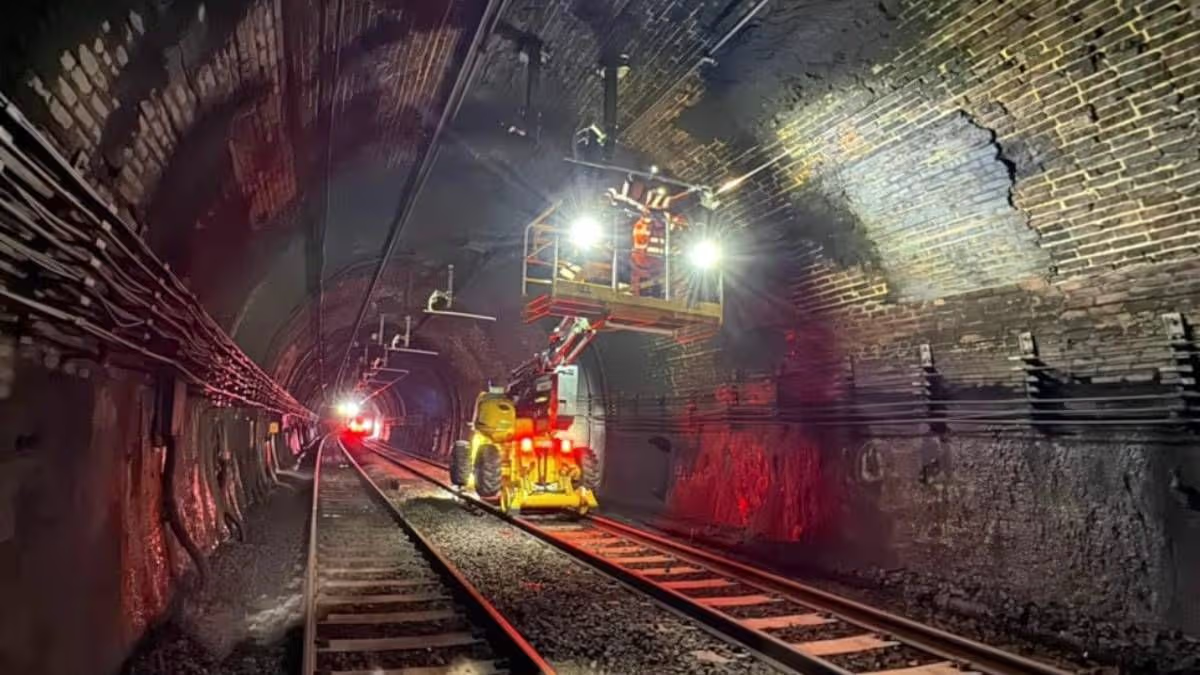
The Severn Tunnel is no ordinary piece of railway infrastructure. Opened in 1886, this 4.35-mile (7km) Victorian engineering marvel is one of the most challenging environments on the entire UK rail network. Running under the tidal waters of the Severn Estuary, the tunnel is perpetually damp, filled with salty, corrosive air that relentlessly attacks the equipment within. Since the line was electrified, this harsh climate has accelerated the wear and deterioration of the overhead power lines that trains depend on. Nia Watkins, Regional Asset Manager for Network Rail’s Wales and Borders route, emphasises that this vulnerability makes the upgrade not just important, but crucial for sustaining safe and dependable services. The work is a direct response to these unique conditions, designed to future-proof the tunnel against the very elements that make it so formidable.
The scale and innovation of this project are what truly set it apart. In what Network Rail describes as a “world-first” achievement at this magnitude, engineers and contractors from ARQ are replacing the entire overhead power system along the tunnel’s full length. The old, susceptible wiring is being stripped out and replaced with a single, continuous 7km copper contact wire. This new wire will be supported by 838 specially modified bridge arms, all designed to resist corrosion. In total, a staggering 9,000 metres of wiring is being replaced. This comprehensive overhaul is a highly complex and coordinated effort, aimed squarely at building greater resilience into the network. The goal is straightforward but significant: to drastically reduce the risk of future electrical faults and unplanned disruptions, benefiting both passenger and freight services that are the lifeblood of the regional economy.
Inevitably, an engineering feat of this nature requires temporary trade-offs for long-term gain. The necessary closure of the railway between Newport and Bristol Parkway means a direct impact on travel plans. During the 18-day period, replacement bus services will bridge the gap between the two stations. Train services between London and South Wales will be rerouted via Gloucester for most of the period, adding to journey times. Passengers are strongly advised to check their specific travel dates carefully, as there will be exceptions; on Sunday, May 24th, for instance, trains will not run via Gloucester, with services operating only on reduced routes. Marcus Deegan, GWR’s Station Manager at Bristol Parkway, acknowledged the inconvenience, expressing genuine gratitude for passengers’ patience. He framed the bus replacements as a necessary, if undesirable, step to enable work that will yield lasting improvements in reliability for everyone who uses this vital corridor.
This tunnel project is also synchronising with another exciting development in the region’s rail revival. Concurrently, Network Rail is replacing track that will serve the new Bristol Brabazon station. This station is a cornerstone of a broader initiative to reconnect communities to the rail network after decades of absence. It will mark the return of passenger services on the Henbury line for the first time since 1964, with future extensions planned for Portishead and Pill. Deegan highlighted this wider context, noting that the investment in the Severn Tunnel directly enables these new services. By combining essential maintenance with forward-looking expansion, the work aims to be a dual catalyst: enhancing the robustness of a major national artery while also stimulating local economic growth and reconnecting communities along the revived lines.
In summary, while the immediate picture involves disruption and replacement buses, the overarching narrative is one of renewal and future-proofing. The ambitious upgrade to the Severn Tunnel tackles a unique and punishing environment head-on with innovative engineering. It seeks to transform a historical vulnerability into a source of modern resilience, ensuring this 138-year-old tunnel can continue to serve the UK for generations to come. When combined with the parallel works to reintroduce passenger services to long-disconnected areas, this period of investment represents a significant chapter in the story of rail travel in South Wales and the West of England. The short-term headaches for passengers are, therefore, the unavoidable preamble to a more reliable, resilient, and expanded railway network for the future.