
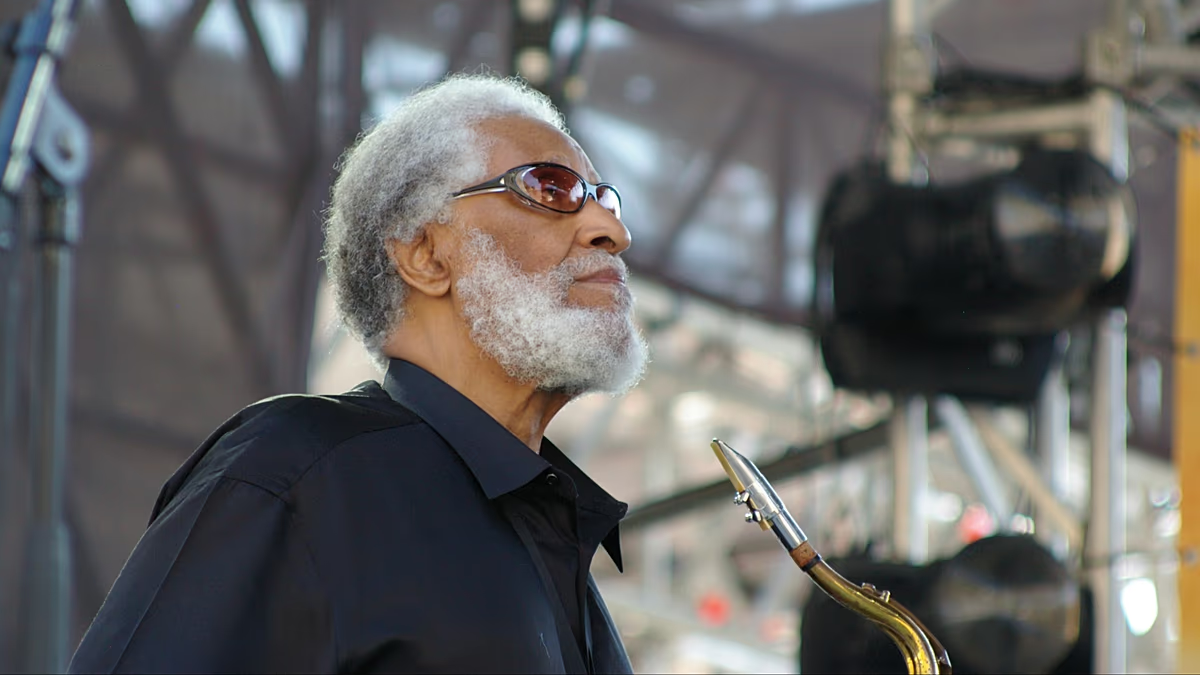


The world of music has lost one of its true giants with the passing of Sonny Rollins. At the age of 95, the man known as the “saxophone colossus” died peacefully at his home in Woodstock, New York. His publicist, Terri Hinte, confirmed the news, paying tribute to him as “one of the most honored and influential figures in American music of the 20th century and beyond.” While no specific cause was given, Rollins had lived with pulmonary fibrosis and other respiratory challenges in his later years, having stepped away from the stage in 2012. In announcing his passing, a poignant quote from the maestro himself was shared, offering a glimpse into his spiritual outlook: “I think when the creative person ends, he continues in the next existence… A spiritual person doesn’t feel like that.” With these words, Rollins leaves us not with an ending, but with a sense of enduring continuity, a belief that the creative spirit is a permanent, eternal force.
Sonny Rollins was not just a musician; he was a living bridge to the very foundations of modern jazz. Born Theodore Walter Rollins in Harlem in 1930, he was among the last surviving titans of the bebop revolution, that electrifying post-war period that redefined what jazz could be. His career was a six-decade-long conversation with genius, having shared stages and recording studios with legends like Miles Davis, Dizzy Gillespie, Charlie Parker, John Coltrane, Thelonious Monk, and Art Blakey. As a bandleader, he was profoundly prolific, releasing over 60 albums that charted his relentless artistic journey. It was the 1957 masterpiece ‘Saxophone Colossus’ that cemented his nickname and his legacy, an album so powerful it was later inducted into the Library of Congress’s National Recording Registry. They praised the “power, grace and humour” of his solos—a perfect trinity to describe his approach. Other landmark records like ‘Way Out West,’ ‘A Night at the Village Vanguard,’ and the politically charged ‘Freedom Suite’ are all pillars in the jazz canon, each showing a different facet of a master at work.
What truly set Rollins apart was his insatiable curiosity and his refusal to be defined by any single achievement. He famously called himself “a work in progress,” an artist who never settled into a comfortable style. After reaching early peaks, he famously took a two-year hiatus in the late 1950s, practicing obsessively on the Williamsburg Bridge in New York to reinvent his sound. The result was another classic album, aptly titled ‘The Bridge.’ This spirit of experimentation never left him; he later wove elements of funk and R&B into his music, ensuring his voice remained contemporary. His influence stretched far beyond the jazz club, composing the memorable score for the film Alfie and lending his iconic, ruminative saxophone to the Rolling Stones’ 1981 hit “Waiting on a Friend,” introducing his sound to a generation of rock fans. For Rollins, the saxophone was not confined to a genre—it was a tool for human expression, wherever that might lead.
His art was deeply connected to his humanity, a fact never clearer than in the aftermath of the September 11th attacks. Living just blocks from Ground Zero, Rollins was evacuated from his home, facing the same shock and grief as the nation. Yet, just four days later, he took the stage in Boston for a concert that would become the album Without a Song: The 9/11 Concert. It was his wife and manager, Lucille, who urged him to play, understanding that his music could offer a form of healing. From that emotionally raw performance came the track “Why Was I Born?,” which earned him a Grammy in 2006. This moment encapsulates the Rollins spirit: a resilient, profound commitment to his craft as a public service. His 2001 album This is What I Do also won a Grammy, proving that his creative powers remained undimmed into his seventies. These awards were bookmarks in a life of dedication, but the true reward was the connection he forged with audiences, using his horn to speak where words failed.
In recognition of a lifetime of enriching American culture, Rollins received the nation’s highest artistic honors. In 2010, President Barack Obama presented him with the National Medal of Arts. At the ceremony, Obama revealed a more personal connection, stating that Rollins’s fearless innovation had inspired him “to take risks that I might not otherwise have taken.” The following year, Rollins was celebrated at the Kennedy Center Honors, sitting alongside fellow icons in a tribute to his enduring impact. These accolades were not merely for his technical mastery—which was unparalleled—but for the intellectual and spiritual depth he brought to his music. He played with the weight of history and the lightness of a joke, often within the same solo. He was a philosopher of the saxophone, forever searching for truth through melody and rhythm.
Sonny Rollins is survived by his nephew, trombonist Clifton Anderson, and his nieces. While the indelible voice of his tenor saxophone is now silent, its echo is permanent. He leaves behind a vast, monumental body of work that will continue to inspire, challenge, and comfort listeners for generations to come. From the fiery clubs of bebop’s birth to the world’s great concert halls, from a solitary bridge over the East River to a studio with the Rolling Stones, his journey was one of constant evolution and unwavering integrity. RIP Sonny Rollins (1930 – 2026). The colossus may have departed, but the foundation he built stands forever, and the song, as he believed, goes on.