

A Star’s Mission: Richard Gere Champions the Fight Against Homelessness on the Global Stage
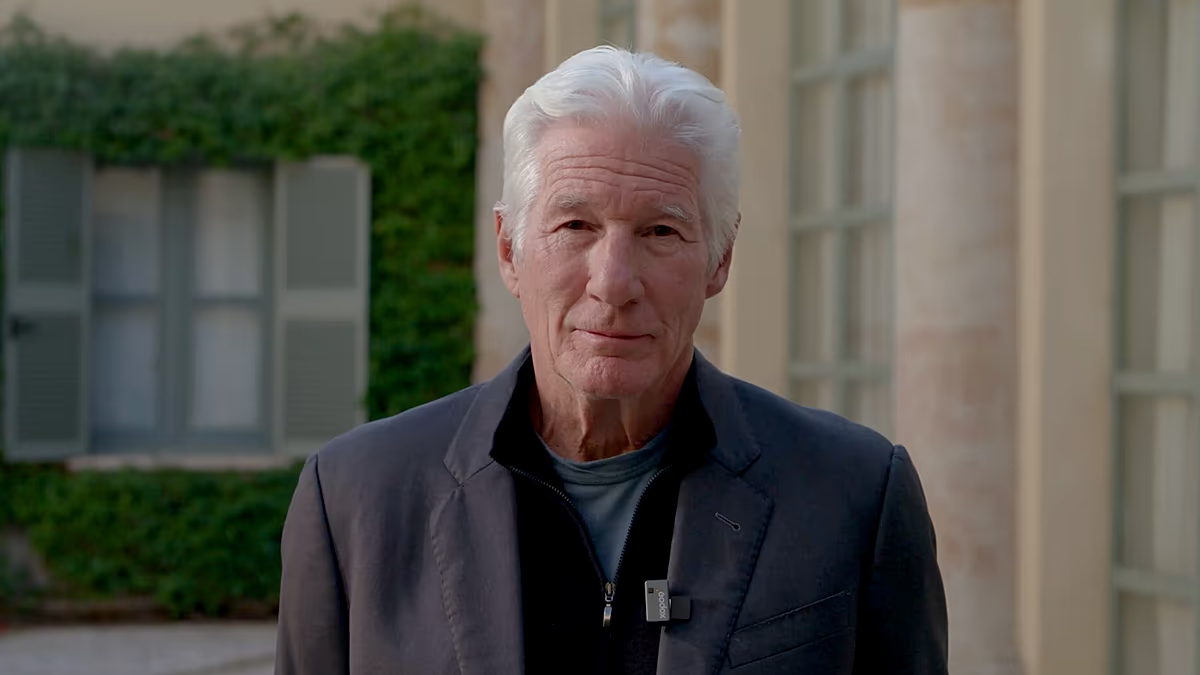
The thirteenth session of the World Urban Forum (WUF13) in Baku shifted the spotlight from urban glamour to a pressing human crisis, centering its narrative on a documentary about homelessness. This film featured Latyr Thioye, a beneficiary of the Spanish organization HOGAR SÍ, which was co-founded by Hollywood icon Richard Gere and his wife, philanthropist Alejandra Silva. In an exclusive interview with Euronews, Gere articulated the core belief driving his decade-long involvement: homelessness is not an inevitable social ill but a solvable injustice. He and Alejandra, now board trustees, advocate for a fundamental shift in perspective—treating safe housing not as a final reward for meeting certain conditions, but as the essential first step toward reclaiming dignity and opportunity.
Gere’s passion is rooted in the rigorous, evidence-based “Housing First” methodology employed by HOGAR SÍ. He argues passionately that a home is the foundational gateway to all other human rights—without it, health, education, and stable employment remain out of reach, perpetuating a vicious cycle of exclusion. His alignment with UN-Habitat felt natural, he explains, as it provides a critical multilateral platform to elevate such issues onto the global policy stage. Through initiatives tied to the UN’s 2030 Agenda, he has worked to raise the profile of marginalized communities, sharing best practices that prove ending homelessness is achievable when housing is prioritized as a starting point for inclusion and recovery.
The choice of Baku as the host city for WUF13 held particular significance for Gere. He viewed the forum’s first convening in the region as a vital step toward decentralizing the global conversation on urban challenges, ensuring diverse perspectives inform the solutions. He emphasized that cities, as hubs of both profound inequality and innovative potential, require gatherings like this to fuse political, social, and technical expertise. For Gere, any vision of a successful, sustainable city is fundamentally incomplete if it ignores those living on its streets; homelessness must be central to the dialogue on urban futures.
Gere’s commitment transcends philanthropy; it is deeply personal. He traces a pivotal moment to his preparation for the film Time Out of Mind, during which he walked the streets of New York unrecognized, experiencing the crushing indifference and invisibility faced by those without homes. Conversations with individuals experiencing homelessness, including a former colleague, deepened his understanding that, without a strong support network, anyone could find themselves in similar circumstances. This empathy has fueled a parallel journey to his acclaimed acting career—a decades-long advocacy for human rights, refugees, and vulnerable communities driven by a conviction that a meaningful life lies in serving the unseen and unheard.
At the forum, Gere’s documentary, What Nobody Wants To See, formed part of the Urban Cinema program, visually confronting the often-ignored realities of city life. This collaboration between The Gere Foundation, HOGAR SÍ, and UN-Habitat reflects a broader trend of leveraging cultural influence to amplify humanitarian diplomacy. Looking forward, Gere expresses hope and conviction in HOGAR SÍ’s strategy, which boldly demands structural change. He believes the organization can play a key role not just in Spain—where he notes a solvable population of about 37,000 people experiencing homelessness—but across Europe, proving that through evidence, collaboration, and respect, eradication is within reach.
The resounding message Gere helped champion in Baku was clear: housing is far more than bricks and mortar. It is the bedrock of human dignity, belonging, and a stable life. By framing the issue as a solvable challenge rather than a permanent condition, Gere and his partners advocate for a world where a safe place to call home is recognized not as a privilege, but as a fundamental right for all. His journey from Hollywood’s red carpets to the forefront of urban advocacy underscores a powerful truth: building equitable cities begins by ensuring no one is left without a door to close behind them.