

A New Chapter for Hungary: Orbán Returns to Brussels as Magyar Takes the Reins
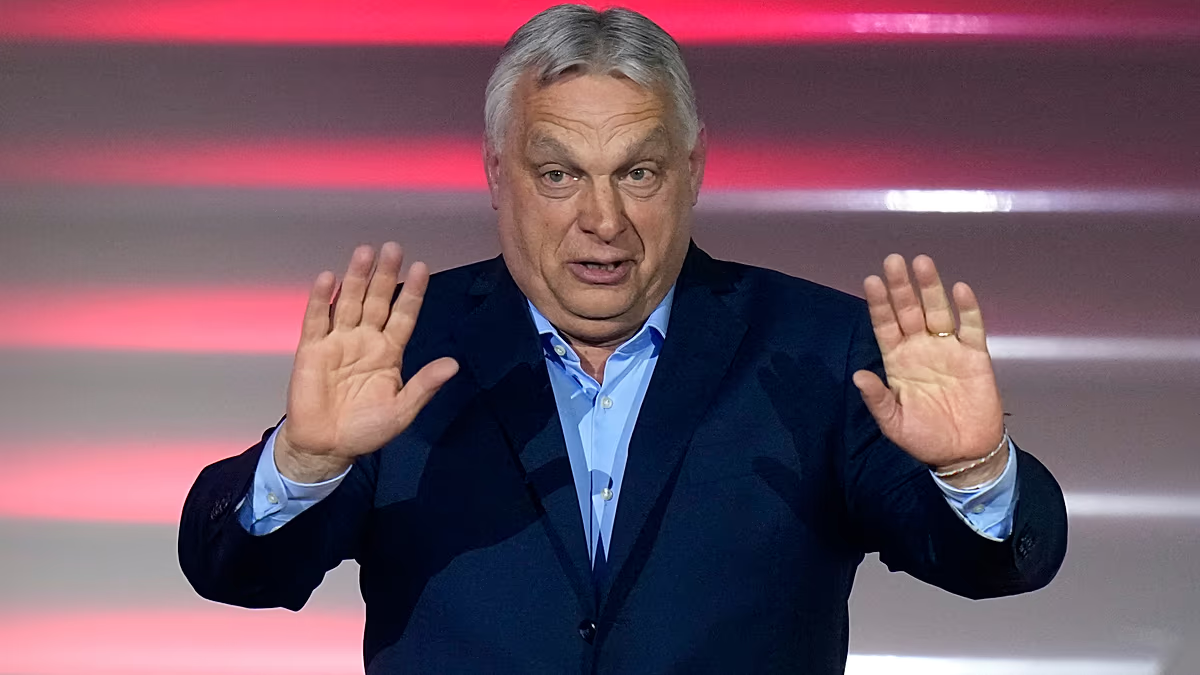
For the first time in nearly two decades, the European Council summit will witness a changing of the guard for Hungary. The upcoming meetings in Brussels mark a profound shift, not just in personnel but in the very direction of Hungarian politics and its relationship with Europe. Viktor Orbán, the former prime minister whose name became synonymous with “illiberal democracy” and fierce battles with Brussels, will return to the EU capital next week. However, his capacity has dramatically altered. He will attend not as the head of a member state, but as a founder of the far-right Patriots for Europe alliance, joining figures like Czech Prime Minister Andrej Babiš. This gathering precedes the summit where Hungary will be represented by its new prime minister, Péter Magyar, underscoring a complete separation of powers and ideologies. Orbán’s presence in the city where he so often played the disruptor now serves as a stark reminder of his party’s seismic election loss and the new era that has dawned.
The political landscape in Hungary was irrevocably transformed in April by the landslide victory of Péter Magyar’s Tisza Party. This defeat ended Orbán’s 16-year reign, a period during which he consolidated power, reshaped the nation’s institutions, and positioned Hungary as the EU’s most persistent internal critic. Magyar’s campaign resonated with voters weary of protracted conflict with European partners, centering on a powerful, clear message: a fierce commitment to rooting out corruption and an unequivocal pledge to mend Hungary’s frayed ties with the European Union. His promise extended beyond policy shifts; he vowed to dismantle the vast political machine and power structure Orbán had built. Since that humbling loss, Orbán himself has retreated from the public eye, his once-constant social media presence fallen silent. Opting not to take his parliamentary seat, he has nonetheless retained the chairmanship of his Fidesz party, vowing to oversee its renewal—a task made more urgent by internal criticism over a campaign strategy that many within Fidesz believe focused too narrowly on the war in Ukraine at the expense of domestic concerns.
Orbán’s legacy in Brussels is one of consistent tension and obstruction. Throughout his tenure, he was a polarizing figure who positioned himself as a defender of national sovereignty against what he portrayed as EU overreach. His government repeatedly blocked crucial EU financial and military support packages for Ukraine, arguing against further escalation in the conflict. This stance was compounded by his maintenance of close diplomatic and energy ties with Russian President Vladimir Putin, even after the 2022 invasion. These actions, coupled with profound concerns from European institutions about the erosion of democratic norms, the independence of the judiciary, and systemic corruption, led the European Commission to freeze billions of euros in cohesion funds destined for Hungary. This financial pressure created a significant economic strain, setting the stage for a political reckoning.
In stark contrast, Prime Minister Péter Magyar’s government has hit the ground running with a diametrically opposite approach. His administration has engaged in intensive, good-faith negotiations with the European Commission with a primary goal: to unlock the frozen funds and restore Hungary’s standing as a trustworthy partner. This diplomatic push proved remarkably successful, culminating in a late-May political agreement that released €16.4 billion of the €17 billion previously withheld. This achievement is not merely a financial win; it is a powerful symbolic act, signaling Hungary’s return to the European mainstream. Furthermore, Magyar moved swiftly to reverse Orbán’s most impactful vetoes, particularly regarding Ukraine. By reaching a bilateral agreement with Kyiv on the rights of the Hungarian minority in Ukraine, he removed a key obstacle, thereby clearing the path for Ukraine to formally begin its EU accession talks—a process Orbán had single-handedly stalled.
This divergence in Brussels will be visually and politically encapsulated next week. As Prime Minister Magyar sits at the European Council table, focused on integration and cooperation, his predecessor will be elsewhere in the city, rallying the Patriots for Europe. This alliance, founded by Orbán in 2024 and now the third-largest group in the European Parliament, represents his ongoing ambition to shape European politics from the ideological flank. Orbán’s scheduled press conference during this visit is a clear statement that, while he has lost national power, he intends to remain a significant player on the transnational stage, advocating for his vision of a Europe of nation-states. His political journey has now entered a new phase, one of opposition at home and factional leadership abroad, even as the government he once led moves decisively away from his blueprint.
The twin events in Brussels—the Patriots’ gathering and the European Council summit—therefore represent a pivotal moment for Hungary and the EU. One chapter, defined by confrontation and illiberal politics, has closed. A new one is being written by Péter Magyar, defined by the pragmatic pursuit of integration, the rule of law, and European solidarity. The unlocking of funds and the unblocking of Ukraine’s path are tangible proofs of this change. Yet, Orbán’s parallel presence serves as a reminder that the ideological battles within Europe persist. Hungary’s journey from a problem child to a reuniting partner is underway, but the forces that shaped its recent past are regrouping, ensuring that the nation’s political evolution will continue to be watched closely both in Budapest and in Brussels.