



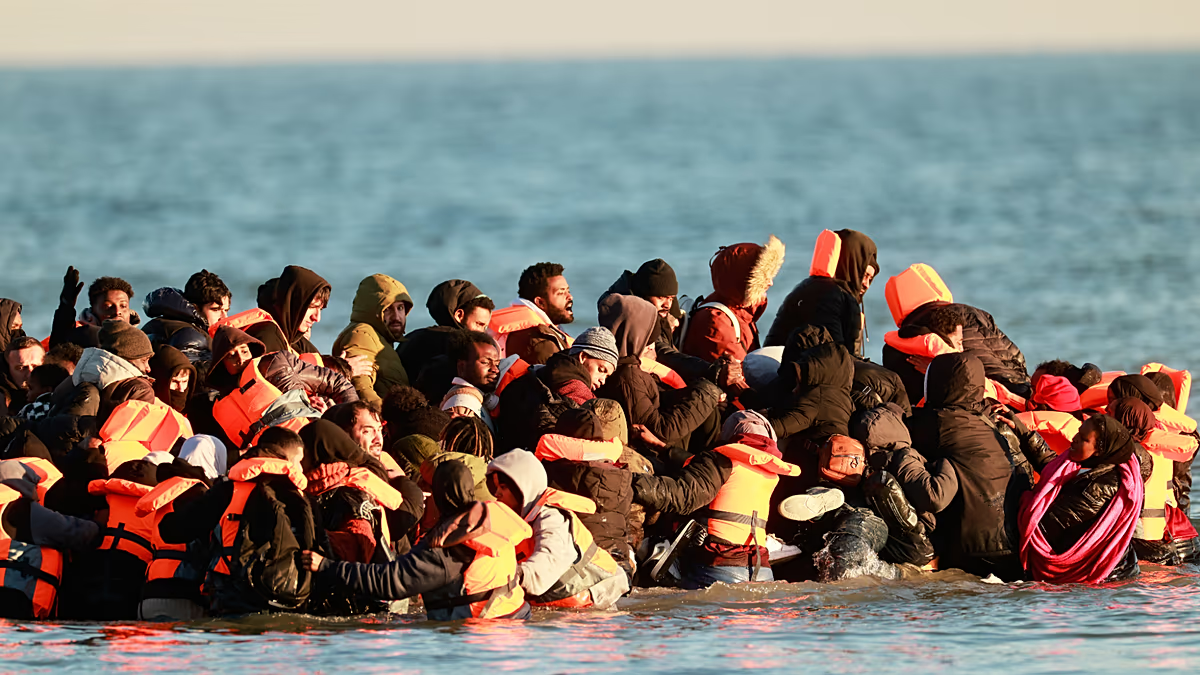
The year 2025 has brought into sharp focus the immense and ongoing challenge of migration facing the European Union. With 669,400 first-time asylum applications and 178,000 irregular border crossings recorded, the scale of movement continues to test the bloc’s systems and its foundational principles of solidarity. This pressure is not distributed evenly; it concentrates intensely on the frontline states along the critical Central Mediterranean route. Specifically, Spain, Italy, France, Germany, and Greece collectively received a staggering 83% of all first-time asylum requests. This geographical reality places a disproportionate burden on these nations, straining their infrastructure and political will, while exposing a fundamental tension within the EU between border countries and those in the interior.
The consequences of this concentration are severe and human. The frontline states often lack the physical capacity—sufficient reception centers, housing, and administrative facilities—to humanely shelter the sheer number of new arrivals. As a result, processing these asylum claims can drag on for years, a bureaucratic purgatory that leaves hundreds of thousands of vulnerable individuals in a state of legal and social limbo. Furthermore, local and national budgets in these countries are stretched beyond their limits, struggling to provide adequate long-term access to essential services like healthcare, education, and social assistance. This creates a double crisis: one for the asylum seekers awaiting a future, and another for the host communities whose public services are overwhelmed, fostering social tension and political frustration.
In response to these systemic pressures, the EU has enacted its landmark Migration and Asylum Pact, designed to fundamentally reshape the bloc’s approach. Its core ambition is to enforce a mandatory system of solidarity, compelling non-border countries to share the responsibility. Member states are now presented with a choice: they must either agree to relocate a set quota of asylum seekers from frontline states to their own territory—with a baseline minimum of 30,000 relocations per year—or contribute financially, paying approximately €20,000 per person into a shared EU fund for each relocation they decline. Alongside this solidarity mechanism, the Pact aims to accelerate procedures by mandating that border states conduct initial identity, health, and security checks within a strict seven-day timeframe, while also upgrading shared databases and fast-tracking applicants from countries with low recognition rates.
However, the Migration and Asylum Pact represents only one pillar of the EU’s strategy. A separate and equally critical component is the Return Regulation, which stands as the Commission’s most controversial proposed fix. This regulation seeks to significantly expand and harmonize deportation powers across member states, aiming to increase the rate of returns for those whose asylum claims are ultimately rejected. The logic is clear: to maintain public trust in the asylum system, there must be a credible and efficient process for those who do not qualify for protection. Yet, this focus on returns raises profound ethical and practical questions, touching on issues of detention, the use of coercion, and cooperation with often-unreliable third countries, making it a flashpoint for debate about the character of European governance.
According to the European Commission’s own assessment, implementation of this new framework is progressing, with a recent State of Play report indicating that “the key pillars of the new system are now in place.” This official optimism, however, masks a more complex reality on the ground. The critical question remains: Are EU states truly ready, both technically and politically, for this new system to become fully operational? Practical readiness involves establishing new reception facilities, hiring and training thousands of border and case workers, and achieving seamless digital interoperability between national systems. Political readiness is even more fragile, requiring sustained commitment from all 27 member states to the principles of forced solidarity and increased returns, even when public opinion shifts or populist pressures mount.
As Europe stands at this pivotal juncture, the success of its new migration architecture is uncertain. The system’s ultimate test will be its ability to function not just on paper, but under the intense pressure of the next major influx. It must balance rigorous border management with an unwavering commitment to human rights, and replace ad-hoc crisis responses with predictable, shared responsibility. The path forward will shape not only the lives of those seeking sanctuary but also the very cohesion of the European Union itself. The bloc’s capacity to manage this human flow fairly and effectively will be a definitive measure of its unity and its values in the years to come.