



The world is filled with landmarks, but for a dedicated community of global explorers, the ultimate treasure is not a single site—it is the entire map itself. This pursuit finds its home within the Most Traveled People (MTP), a club born from one man’s thwarted ambition. In 2005, Charles Veley, hoping for official recognition as the world’s most travelled person, found that the Guinness Book of Records had discontinued the title. Undeterred, he built his own community. Today, MTP’s platform hosts over 50,000 members who meticulously log their journeys, fostering a friendly global competition. The highest accolade is achieving “grandmaster” status by providing proof of travel to all 193 UN-recognized countries. Yet, Veley emphasizes that MTP is more than a checklist; it’ Fitxers a motivator for deeper cultural immersion. “When people go to a country and only visit the capital, that is not really experiencing the country,” he notes, encouraging explorers to venture beyond the obvious.
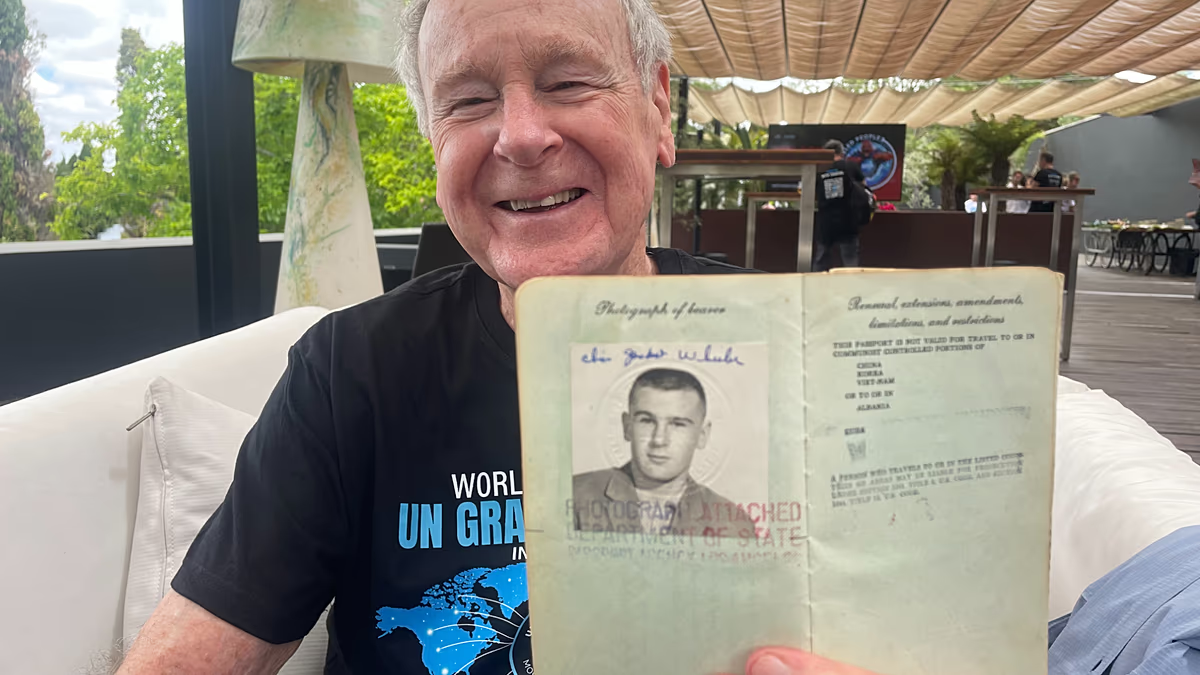
For members like American expatriate Jack Wheeler, MTP provided a framework for a lifelong passion. What began as a casual inquiry from his wife about how many countries he’d visited (140 at the time) evolved into a methodical “game.” Wheeler, now 82, made a habit of tacking on visits to neighboring nations during his trips, a strategy that culminated in 2014 on the islands of São Tomé and Príncipe. His secret? Blending business with pleasure. For decades, Wheeler has run a company organizing expeditions. “People pay me to take them to extraordinary places around the world. That’s how I do it,” he explains, showcasing a well-worn passport from the 1960s as a testament to his enduring journey. His story mirrors that of German-American Wendy Arbeit, who achieved her own grandmaster status last year by gaining entry into North Korea as part of the first post-pandemic tourist group—an experience she describes as “incredible, very safe, very clean.”
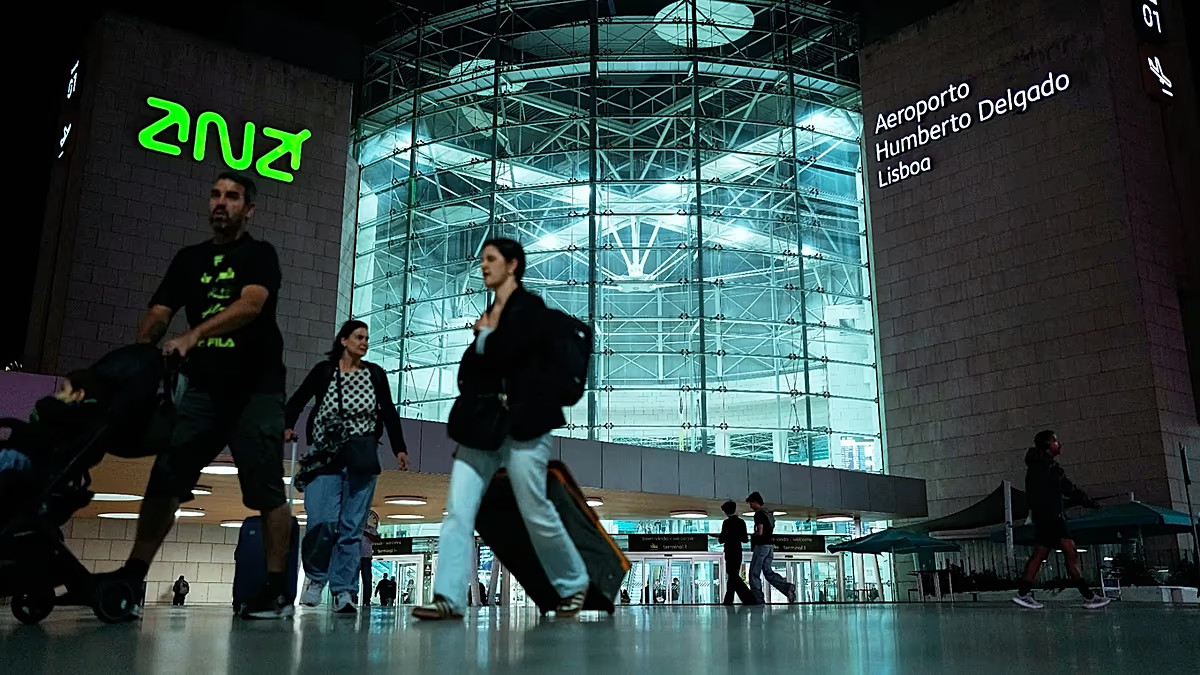
The community, while global, finds deep camaraderie in personal gatherings. Recently, 200 members, including 103 grandmasters, convened in Azeitão, Portugal. Here, Wheeler and Arbeit met, their shared milestone forming an instant bond. The members, predominantly from North America and Europe with growing Asian participation, are united by a desire to share stories that transcend typical tourist tales. Many narratives are laced with adrenaline and peril, from navigating active conflict zones to fraught encounters with authorities. Argentine Nicolas Pasquali recalls the Central African Republic as particularly dangerous, riddled with civil war and Wagner Group mercenaries, yet he crossed it by motorcycle with local aid. His travels also led to brief imprisonments in Iraq, on false espionage charges, and in the Democratic Republic of Congo over a visa bribe refusal—harrowing experiences he recounts with the perspective of one who has safely emerged on the other side.
Irish grandmaster David Langan, who completed his global circuit in 2022, has a unique, quieter ritual: visiting a post office in every country. He accomplished this even in Somalia, which he considers the most dangerous nation on his list. “I would say Mogadishu, in Somalia, is considered dangerous. But, as with everything, you need proper security and to be careful. I felt safe when I was there,” Langan reflects, highlighting a common thread among these veterans: a nuanced understanding of risk. They are not reckless adventurers but calculated travellers who rely on research, trusted local contacts, and situational awareness. Their stories underscore that true exploration often lies in the ordinary moments—like mailing a postcard—within extraordinary contexts.
Financially, such a lifestyle is undoubtedly an investment, but members employ savvy strategies to manage costs. While it is an expensive hobby, some argue that global travel has never been more accessible. Langan points to lower airfares and alternative accommodations. “It’s a matter of staying in cheaper hotels or staying in people’s homes,” he says. Pasquali estimates that visiting every country can be accomplished with careful planning and a budget of around 150,000 euros, prioritizing savings on transport and lodging. This practical approach demystifies the feat, framing it as a attainable goal for the dedicated, rather than an exclusive pursuit for the ultra-wealthy. The key is prioritization and a willingness to embrace simplicity on the road.
Ultimately, MTP represents more than a club or a ranking; it is a testament to human curiosity and connection. These individuals, who prefer the term “traveller” over “tourist,” seek not just to see places, but to understand them through direct, often unfiltered, experience. Their journeys are driven by a desire to witness the vast tapestry of human life in all its complexity—from the pristine order of North Korea to the chaotic vibrancy of Mogadishu’s markets. As the community looks ahead to its next major gathering in Chengdu, China, the mission endures: to explore thoroughly, to share openly, and to continuously redefine the boundaries of their own world map. In doing so, they remind us that the planet, for all its conflicts and challenges, remains a place of endless discovery for those willing to look beyond the guidebook.