




In an era where our daily lives are increasingly interwoven with digital threads, access to the internet has transcended luxury to become a fundamental utility across European homes. Much like electricity or running water, a reliable connection is central to modern existence, enabling everything from work and education to healthcare and social connection. Recent data underscores this profound integration, revealing that by 2025, a remarkable 94% of individuals within the European Union had used the internet in the preceding three months. A mere 4% reported a full year without going online, highlighting just how marginal digital exclusion has become in most of the bloc. This connectivity is increasingly mobile-first, with nearly 90% of individuals relying on smartphones and tablets as primary gateways to the online world. This paints a picture of a continent that is overwhelmingly online, yet beneath this uniform statistic lies a complex and uneven landscape where the experience of being connected—and its cost—varies dramatically from one member state to another.
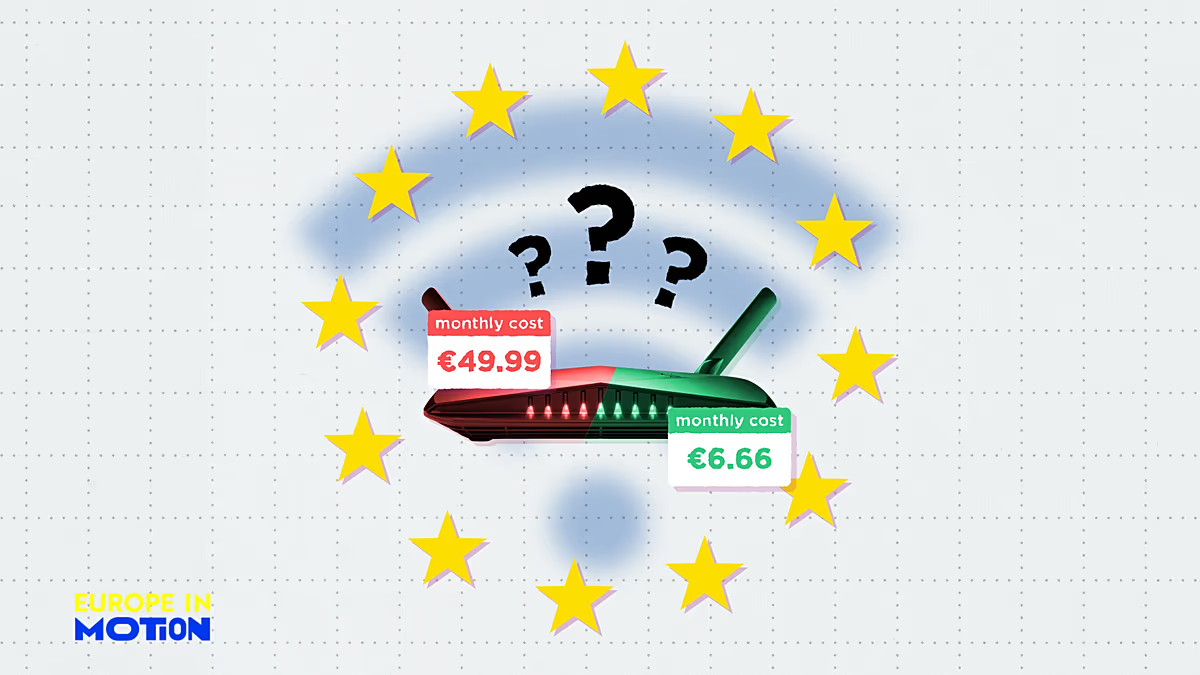
A striking disparity emerges when examining the monthly price of a broadband connection. Research analysing thousands of tariffs globally reveals a clear economic divide within the EU. Luxembourg stands as the most expensive, with an average monthly cost nudging €50. It is closely followed by the Netherlands and Finland, where prices are only slightly lower. Interestingly, these nations also report some of the highest levels of internet usage in the bloc, suggesting that in higher-income economies, cost, while significant, does not present a prohibitive barrier to access. In stark contrast, Eastern European nations offer the most affordable access within the EU. Romania provides the cheapest broadband in the bloc at an average of approximately €6.66 per month—a figure that ranks among the lowest rates worldwide. Lithuania and Bulgaria follow with averages of €14.90 and €15 respectively. This affordability has coincided with dramatic growth; between 2015 and 2025, both Bulgaria and Romania saw household connectivity surge by 34% and 28%, demonstrating how accessible pricing can directly accelerate digital inclusion and close usage gaps.
The reasons behind this pronounced price geography are multifaceted and extend beyond simple comparisons of national wealth. Eastern Europe’s position as having the lowest internet prices on a subregional level globally is largely attributed to its telecommunications evolution. Having modernised its infrastructure later than Western counterparts, the region often bypassed older copper-based systems entirely, investing directly in extensive fibre-optic networks. Fibre is not only the fastest and most stable connection type but also, once the physical lines are laid, can be more cost-effective to operate and upgrade, savings that can be passed to consumers. Conversely, in Northern and Western Europe, higher broadband costs reflect a broader pattern of a higher cost of living. Furthermore, these regions may contend with the legacy costs of maintaining and upgrading older, pre-existing network infrastructures. Southern Europe finds a middle ground, ranking as the fourth most affordable subregion analysed, indicating that lower prices are not exclusive to the EU’s eastern flank.
However, the story of digital Europe is not told by price tags and national averages alone. A critical, persistent divide exists within countries themselves, between urban and rural areas. For some nations, this divide has nearly vanished. In 2025, cities in Ireland, Denmark, the Netherlands, Luxembourg, and Finland all enjoyed connectivity rates exceeding 99%. Impressively, the rural areas of Ireland, the Netherlands, and Denmark matched this near-universal access, also reporting rates above 99%. This demonstrates that with focused investment and policy, geographical barriers can be overcome. Yet, for other member states, the rural-urban gap remains a significant challenge to equitable access. Greece, Bulgaria, Croatia, and Portugal registered the lowest internet connectivity rates in rural areas within the EU. In these regions, challenging terrain, lower population density, and higher infrastructure costs can deter network investment, leaving rural communities and businesses at a distinct socio-economic disadvantage in an increasingly digital single market.
The implications of these disparities are profound and touch upon core European values of equality and cohesion. Affordable, high-quality internet in urban Romania is a success story, but if a farmer in rural Bulgaria cannot access a stable connection for market prices or telemedicine, the EU’s digital single market remains incomplete. Similarly, a high cost in Luxembourg may not limit basic access but could strain household budgets nonetheless. The data prompts essential questions about what constitutes “access” in the 21st century—is it merely any connection, or is it a fast, reliable, and affordable one that allows for full participation? As remote work, online learning, and digital public services become standard, ensuring this latter definition of access becomes a matter of social justice and economic competitiveness. The EU’s digital decade targets aim for gigabit connectivity for all by 2030, a goal that will require targeted investments, especially in rural and underserved regions where the market alone may not provide a solution.
In conclusion, while Europe stands as a highly connected continent, its digital landscape is one of contrasts. From the premium-priced, ubiquitous networks of the northwest to the affordable, fibre-rich markets of the east, and from the virtually gap-free access in some rural heartlands to the persistent connectivity deserts in others, the journey toward a truly inclusive digital society is ongoing. The trends show encouraging growth, particularly in nations that have combined modern infrastructure with low costs. The challenge ahead lies in ensuring that the benefits of the digital age are not determined by one’s postal code or income. Bridging the final gaps in rural access and ensuring affordability remains aligned with quality will be crucial in building a Europe where every individual, community, and business can thrive in the connected world. The foundation of near-universal usage is there; the next step is to make that foundation equally strong for all.