



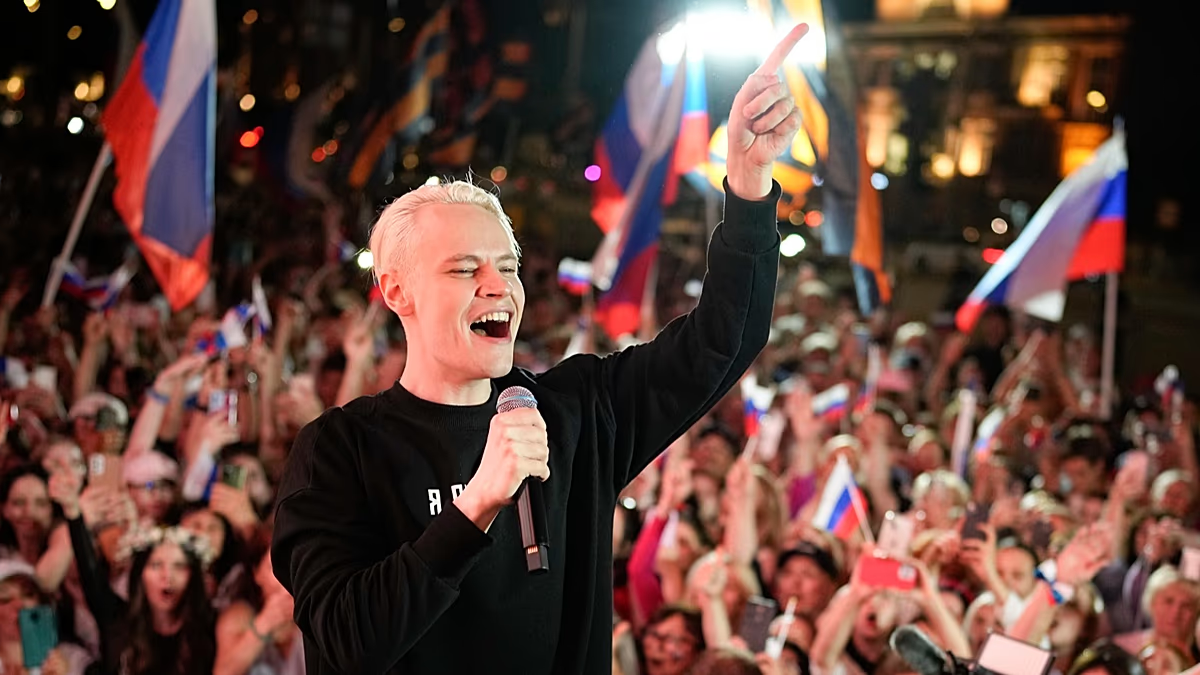
In an era where global debates increasingly focus on regulating artificial intelligence in the creative arts—aiming to protect artists’ intellectual property, likenesses, and livelihoods—a Russian performer has adopted a starkly contrary stance. Rather than viewing AI as a threat to artistic integrity, 34-year-old singer Yaroslav Dronov, known by his stage name Shaman, has weaponized the technology for political messaging. A former contestant on Russian talent shows and now a vocal supporter of the government, Shaman has become a prominent cultural figure aligned with the state, performing at official events endorsing the invasion of Ukraine and at initiatives like the “traditional values”-focused Intervision 2025. His alignment has placed him on international sanctions lists, leading to the removal of his music from major Western platforms like Spotify and YouTube. Undeterred, his latest project, the music video for the patriotically titled song “Mother Russia,” leverages AI deepfake technology to target fellow citizens deemed disloyal by the authorities.
The video’s concept is a pointed political spectacle. It features photographic portraits of Russian public figures who have left the country following the 2022 invasion, individuals officially designated as “foreign agents.” The roster includes comedian Maxim Galkin, rappers Noize MC and Morgenshtern, journalist Yury Dud, businessmen Oleg Tinkov and Mikhail Khodorkovsky, and political scientist Ekaterina Schulmann. In a symbolic act, Shaman pins their images to a board, after which AI-generated clones of their faces come to life, forming a choir that sings along to his anthem. A disclaimer acknowledges the use of AI, but the artistic and political intent is unambiguous. As Shaman declared on VK, Russia’s dominant social network, the deepfakes force these individuals to “sing for Russia free of charge,” a direct jab at their perceived betrayal and a rhetorical reclaiming of their voices for the state’s narrative.
Reactions from those featured have been mixed, reflecting the complex personal and professional tensions at play. Some expressed irritation at the use of their old photographs, while others shrugged it off as inconsequential or even free publicity. Blogger Ilya Varlamov offered a more subversive interpretation, suggesting that by featuring these banned figures so prominently, Shaman had inadvertently allowed “foreign agents” to reappear on Russian television screens, a potential own-goal for state propaganda. In an ironic twist, one notable absentee, singer Monetochka (Yelizaveta Gyrdymova), expressed disappointment at her exclusion. Living in Lithuania and under a Russian criminal case for evading “foreign agent” duties, her reaction highlights the perverse status these designations confer, where being targeted can be seen as a badge of opposition relevance, and being overlooked can feel like an erasure.
The video has ignited significant debate within Russia about the legal and ethical boundaries of AI. Experts note that Russian law does theoretically offer grounds for lawsuits over the unauthorized use of one’s image, especially in a context that could be seen as distorting their likeness for propaganda. The individuals depicted could potentially pursue legal action for defamation or violation of personal rights. However, widespread skepticism exists regarding the feasibility of such a challenge. Shaman’s close ties to the political establishment create a formidable obstacle; launching a case against a state-affiliated artist is viewed by many commentators as a futile gesture unlikely to succeed in the current judicial climate. This perceived impunity underscores the video’s power as a political tool, demonstrating how technology can be deployed not just against artists, but by artists acting as extensions of state authority.
Shaman himself has framed his actions not as art or retaliation, but as a moral duty. In his statements, he positions himself as a truth-teller, declaring he “does not have the right to conceal this betrayal” and vowing to “be lit up with the truth like a Kremlin star.” This rhetoric frames the deepfake video as an act of patriotic exposure, using AI to visually and audibly “reclaim” the dissenting voices for the motherland. It is a stark contrast to global anxieties about AI usurping human creativity; here, AI is used to enforce a singular, state-approved narrative by digitally conscripting the images of exiles. As of now, no lawsuits have been filed, leaving the video as a standing provocation and a case study in the use of creative technology for political performance.
Ultimately, Shaman’s “Mother Russia” video transcends a simple music release. It is a cultural-political artifact that crystallizes several contemporary dilemmas: the weaponization of deepfake technology, the blurring line between state propaganda and personal artistic expression, and the vulnerability of individual identity in the digital age. While international bodies grapple with how to protect artists from AI, this episode illustrates a parallel reality where AI can be harnessed to attack, mock, and politically neutralize them. The video serves as a potent reminder that the ethical landscape of artificial intelligence is not universally defined; it is shaped by the political terrain in which it is deployed, becoming a mirror for power, conflict, and control.