
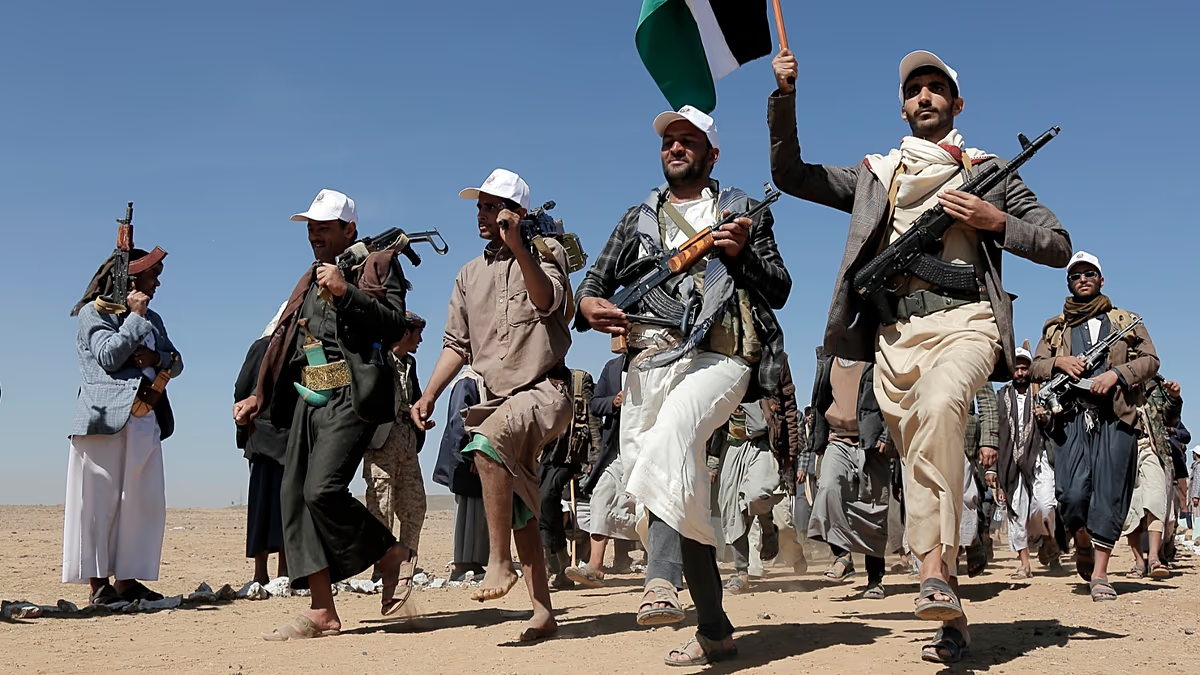


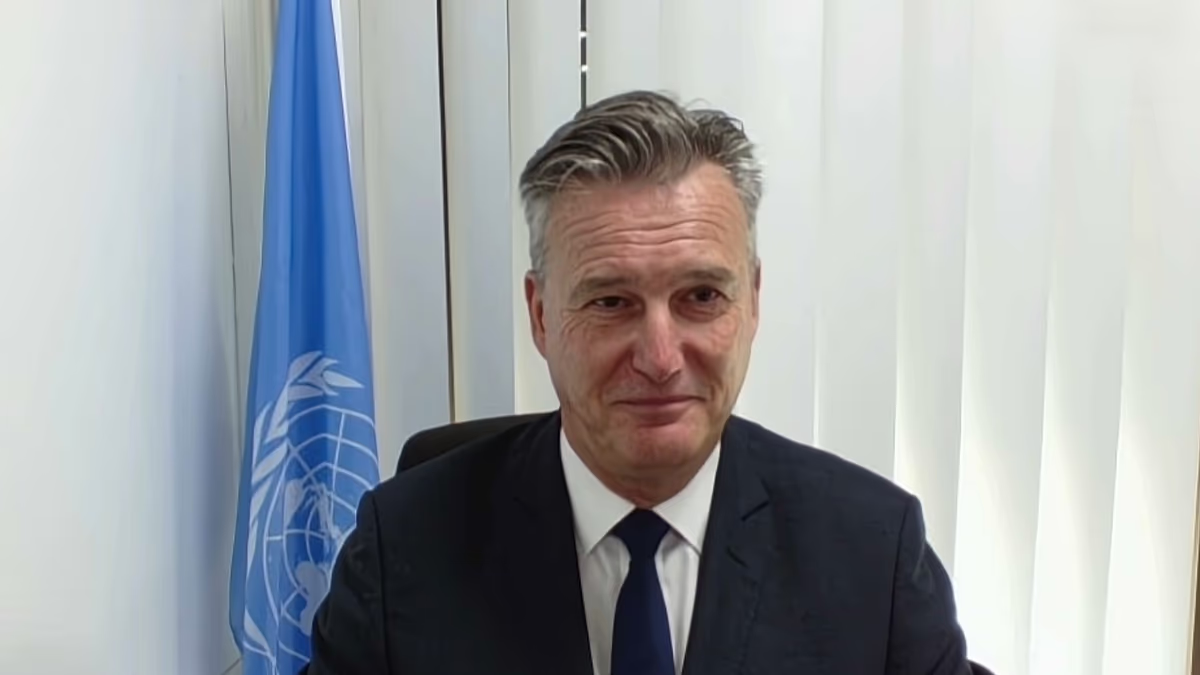
The situation along the Blue Line—the UN-drawn boundary between Lebanon and Israel—remains a simmering fault line, charged with decades of history, grievance, and recent trauma. As Deputy Head of Mission for the United Nations Interim Force in Lebanon (UNIFIL), Hervé Lecoq operates within this tense landscape, a steward of a fragile calm. His assessment of the prospects for a formal peace process between Israel and the Lebanese militant group Hezbollah is starkly realistic: it is, in his words, “very complicated.” This phrase, diplomatic in its delivery, encompasses a world of challenges—the absence of diplomatic relations between the states, the deeply embedded ideological stance of Hezbollah, the shadow of the war in Gaza, and the memory of the devastating 2006 war. UNIFIL’s mandate, renewed continuously since 1978, is not to orchestrate a grand political settlement but to maintain stability and assist the Lebanese state in asserting its authority in the south. Lecoq’s clarity on this point is crucial; the mission’s soldiers, hailing from dozens of contributing countries, are peacekeepers, not peacemakers. They patrol, observe, and liaise, creating a buffer of presence and dialogue, but they cannot will a political solution into existence.
This leads directly to the core of Lecoq’s message, a principle that defines both the limits and the necessity of UNIFIL’s work. He insists the force cannot “force an agreement.” This is not an admission of weakness but a sober acknowledgment of reality. True and lasting peace cannot be imposed from the outside by a military contingent, no matter how well-intentioned. An armed international presence can deter escalation and manage incidents, but it cannot resolve the fundamental political and security dilemmas that fuel the conflict. The ghosts of past invasions, the unresolved issue of disputed border points like Shebaa Farms, and the very nature of Hezbollah as both a political party and a state-within-a-state armed force are matters that sit squarely in the realm of sovereign political decisions. UNIFIL’s role is to create and preserve the space wherein those decisions could one day be made, not to make them itself. It is the difference between holding the ring for a negotiation and being one of the negotiators.
Therefore, any potential breakthrough, as Lecoq emphasizes, depends entirely on the “political will of both parties.” This phrase is the linchpin of the entire endeavor. On one side, it requires a decision from the Israeli government to engage, directly or indirectly, with an organization it designates as a terrorist group, and to address Lebanese state sovereignty in a comprehensive manner. On the other, it requires a conscious strategic choice by Hezbollah—and by extension its powerful patron, Iran—to transition from a posture of “resistance” and armed deterrence to one of political compromise and enduring peace. It also demands a stronger, more unified Lebanese government capable of exercising full authority over its territory and making binding decisions. Currently, that political will is not merely absent; it is actively being overshadowed by broader regional turmoil. The catastrophic war in Gaza has created a powerful axis of solidarity and conflict, pulling Hezbollah into a sustained low-intensity conflict along the border in support of Hamas, thereby entrenching the military logic over the diplomatic one.
In this volatile environment, UNIFIL’s human task becomes one of relentless, incremental diplomacy at the tactical level. Lecoq and his team, alongside the UNIFIL commander, are perpetual mediators in a thousand minor crises. When a farmer strays near the Blue Line, when a construction project is misperceived as a military post, when a rocket is fired or artillery returned, UNIFIL’s liaison and coordination mechanisms swing into action. They work to de-escalate, to clarify, to prevent a local misunderstanding from spiraling into a wider conflagration. This is the daily, unglamorous work of peacekeeping: building fragile channels of communication between enemy militaries, cooling tempers, and buying time. It is about preserving a semblance of normalcy for the civilians living in villages on both sides of the border, who simply wish to tend their orchards and send their children to school without fear. This granular, human-centric work is the essential foundation without which talk of a grand peace process is meaningless.
The path forward, then, is not a straight line to a signing ceremony but a difficult, winding track that requires sequential steps. A sustainable calm would likely begin with a ceasefire in Gaza, which could potentially decouple the Lebanese front from that conflict. This would need to be followed by a firm cessation of hostilities across the Blue Line, upheld by both sides and robustly monitored by UNIFIL. Then, and only then, could the painstaking work of negotiating more enduring security arrangements begin—potentially involving discussions on the withdrawal of armed elements from the border area, the delineation of disputed points, and the enhancement of the Lebanese state’s security presence. This process would be fraught and slow, requiring not just the political will of the direct parties but also the active and coordinated engagement of key international powers who hold influence over them.
Ultimately, Hervé Lecoq’s statement is a portrait of pragmatic hope grounded in severe constraints. It acknowledges that UNIFIL is not a magic wand, but it affirms that the mission’s presence is indispensable. By stating they cannot force an agreement, he honors the agency and responsibility of the Lebanese and Israeli people and their leaders. By highlighting the prerequisite of political will, he outlines the only true way out of the cycle of threat and retaliation. And by continuing UNIFIL’s mission of vigilance and liaison amid the complications, he keeps alive the possibility, however distant, that one day that political will might emerge. In a region weary of conflict, the value of that preserved possibility, and the soldiers who guard it, cannot be overstated. Theirs is the patience that holds the line, literally and figuratively, waiting for the moment when politics finally chooses peace.