



The Shadow War Expands: Houthi Intervention Threatens Global Trade Amid Regional Conflict
A dangerous new phase in the Middle East’s ongoing conflict has opened on the high seas, with profound implications for global stability and the world economy. Yemen’s Houthi rebels, having formally entered the wider Iran war on Tehran’s side earlier this year, have dramatically escalated their regional role. On Monday, they announced a missile attack directed at Israeli territory and, more consequentially, declared a total ban on Israeli maritime navigation in the Red Sea. This move explicitly extends the threat to the vital waterways of the Gulf of Aden and the Bab el-Mandeb Strait, a narrow chokepoint only 26 kilometers wide. The declaration is a strategic gambit that simultaneously places two of the planet’s most critical maritime arteries—the Bab el-Mandeb and the already-blockaded Strait of Hormuz—under acute threat, effectively putting a vise on global energy and trade flows.
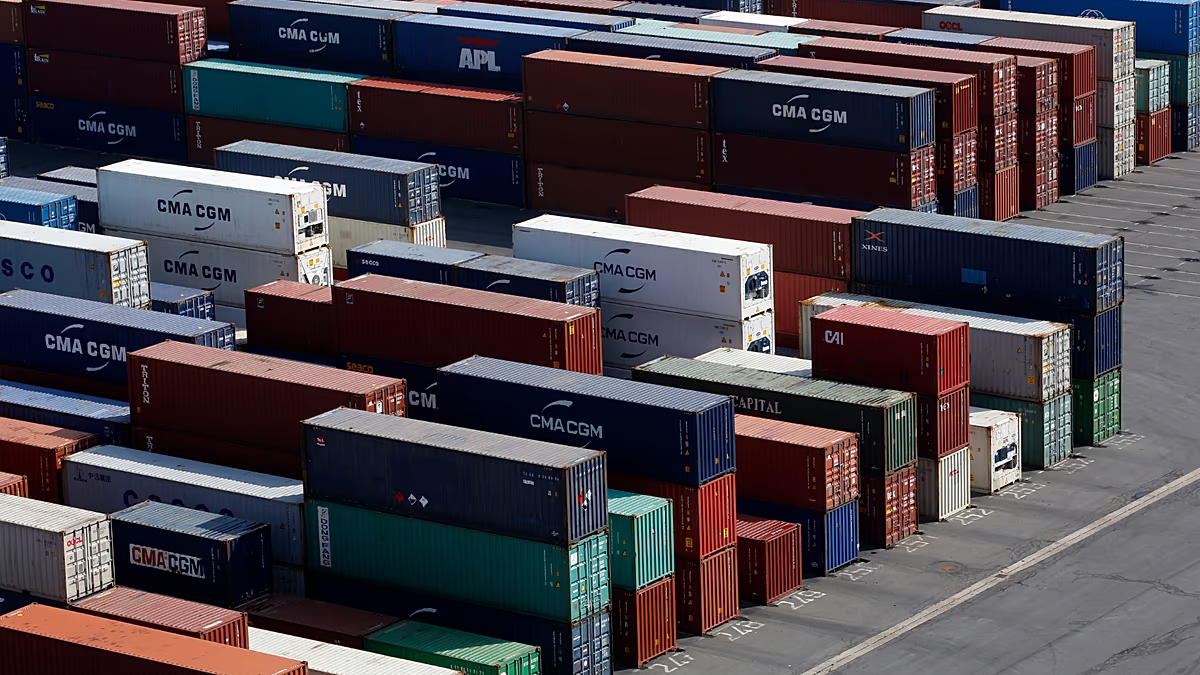
This is not an empty threat from an untested actor. The Houthis have a recent and disruptive track record. During the recent Israel-Hamas war in Gaza, the group launched nearly 200 attacks on commercial shipping in the Red Sea, a corridor through which an estimated $1 trillion in goods passes annually. That sustained campaign forced a massive rerouting of global trade, as major shipping companies abandoned the route for a far longer, costlier journey around the southern tip of Africa. The economic toll was severe: a typical Asia-Europe voyage was extended by about two weeks with significantly increased costs, while the volume of oil passing through the Bab el-Mandeb Strait plummeted from 8.8 million to around 4 million barrels per day. While these attacks paused following the Gaza ceasefire in October 2025, the Houthis warned they would resume if the broader Iran war escalated—a condition they now seem to believe has been met.
The timing of this proclamation is critically significant, intensifying an already perilous moment. It came as exchanges of fire between Israel and Iran placed a fragile April ceasefire under severe strain, dashing hopes for a near-term peace deal. By launching missiles and issuing the shipping ban, the Houthis are actively opening a new front, demonstrating the coordinated nature of the so-called Axis of Resistance. This network, backed, trained, and armed by Tehran, includes Lebanon’s Hezbollah, Hamas, and various Iraqi militias. The Houthis, formally known as Ansar Allah, are not mere proxies but a battle-hardened force that has controlled Yemen’s capital, Sanaa, and much of the country’s north for nearly a decade. Their actions are a powerful signal of solidarity with Iran and a direct challenge to Israel and its allies, aiming to exert pressure far beyond their immediate geography.
The global economic stakes are almost unimaginably high. The Bab el-Mandeb Strait is the gateway for roughly 12% of all global maritime trade, connecting the Indian Ocean to the Red Sea and the Suez Canal beyond. The Strait of Hormuz, currently blockaded by Iran as a central tactic in its war, is even more crucial, carrying about one-fifth of the world’s seaborne oil and gas. The Houthi statement transforms the Red Sea from a transit zone into a potential battlefield, declaring “all enemy movements to be legitimate military targets.” For shipping companies, insurers, and global markets, this creates an impossible calculus. The previous round of attacks caused major disruption; a renewed campaign, now framed as part of a larger regional war, could trigger a deeper and more lasting crisis in global supply chains, spiking energy and goods prices worldwide.
On the military front, the Houthi claim of a “missile barrage targeting sensitive Israeli enemy targets” and the Israeli military’s confirmation of an interception attempt mark a direct long-range escalation. It represents the first such announced attack since the April ceasefire began and shows the group’s capability and willingness to project power across more than 1,600 kilometers. While the immediate physical damage may be limited by Israel’s air defenses, the psychological and strategic impact is substantial. It forces Israel and its partners to defend against a persistent, multi-directional threat, stretching resources and complicating diplomatic efforts. Each intercepted missile still carries the message that no front is quiet and that the conflict’s boundaries are continually expanding.
In sum, the Houthi announcement is a pivotal development that merges regional warfare with global economic security. It leverages the group’s proven capacity for maritime disruption to actively support Tehran in a broader conflict, directly targeting Israeli interests and, by extension, international commerce that depends on free navigation. As the fragile ceasefire between Israel and Iran teeters, this move ensures that the repercussions of any further escalation will be felt not just in the Middle East, but in ports, on fuel pumps, and in store prices around the world. The waters of the Red Sea have once again become a mirror reflecting and amplifying the region’s tensions, reminding us that in an interconnected world, a conflict in one desert can very quickly create waves on every shore.