



Since the dawn of human consciousness, when our earliest ancestors first gazed upwards in wonder, the sun and the moon have been the ultimate constants. They have shaped our very existence, serving as the foundation for faith, the mechanism of time, the guide for agriculture, and the inspiration for countless myths and artworks. This summer, the Saatchi Gallery in London embarks on a monumental endeavor to capture this entire spectrum of fascination within its walls. Their major new exhibition, The Sun and The Moon, gathers the perspectives of more than 170 artists across nine gallery spaces, creating a vast tapestry of celestial inspiration. As the second installment in the gallery’s series exploring nature’s influence on art—following the popular FLOWERS exhibition—this show aims to be nothing less than a complete 24-hour journey. Curator Katherine Benson describes it as an exploration of how these celestial bodies, ever-present throughout human history, have continuously ignited the creative spirit.
The exhibition is ingeniously structured as a cyclical day, inviting visitors to travel from dawn’s first light through the brilliance of noon, into the emotive hues of sunset, and finally into the profound depths of night. It opens with established artists like Patrick Caulfield and Barbara Hepworth before transitioning into the Dawn gallery, which examines ancient understandings of the sun and moon as cosmic forces. Here, a 1st-century BC Celtic bust of Sol Invictus or a replica of the prehistoric Nebra Sky Disc might sit alongside a 17th-century Indian fabric depicting the sun and a contemporary costume from the Royal Opera. This blending of epochs underscores a timeless dialogue. Subsequent rooms delve into the sun’s practical roles in timekeeping and agriculture, as well as the rituals of summer culture, each space bathed in the emotional and symbolic light appropriate to its time of day.
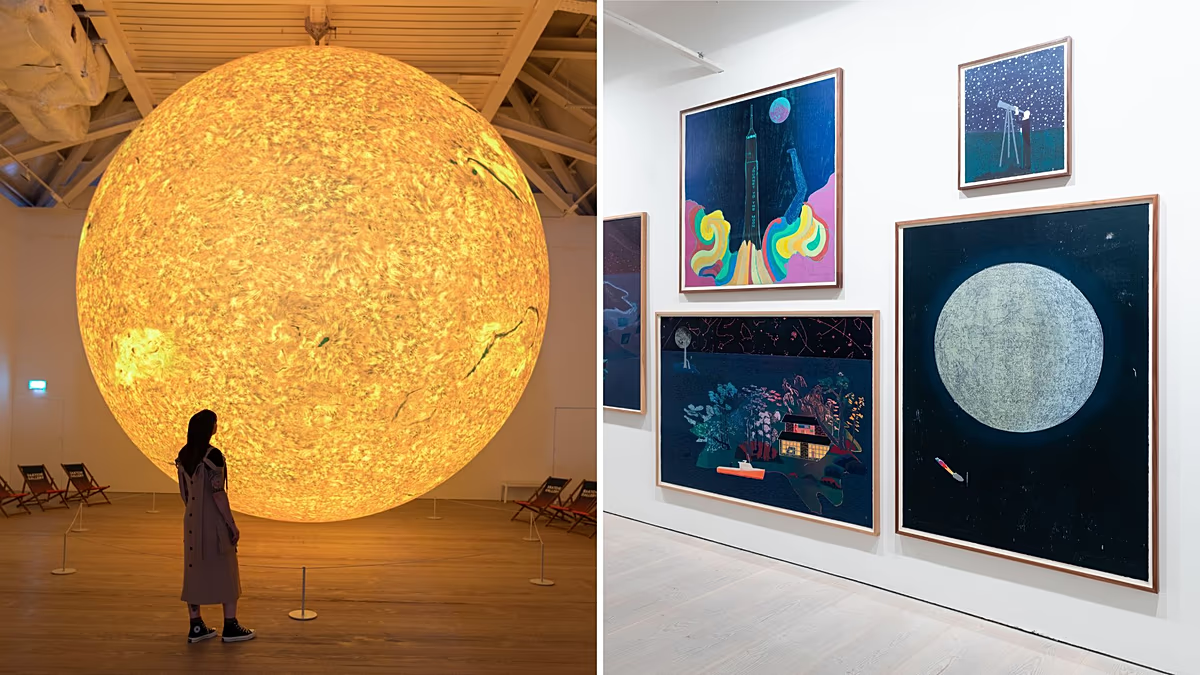
The breathtaking centrepiece of the solar journey is Luke Jerram’s Helios, a stunning six-metre sphere that dominates the exhibition’s midway point. Constructed from 400,000 detailed photographs of the sun provided by astrophotographers and NASA, the illuminated orb glows with serene majesty. Visitors are encouraged to sink into deckchairs beneath it, gazing upward as it slowly pulsates with light, accompanied by an ambient soundtrack. It is a space designed for awe, a moment to contemplate our star’s essential gift of light, warmth, and energy, as well as its profound cultural and religious significance throughout history. Jerram hopes the work inspires exactly this sense of wonder and connection, offering a hushed, communal moment of reflection—or, as the exhibition gently acknowledges, a perfect spot for a quiet nap amid the artistic pilgrimage.
The exhibition then turns its gaze to the moon, charting its phases and our historical observations before landing at a powerful gallery titled Walking on the Moon. This space focuses on the cultural legacy of the Apollo missions, deliberately highlighting often-overlooked narratives. Its centrepiece is Moon Landing, a remarkable collaborative textile by Margot Selby and composer Helen Caddick. This work honours the Navajo women who hand-wove the critical integrated circuits and the women at the Raytheon plant who wired the memory cores for the Apollo 11 guidance computers. Caddick’s accompanying score is structurally based on the binary logic of weaving itself, with instruments playing in an interlocking pattern. The magnificent textile, woven by Selby and her studio over four months using 30,000 threads, visually interprets the music’s rhythms, creating a poignant monument to these essential, yet historically silent, contributors to one of humanity’s greatest achievements.
Beyond these historical narratives, the exhibition actively expands the celestial conversation to include fresh and diverse voices. British Zambian artist Kay Gasei presents an intimate, mythological painting from his Moonlight Series, drawing on personal memories of childhood mischief and adventure under the night sky. Meanwhile, Sakha artist Aina Petrova bridges ancient tradition and contemporary design with her URSUUNA project—reimagined Arctic snow goggles. Originally carved from wood or bone over a thousand years ago to prevent snow blindness, these vital tools of survival and cultural identity are reinterpreted by Petrova in silver and brass. By displaying her contemporary pieces alongside an original pair, she forges a direct link to her ancestry. She enthusiastically invites visitors to try them on, hoping to foster greater visibility for Indigenous cultures worldwide and a deeper understanding of humanity’s varied relationship with the harsh, beautiful environments under the same sun and moon.
The final descent into Midnight and The Darkest Hours explores the realms of folklore, dreams, and altered perception, culminating in two immersive installations by the renowned collective teamLab. These works, part of their “Cognitive Sculpture” series, feature luminous spheres that seem to float in space but are composed solely of light and environment, with no physical form. As teamLab’s Takashi Kudo explains, they cannot be photographed and are perceived unstably, revealing themselves only through patient observation. They exist as a shared experience, to be discussed only with others who were present. This concept provides a fitting, profound conclusion to an exhibition about the celestial: some wonders, like the sky itself, must be personally experienced to be fully comprehended. As curator Katherine Benson hopes, the entire journey leaves visitors with a renewed sense of connection—to the universe, to human history, and to each other—reminding us that we have all always lived under the same eternal lights. The Sun and The Moon: Art Inspired by the Celestial runs at London’s Saatchi Gallery until 8 September 2026.