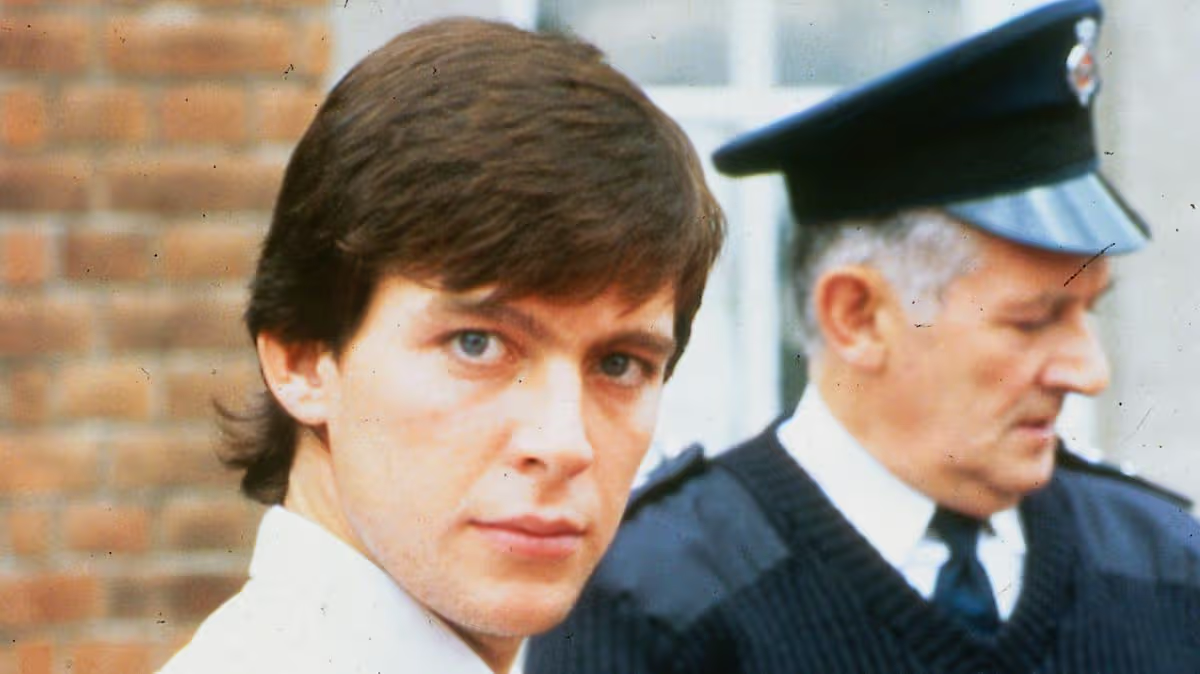




The harrowing details of Malcolm Phillips’ abuse, detailed within a courtroom but stretching back decades into the past, paint a picture of profound betrayal and institutional failure. For eighteen years, from 1976 to 1994, Phillips wielded his authority as the manager of Skircoat Lodge Care Home in Halifax, West Yorkshire, not as a shield for the vulnerable children in his care, but as a weapon against them. His was a “regime of fear,” a term that chillingly encapsulates the environment where both boys and girls were subjected to sexual abuse, their safety and innocence sacrificed to the man entrusted with their protection. This was not a single, isolated incident, but a prolonged period of systematic violation, highlighting a catastrophic breach of duty that would leave deep and lasting scars on the lives of at least six victims—four girls and two boys—whose courage in coming forward would finally bring the truth to light decades later.
The legal proceedings that unfolded at Bradford Crown Court were, by necessity, unconventional and fraught with a painful sense of incompletion. By the time his crimes were adjudicated, Phillips was 93 years old and suffering from significant age-related health and cognitive issues. These conditions rendered him unfit to stand a traditional trial, where he could actively participate in his own defense. Instead, the court held a “trial-of-facts,” a unique legal process designed for such circumstances. Here, a jury listened to the evidence not to deliver a verdict of guilt, but to determine, on the balance of probabilities, whether Phillips had committed the alleged acts. In January of last year, after hearing testimony detailing multiple counts of rape, indecent assault, and indecency with a child, the jury concluded that he had indeed carried out these offences. This finding, while a crucial validation for the survivors, existed in a legal limbo, devoid of the finality of a formal conviction.
This limbo culminated in a moment of immense frustration and solemn resignation in court. With Phillips found unfit for trial and the jury’s factual finding in place, Judge Kirstie Watson’s sentencing options were severely constrained by law. The only permissible sentence was an absolute discharge, meaning Phillips would face no formal punishment. Judge Watson imposed this outcome with “great reluctance,” openly acknowledging the grievous nature of his crimes. She directly addressed the inevitable public outcry, asking, “There will be those who ask ‘what is the point?’” Her answer was a powerful tribute to the survivors: for the victims, this arduous process had given them a voice and ensured they were finally listened to after years of silence. Other potential sentences, like committal to a hospital or a supervision order, were deemed unsuitable by a pre-sentence report, as Phillips’ ailments were physical and age-related, not stemming from a treatable mental disorder.
The stark inequity of this outcome was thrown into even sharper relief by the sentence handed to his accomplice. Linda Brunning, 66, who had served as Phillips’ assistant at Skircoat Lodge, was tried and convicted in the normal manner for her active role in the abuse. The court found her guilty of physically restraining one boy while Phillips assaulted him and of indecently assaulting another young boy herself. For these acts of complicity and direct abuse, Brunning was sentenced to 25 years in prison. The contrast between her lengthy prison term and Phillips’ absolute discharge, both arising from the same web of atrocities, underscores the complex and often unsatisfying intersection of justice, aging, and legal procedure. It highlights a system that, while bound by rules designed to protect the incapacitated, can produce results that feel deeply at odds with a natural sense of retribution and closure.
Ultimately, this case transcends the fate of a single, now-elderly abuser. It stands as a somber testament to the lasting damage inflicted upon children in care settings, whose cries for help were silenced by a structure of fear and authority. The survivors’ perseverance in seeking accountability, despite the advanced age of their perpetrator and the emotional toll of revisiting their trauma, is the true cornerstone of this story. Their voices, amplified through the trial-of-facts, have permanently etched Phillips’ crimes into the public record, ensuring that the history of Skircoat Lodge Care Home now includes this official acknowledgment of the suffering that occurred within its walls. While the legal outcome may feel inconclusive, their act of testimony itself is a form of justice—a reclamation of their narratives from the shadows of the past.
The legacy of this case therefore poses difficult, enduring questions about responsibility, healing, and the long arm of the law. It forces a confrontation with the reality that some perpetrators may physically evade earthly punishment, while the psychological sentences served by their victims endure for a lifetime. The story of Malcolm Phillips and Skircoat Lodge is a grim reminder of the vigilance required to protect society’s most vulnerable and of the immense courage it takes for survivors to step forward, even when the path to judicial consequence is obstructed. Their success in securing a factual finding ensures that, although Phillips walked free from court, he does not walk free from history’s judgment, nor from the enduring truth of his victims’ testimonies.