


Paragraph 1
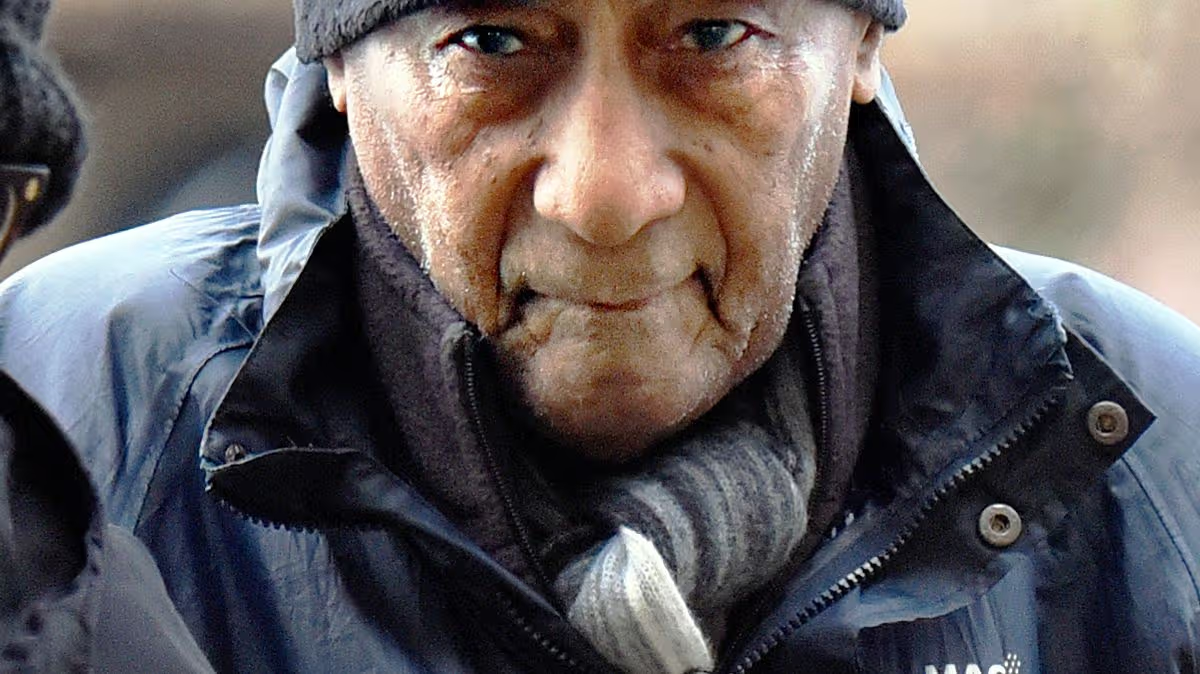
A long-running legal saga that challenged the very foundations of international football’s transfer system has quietly reached its conclusion. Former French international midfielder Lassana Diarra has settled his dispute with FIFA and the Belgian Football Association, as confirmed by sources on Monday. This agreement draws a line under a bitter and protracted battle that began over a decade ago, one that saw Diarra seeking substantial damages—reportedly in the region of €65 million. The settlement closes a case that became far more than a personal grievance; it evolved into a landmark challenge with the power to reshape the rules governing how players move between clubs across Europe.
Paragraph 2
The origins of the conflict are rooted in a contract dispute in 2014. After a disagreement over unpaid wages, Diarra terminated his contract with Russian club Lokomotiv Moscow. The club deemed this termination unjustified and pursued him for compensation, initially for a staggering €20 million, later reduced to €10.5 million. This action triggered a chain of events governed by FIFA’s regulations, which created a chilling effect on Diarra’s career. Fearing it could be held jointly liable for this compensation under those rules, Belgian club Charleroi backed out of a deal to sign him. This left Diarra in a professional limbo, effectively punished by a system that seemed to prioritize club protection over player mobility, setting the stage for his monumental legal challenge.
Paragraph 3
The heart of Diarra’s case was a fundamental question: did FIFA’s regulations unlawfully restrict the free movement of workers within the European Union? In a pivotal ruling in October 2024, the Court of Justice of the European Union (CJEU) answered with a resounding yes. The court found that FIFA’s rules imposed “considerable legal risks” and “potentially very high financial risks” on players and clubs alike. It argued that these measures went beyond what was necessary to maintain stability and fairness in the sport, instead distorting competition and acting as a significant barrier to a player’s right to pursue their career across EU borders. This judgment was a seismic victory for player rights, directly validating Diarra’s long-held position.
Paragraph 4
While the CJEU ruling provided a powerful legal precedent, Diarra’s personal fight for compensation continued. Negotiations with FIFA reportedly stalled until this final, confidential settlement was reached. In its statement, FIFA confirmed the end of all legal proceedings but was careful to note that it “does not acknowledge any wrongdoing and has not made any compensation payments.” The specific terms, including any financial arrangement, remain private. For Diarra, now long retired, the settlement represents a hard-won personal resolution after years of uncertainty. For the football world, it formally closes the book on one of the most significant legal cases ever brought against its governing body.
Paragraph 5
The true legacy of Diarra’s fight, however, is not in the confidential settlement but in the tangible reforms it compelled. Even before this case concluded, the CJEU’s damning verdict forced FIFA’s hand. The global governing body has since revised its transfer framework, introducing interim rules that shift the burden of proof in contractual disputes and alter compensation calculations. These changes aim to reduce the disproportionate risks the court identified, creating a somewhat fairer landscape for players seeking to move clubs. In this sense, Diarra’s perseverance has already improved the working conditions for current and future professionals, ensuring others might not face the same career-blocking obstacles he did.
Paragraph 6
The reverberations of this case continue to echo. Diarra’s journey from a sidelined player to the catalyst for a European court judgment has empowered others. It has lent crucial momentum to a broader, Europe-wide class-action lawsuit supported by powerful player unions. This collective action seeks compensation for countless players who believe they suffered financial losses under the old, restrictive regime. Therefore, while Lassana Diarra’s personal battle is now over, the movement it inspired is very much alive. His story stands as a testament to how the determination of one individual can challenge entrenched systems, drive legal evolution, and ultimately push the world’s most popular sport toward greater fairness and freedom for its athletes.