


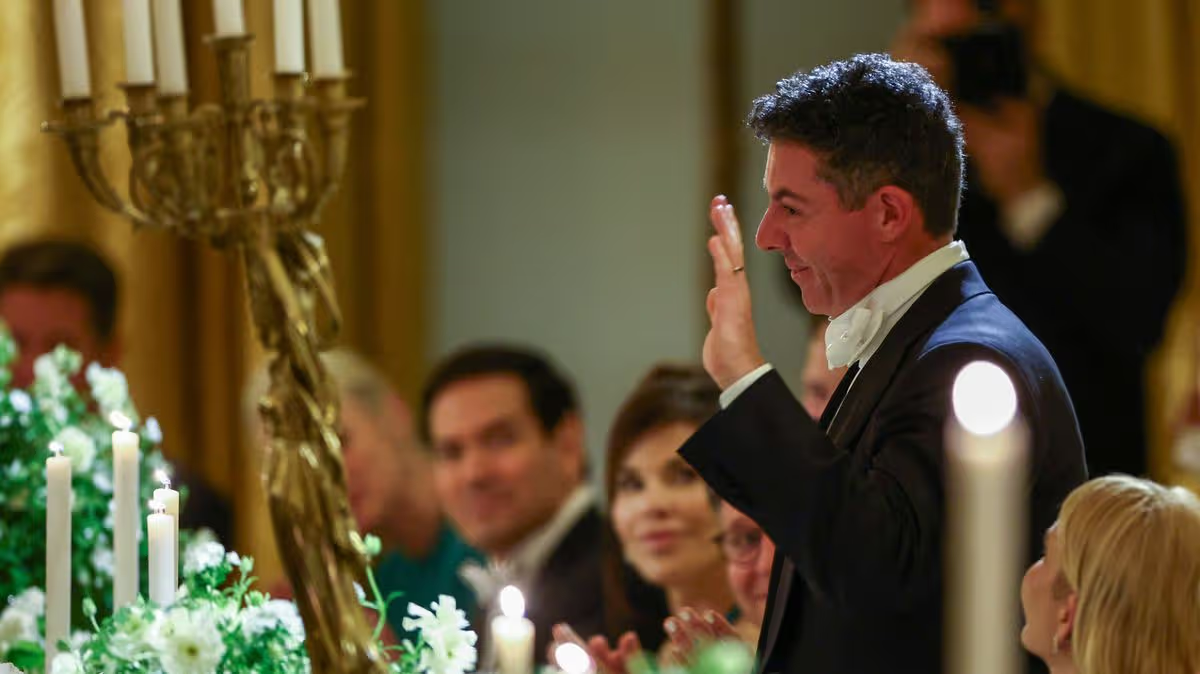
On a spring evening in April 2026, the East Room of the White House glittered with the refined spectacle of a state dinner, a celebration of the enduring alliance between the United States and the United Kingdom. President Donald Trump and First Lady Melania Trump hosted Britain’s King Charles III and Queen Camilla, an event steeped in diplomatic tradition and ceremonial elegance. Amid the dignitaries and diplomats, however, was a surprising guest: Rory McIlroy, the golfing superstar who had just weeks earlier cemented his legend by winning back-to-back Masters titles at Augusta National. McIlroy’s presence added a uniquely modern, sporting dimension to the historic gathering, blending the worlds of royal statecraft and athletic excellence.
President Trump, delivering his prepared remarks on the “unconquerable courage” shared by the two nations, made a spontaneous and memorable departure from his script. As he spoke of courage, he abruptly turned his attention to the golfer, calling out, “Speaking of that, where’s Rory McIlroy? Stand up Rory, will you please?” This unprompted interjection humanized the formal event, showcasing Trump’s well-known penchant for the dramatic and personal. He lavished praise on McIlroy’s recent triumph, calling it “unconquerable courage” and noting, “I watched that man win a tournament, that was a tough one.” After asking the assembled guests to applaud, he humorously quipped, “All right, now I’ll get back to my speech, Rory,” seamlessly weaving McIlroy’s contemporary achievement into the narrative of timeless Anglo-American fortitude.
McIlroy’s victory at the Masters had been a monumental feat, placing him alongside an exclusive pantheon of golf legends—Jack Nicklaus, Nick Faldo, and Tiger Woods—as only the fourth man to defend his title at Augusta. Since that win, however, the Northern Irishman had kept a relatively low profile, a contrast to the roaring spotlight of his accomplishment. His decision to attend the state dinner placed him in an entirely different arena, one of politics and royalty, yet President Trump’s direct acknowledgment bridged these spheres, treating the golfer’s mental fortitude on the course as a virtue worthy of national celebration alongside the courage of states and monarchs.
The President’s admiration for McIlroy was no fleeting moment at the dinner; it was part of a broader, public fascination. Following the Masters win, Trump had taken to his Truth Social platform to congratulate McIlroy, declaring he was “becoming more and more a LEGEND” and expressing his anticipation to watch him compete at the upcoming Cadillac Championship at Trump National Doral. This hope, however, was met with disappointment as McIlroy later confirmed he would skip that prestigious event, the second consecutive £16 million Signature Event he opted out of that season. While this was a blow to Trump’s hopes of seeing him on the Blue Monster course, it underscored McIlroy’s own agency and selective schedule, maintaining focus amid the whirlwind of fame and political attention.
Industry insiders, like seasoned golfer Padraig Harrington, viewed McIlroy’s latest victory not just as a repeat but as a promise of a historic legacy. Harrington speculated that with his now-rounded game—particularly his improved short game and putting—and exceptional mental strength, McIlroy could potentially win “five or ten” Masters titles, remaining competitive at Augusta even into his fifties. This perspective frames McIlroy not as a fleeting champion but as a golfer whose prime could stretch across decades, a prospect that elevates his achievement from a spectacular moment to the possible foundation of one of golf’s greatest careers.
The evening, therefore, became a poignant intersection of sport, state, and legacy. President Trump’s impromptu tribute during a royal visit highlighted how modern athletic heroism can resonate within the grandest traditions of diplomacy. For Rory McIlroy, the dinner was a testament to his transcendence beyond the golf course, becoming a symbol of excellence recognized in the halls of power. As he stood in the White House, applauded by kings and presidents, his back-to-back Masters wins were celebrated not merely as sports news, but as a story of human courage and potential, a narrative fit for both the history books and the future lore of Augusta.