


The human cost of the ongoing conflict in Gaza was brought into sharp relief on Tuesday, as Israeli airstrikes claimed the lives of at least five Palestinians, underscoring the persistent and deadly violence that continues to shatter civilian life long after major hostilities have officially ceased. Among the dead was a nine-year-old boy, Adel al-Najjar, whose simple, innocent act of gathering firewood for his family in Khan Younis ended in tragedy. According to authorities at Nasser hospital, he was killed by Israeli fire near a demarcation line separating Israeli-controlled territory from the rest of the besieged coastal enclave. The incident, which drew no immediate comment from the Israeli military, stands as a heartbreaking testament to the peril faced by Gaza’s most vulnerable population, where even the most mundane chores can become fatal.
The grief and anger from Adel’s family echoes the despair of countless others in Gaza. A relative, Sabreen al-Najjar, voiced a wrenching plea that resonates across communities living under the shadow of conflict: “Every day they target children. What is the guilt of those children? Tell me, what is the guilt of these children? Do they carry weapons or tanks? They go to collect cardboard boxes (and firewood) for their mothers so they can cook and eat, just to eat and drink.” Her words lay bare the profound injustice felt by families who see their children—symbols of hope and innocence—caught in a cycle of violence they did not create and cannot escape.
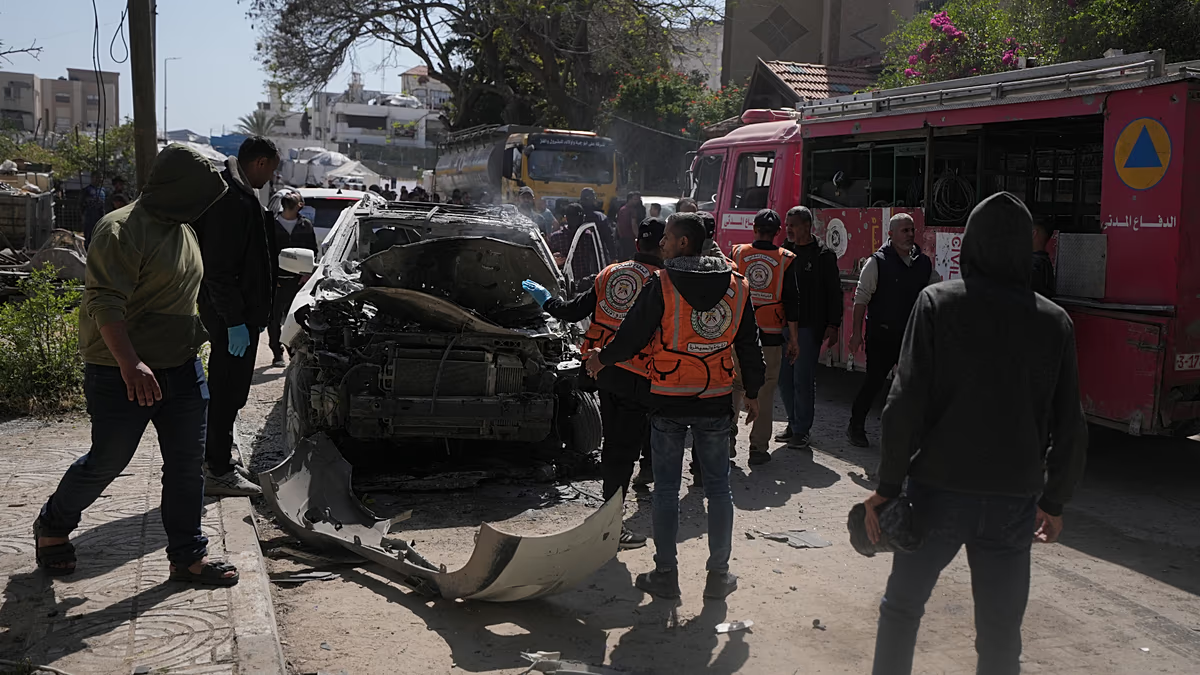
In a separate strike in Gaza City, the conflict’s brutality was further illustrated when four men were killed by a direct Israeli hit on their vehicle. While the Israeli army stated it had targeted “a terrorist” in the area, it offered no additional details, leaving families and local officials to grapple with the aftermath. This incident contributes to a grim statistic maintained by Gaza Health officials, who report that since the October ceasefire between Israel and Hamas, Israeli forces have killed at least 818 Palestinians. This toll includes 226 children and 179 women, numbers that translate into shattered families, orphaned children, and a community grappling with cumulative trauma and loss on a scale that is difficult to comprehend.
Amidst this landscape of destruction and death, fragile threads of hope and humanity persist through efforts to evacuate and treat the wounded. On Monday, a group of eighty-one sick and injured children, accompanied by their families, made the arduous journey from Gaza to Jordan via the King Hussein Bridge to receive critical medical care. For parents like Saleh Zeidan, this lifeline represents a chance at healing for children bearing both physical and psychological scars of war. His young daughter, Duaa, who had her hand amputated and required complex reconstructive surgery, now has the prospect of receiving a prosthetic hand and bone grafts through Jordanian assistance—a poignant reminder that compassion can still bridge the deepest divides.
This medical evacuation is part of a broader, vital initiative led by Jordan, which aims to provide urgent treatment for 2,000 Gazan children. In coordination with the World Health Organisation, more than 450 children have been evacuated from the Strip since March 2025, each case a story of survival against staggering odds. While these children are expected to return to Gaza after their treatment, their temporary respite in Amman’s hospitals offers not just medical intervention but a momentary sanctuary from the relentless pressures of life in a conflict zone, allowing them a chance to recover their health and, perhaps, a fragment of their stolen childhoods.
Ultimately, the events of this single day—the loss of young Adel al-Najjar and four other men, contrasted with the evacuation of dozens of injured children—paint a microcosm of Gaza’s enduring reality. It is a place where death and despair walk hand-in-hand with resilience and international solidarity. Each statistic of the dead, each anguished question from a grieving relative, and each child boarding a bus for medical care tells a part of the same story: a story of a population trapped in a protracted crisis, yearning for safety, dignity, and a future where children can collect firewood without fear, and where healing is not an emergency mission but a fundamental right.