


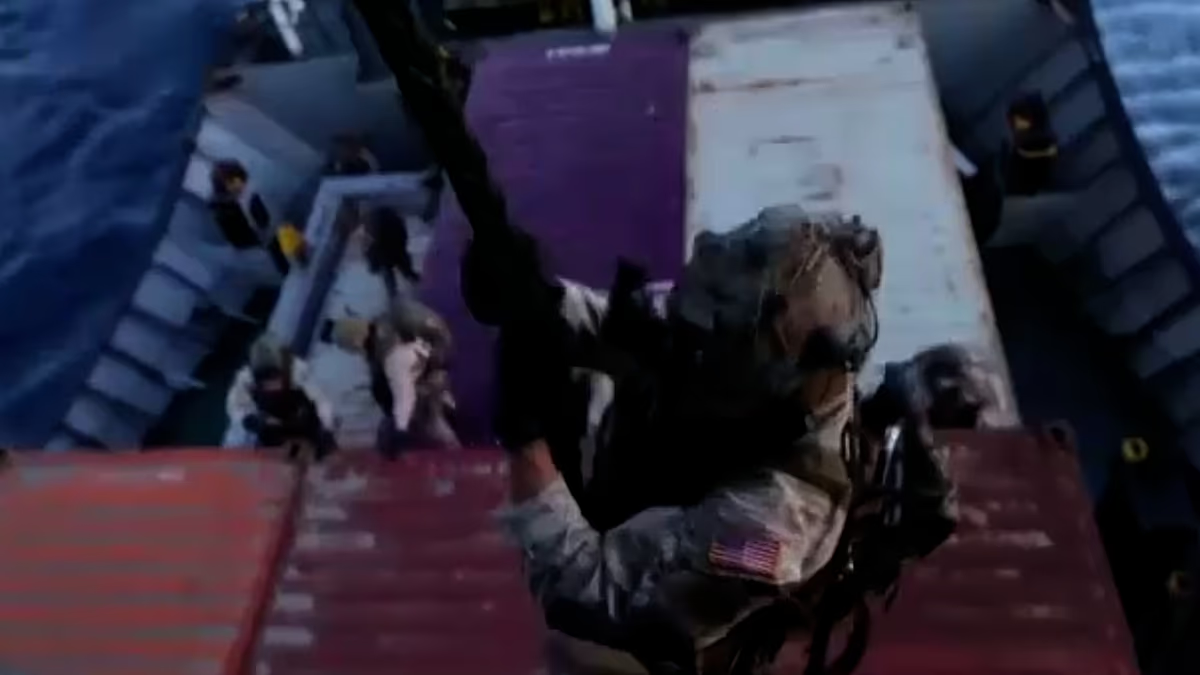
The United States military released stark video footage this week, capturing American Marines stationed on the deck of a commercial vessel, the M/V Blue Star III. The scene is one of tense enforcement in the strategic waters of the Gulf. The ship was suspected of attempting to transit to Iran, a move that would violate an ongoing U.S. maritime blockade aimed at isolating Iranian ports. This visual evidence serves as a powerful, public reminder of the real-world application of this economic pressure campaign—far removed from diplomatic communiques and policy papers—where service members directly intercept and inspect civilian merchant ships on the open sea.
According to a post by the U.S. Department of Defense on the social media platform “X,” the situation aboard the Blue Star III was resolved without escalation. After U.S. forces conducted a thorough search of the vessel, they confirmed that its intended voyage would not, in fact, include a port call in Iran. Consequently, the ship was released to continue its journey. This incident is not isolated; the U.S. Central Command reported that to date, 39 vessels have been similarly redirected to ensure their compliance with the blockade restrictions. These operations underscore a persistent and active enforcement regime, where naval assets are constantly monitoring and intervening in shipping traffic to uphold the complex rules of the sanctions.
The broader context of these maritime intercepts is a protracted and high-stakes standoff between the United States and Iran. The U.S. blockade policy, designed to exert economic and political pressure, has effectively choked off nearly all exports through one of the world’s most critical shipping arteries: the Strait of Hormuz. This narrow channel is a lifeline for global energy supplies, historically facilitating the passage of a significant portion of the world’s seaborne oil. The drastic reduction in traffic through this strait represents a profound alteration of geopolitical and commercial dynamics, with ripple effects felt across international markets and regional security.
The human and economic implications of this choked artery are vast and layered. For the international shipping community, captains and crews find themselves navigating not just physical waters but a labyrinth of geopolitical risk, where a change in routing or documentation can lead to an unexpected encounter with military forces. For Iran, the blockade imposes severe economic strain, limiting its ability to engage in normal trade and extract revenue from exports. For global consumers and industries, especially those reliant on stable energy supplies, the situation introduces volatility and uncertainty into foundational supply chains. This is a crisis conducted on the waves, but its consequences wash onto shores worldwide.
A profound sense of uncertainty shrouds this ongoing maritime confrontation, with no clear end in sight. The blockade and the enforcement actions, like the one involving the Blue Star III, have become a seemingly permanent fixture in the region’s security landscape. Each interception carries the inherent risk of a miscalculation or an accidental clash that could escalate beyond a simple inspection. The presence of armed Marines on commercial decks symbolizes a state of tense and rigid coexistence between normal commerce and high geopolitics, where the rules of trade are rewritten by the priorities of strategic conflict.
In conclusion, the released video is more than a simple operational update; it is a window into a sustained, on-the-water campaign with deep global ramifications. It highlights the meticulous, yet risky, process of enforcing a blockade that has strategically constricted a vital international sea lane. While the immediate narrative from authorities focuses on successful compliance checks and releases, the enduring reality is a region locked in a quiet, grinding struggle—a struggle where the flow of commerce is meticulously policed, economic pressure is relentlessly applied, and the specter of wider conflict perpetually lingers just beneath the calm surface of the sea.