


The agreed ceasefire terms, designed to alleviate the profound humanitarian crisis in Gaza, stipulated that at least 600 lorries carrying aid and commercial goods should enter the Strip daily. However, data from the Gaza Government Information Office paints a starkly different picture. The actual number of lorries arriving has consistently fallen short, averaging less than half of that mandated figure. Among the more than 3,000 lorries that have entered since the ceasefire began, a statistic reveals the crux of a deepening secondary crisis: only one lorry has carried spare parts. This near-total blockade on essential auto components has paralysed transportation across Gaza, stranding vehicles and crippling the engine of daily life. For business owners like Mahmoud Sami, who runs a bus company in Maghazi, the impact is visceral. His buses, once the lifelines of daily routes, now stand idle. “The buses are parked and the cars are parked, we have no tyres, no batteries and no oil,” he explains. The operational collapse is driven by costs that have surged to surreal levels, transforming simple necessities into unattainable luxuries.
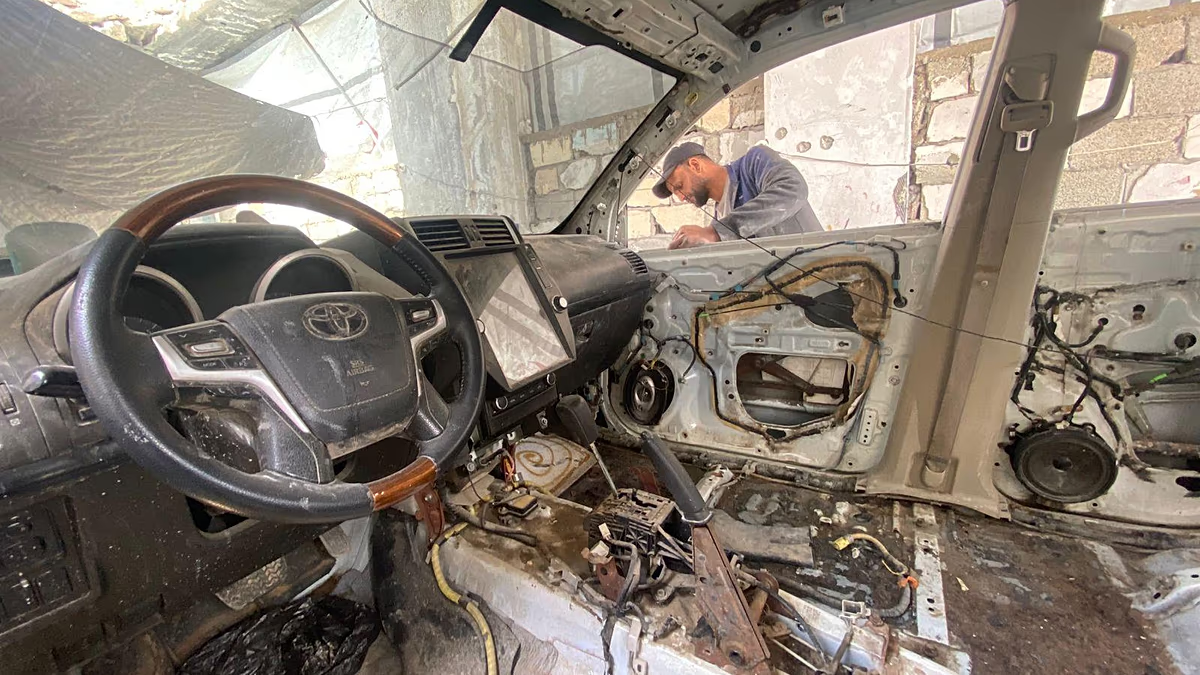
The economic reality on the ground is one of staggering inflation and scarcity. A single bus tyre can now command up to 20,000 shekels (approximately €5,725), while a battery may cost 15,000 shekels (€4,295) or more. These figures are not mere numbers but represent impossible barriers. Some drivers, in a desperate bid to maintain minimal service, have resorted to swapping tyres between vehicles, a temporary and unsafe fix, as purchasing new parts is utterly unfeasible. The market has undergone a catastrophic transformation since October 2023. It is no longer just a story of high prices; it is a story of near-total absence. Mohammed Emad, a mechanic from Nuseirat camp, details the escalation: car repairs that once cost between 2,000 and 2,500 shekels now exceed 17,000 shekels. Engine oil, per litre, has skyrocketed from about 300 shekels to over 1,000 shekels, with prices fluctuating wildly due to the ongoing conflict. The pre-war relative abundance has evaporated, leaving a void filled by desperation.
This void has been exploited by a thriving black market. Economist Ahmed Abu Qamar explains that the severe shortage of spare parts, coupled with a complete lack of regulation for the few items that are allowed in, has enabled unregulated traders to set exorbitant prices at will. The consequences ripple directly through society. The cost of a simple journey between camps in central Gaza, for example, has leapt from one shekel to five, further straining the meagre resources of a population grappling with extreme poverty. Rushdi al-Khor, Chairman of the Automotive Spare Parts Association, underscores the inadequacy of the incoming supplies. The parts that are permitted, he states, do not meet even 5% of market demand and often fail to meet basic industry standards. This reality forces people into dangerous compromises, seeking temporary solutions like improvised components, old second-hand parts, or reused oil. Specialists warn that such practices, particularly concerning braking systems and tyres, drastically increase the likelihood of accidents, adding another layer of risk to already perilous lives.
The crisis extends far beyond civilian hardship, critically undermining essential public services. The spokesperson for Gaza’s Civil Defence Authority, Major Mahmoud Basal, delivers a grave warning: the agency’s operational capacity has fallen to just 10%. In a stark example, Gaza City now has only three operational emergency vehicles remaining. A report from August 2025 revealed that 60% of Civil Defence vehicles across the Strip had gone out of service due to shortages of fuel and spare parts. Faced with no alternatives, teams have been forced to resort to using recycled motor oil in their vehicles—a practice known to cause significant engine damage and drastically shorten operational lifespans. The agency has cautioned that if the situation deteriorates further, first responders may have to reach fires, rescues, and incident sites on foot or rely on borrowing civilian vehicles, severely delaying response times in emergencies where minutes are critical.
With ongoing restrictions persistently limiting the flow of goods and aid, the shortage of spare parts is expected to worsen, entrenching a cycle of immobility. Residents are becoming dependent on increasingly limited and increasingly dangerous transport options for every aspect of daily life: accessing healthcare, reaching workplaces, obtaining food aid, and visiting family. Economists warn that if this situation persists, it could lead to a near-total paralysis of the entire transport and services sector. Such a collapse would not only deepen the economic stagnation but would directly undermine people’s access to hospitals, essential services, and the means to secure a livelihood. The transportation paralysis is thus not an isolated issue; it is a systemic failure that compounds every other aspect of the humanitarian crisis, trapping the population in a state of suspended animation.
The stalled vehicles across Gaza are silent symbols of a broader stagnation. They represent broken promises of ceasefire terms, a collapsed commercial infrastructure, and the profound vulnerability of a population cut off from the means of motion and recovery. From the bus owner watching his fleet rust, to the mechanic unable to source a safe tyre, to the emergency worker pouring used oil into a fire engine, the story is unified by a scarcity of the most fundamental components. This crisis of spare parts, unfolding amid a backdrop of wider deprivation, illustrates how logistical restrictions can strangle a society’s basic functions. It warns of a looming point where not just vehicles, but the very mechanisms of community and survival, grind to a halt, leaving Gaza’s people isolated not only by geography but by immobility itself.