

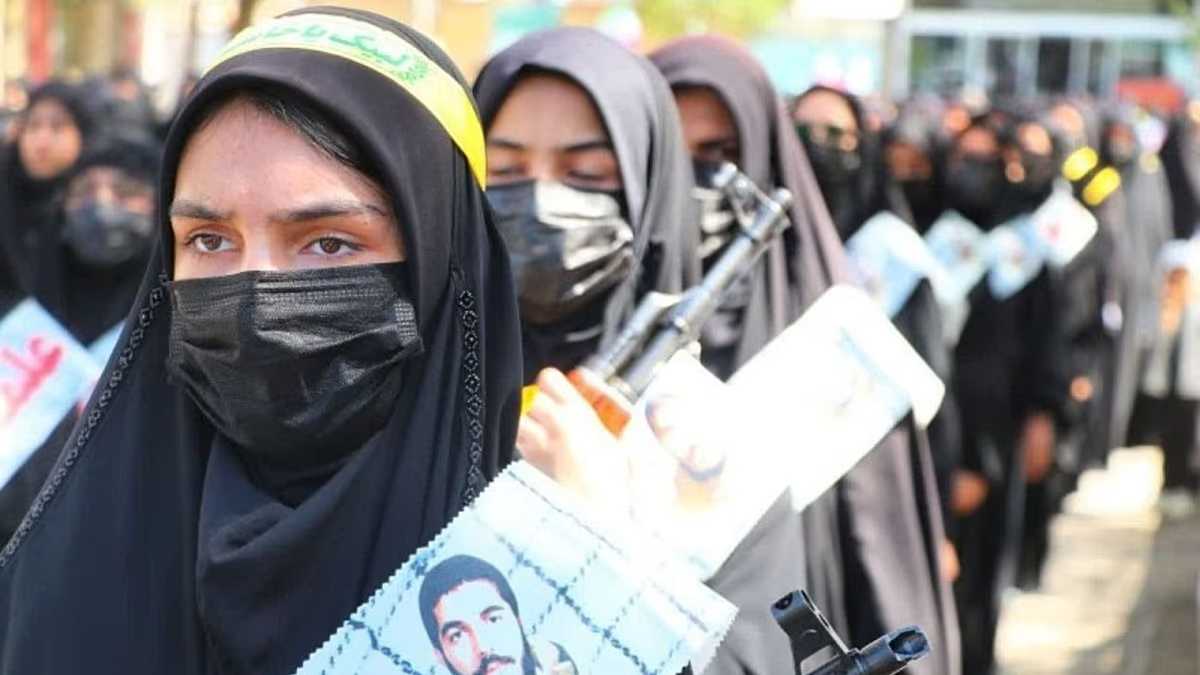
In scenes that challenge conventional narratives of Iranian society, recent videos circulating online depict women openly carrying Kalashnikov rifles and riding in armored vehicles through the streets of major cities like Tehran, Mashhad, and Qom. These displays, promoted by Iranian state media, are framed as evidence of women’s active participation in the nation’s military efforts. The footage shows organized convoys where women, sometimes alongside personnel from the Islamic Revolutionary Guard Corps (IRGC), are heard chanting pro-regime slogans. State television has broadcast these clips, with IRGC-affiliated outlets labeling the phenomenon part of a “jihad of women” in support of the Islamic Republic. This portrayal represents a significant, visible shift in the official imagery of women’s roles within the state’s power structure.
However, the authenticity of these videos has come under intense scrutiny. Researchers and social media users have pointed to visual inconsistencies, suggesting the footage may be AI-generated or digitally edited. Euronews notes it cannot independently verify the material, and Iranian authorities have not acknowledged any fabrication. Notably, some women in the videos are not wearing the full hijab mandated by Iranian law—a detail that stands in stark contrast to the regime’s decades-long, rigorous enforcement of dress codes. This anomaly raises questions about whether the images are carefully crafted propaganda rather than genuine documentation, intended to project a specific message both domestically and internationally.
The use of women in state propaganda is a longstanding tactic for the Islamic Republic, but their depiction has typically been confined to supportive, non-combatant roles. Since the 1979 revolution, official media have celebrated women as “mothers of martyrs” or as volunteers in the Basij paramilitary force, often in the background. During the Iran-Iraq war in the 1980s, such imagery reinforced women’s roles within the framework of sacrifice and motherhood. The current footage, featuring women openly bearing arms in military parades, marks a distinct departure from this historical pattern. It suggests a deliberate attempt to recast women as frontline participants in the nation’s defense, a symbolic elevation meant to convey unity and resolve.
This propaganda campaign unfolds against a backdrop of severe domestic crisis. Prior to the current war, Iran faced widespread unrest. Protests that began in December 2025, triggered by economic collapse, spread to at least 180 cities. A brutal crackdown by security forces followed on January 8 and 9, 2026, resulting in a significant loss of life. Iran’s Supreme Council of National Security reported a death toll of 3,117, but the UN Special Rapporteur on Iran estimated at least 5,000 fatalities. Insiders and human rights organizations fear the actual number could be as high as 32,000. The regime has maintained an internet blackout since January 8, severely restricting information flow and isolating the population from global discourse.
In this context, the videos of armed women appear to be a strategic tool for the regime. Facing both internal dissent and external military pressure from the United States and Israel, the Iranian government is attempting to project an image of popular support, religious fervor, and unshakeable stability. The portrayal of women—a segment of society that has historically been both controlled and mobilized by the state—taking up arms serves to manufacture a narrative of national unity and voluntary mobilization. It is an effort to counter perceptions of vulnerability and to present the regime as one capable of harnessing every segment of society for its war effort.
Ultimately, these videos, whether authentic or manipulated, function as a potent piece of political theater. They seek to reshape the visual language of the Iranian state’s power, moving women from symbolic mourners and supporters to apparent combat-ready defenders. This imagery is designed for domestic consumption to bolster morale and for international viewing to demonstrate resilience. However, the questions surrounding their authenticity, coupled with the stark reality of the regime’s recent violent crackdown and ongoing internet suppression, reveal a deeper story. It is a story of a government leveraging every available medium, including potentially digital fabrication, to craft a narrative of strength and cohesion amid profound internal turmoil and external conflict.