


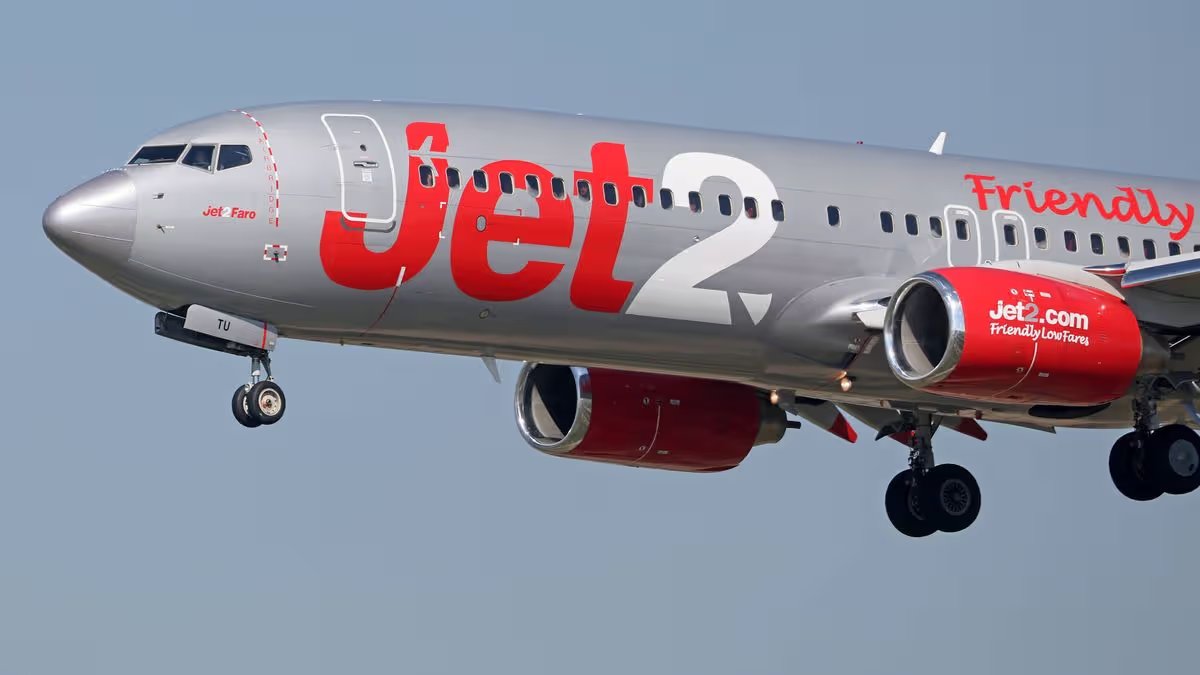
In a swift and unsettling turn of events, a routine holiday flight from the heart of England to the sunny shores of Crete was dramatically interrupted, transforming a morning of anticipation into one of tense procedure and remarkable professionalism. Jet2 flight LS443, carrying passengers from Leeds Bradford Airport with dreams of Greek sunshine, had only just begun its climb into the skies on Monday morning when nature intersected with technology in a startling way. Shortly after its 9am departure, the aircraft experienced a bird strike—a potentially hazardous event where a bird is ingested into an engine or collides with the airframe. Faced with this immediate situation, the flight crew made the decisive and correct call to abort their planned ascent, declaring an emergency to prioritize the safety of everyone on board. The pilots then expertly diverted the Airbus A320 to Manchester Airport, where it touched down safely at 9:53am, bringing the initial crisis phase to a calm and controlled conclusion just under an hour after it had begun.
For the passengers seated inside the cabin, the incident shifted from a theoretical possibility to a visceral reality in a split second. Alex, a traveler from Baildon, provided a firsthand account to the Yorkshire Post that paints a vivid picture of those alarming moments. He described hearing a “very loud bang” from the aircraft, an unmistakable sound that undoubtedly sent a jolt of fear through the cabin. This was immediately followed by an olfactory assault—the distinct and unsettling smell of burning feathers and flesh, a stark confirmation of what had occurred. Instead of continuing toward the Mediterranean, the passengers found themselves in a holding pattern north of Manchester Airport, circling at 10,000 feet for approximately an hour. This period of waiting, while surely anxiety-inducing, was a necessary prelude as air traffic control and the flight crew worked in concert to prepare for a safe landing, managing fuel loads and ensuring all protocols were followed.
The professionalism inherent in modern aviation was on full display upon the aircraft’s arrival at Manchester. As a standard and prudent precaution, emergency crews were standing by, ready to respond as the plane completed its approach. Alex noted that they landed “heavy,” a term indicating the aircraft touched down with more fuel than usual for a landing, a direct result of not having had the opportunity to burn it off during the intended long-haul flight. Fire engines and inspection vehicles met the jet at the end of the runway to conduct a thorough external assessment, particularly focusing on the affected engine and the landing gear, before the passengers were permitted to disembark. This scene, while dramatic to envision, is a well-rehearsed part of aviation safety drills, designed to ensure no hidden damage compromises the safety of passengers as they exit the aircraft.
Thankfully, the story did not end on the tarmac with an emergency inspection. The resilience of airline operations and the focus on passenger care quickly came to the fore. After disembarking from the stricken aircraft, the passengers were escorted to a replacement Airbus A320 that had been arranged by Jet2. This logistical maneuvering ensured the travelers’ holiday plans were disrupted as minimally as possible. Remarkably, by lunchtime—just a few hours after their unexpected descent into Manchester—the same group of passengers was back in the air, finally en route to Heraklion, Crete. This efficient recovery highlights the robust contingency planning airlines maintain, showing that even serious incidents can be managed with minimal long-term impact on customers, turning a frightening event into a testament to operational preparedness.
Bird strikes, while alarming, are a known risk in aviation and are factored into aircraft design and pilot training. Modern jet engines are rigorously tested to withstand impacts, and pilots undergo extensive simulation training for such scenarios. The fact that this incident culminated in a safe landing and a resumed journey is a direct result of this overarching culture of safety. It underscores a critical reality of air travel: while the journey is highly automated and incredibly safe, it ultimately relies on the skilled judgment of human crews who are trained to respond calmly and effectively to the unexpected, transforming potential tragedies into manageable incidents. This event on LS443 serves as a powerful, real-world example of that system working exactly as designed.
In our contemporary, hyper-connected news environment, stories like this one from Flight LS443 unfold in real-time for a global audience. The original report, tagged as breaking news, illustrates the modern media lifecycle—a first alert is swiftly updated with passenger accounts and official details, creating a narrative that evolves by the minute. This immediacy fulfills a public desire for information while also demonstrating the challenging balance media outlets must strike between speed and accuracy. For the passengers, the episode was a frightening interruption; for the world watching, it became a case study in aviation safety and crisis management. Their journey continued, a reminder that even when faced with the sudden, loud bang of the unexpected, structured procedures and human expertise can guide us smoothly back to our intended path.