


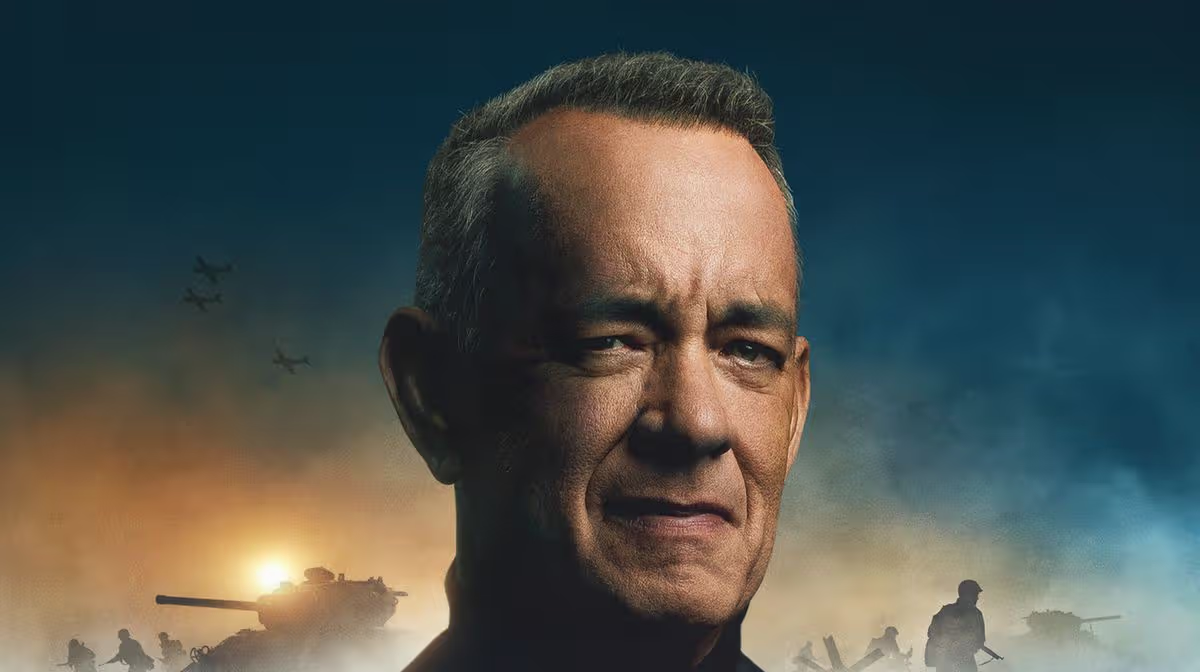
The resonant voice of Tom Hanks, an actor synonymous with some of cinema’s most profound World War II narratives, is now guiding us through the conflict’s vast history in a monumental new documentary series. For Hanks, this project is a deeply personal culmination of a lifelong fascination. Since childhood, he observed that every adult in his world carried a shared ghost: the six-year gap when “time itself seemed to stand still” as the globe burned. This period, which divided lives irrevocably into before, during, and after, left an indelible mark on culture and collective memory. Now, he channels that awe into “World War II with Tom Hanks,” a twenty-part series that promises not just to recount history, but to revive it through newly uncovered archival footage and state-of-the-art restorations, offering viewers a visceral connection to the past.
Hanks’s commitment to this era extends far beyond narration; it is an artistic and moral pursuit. With acclaimed roles in Saving Private Ryan and Greyhound, and his pivotal involvement in Band of Brothers, he has long served as a steward for these stories. He argues that the necessity for such a series lies not in repetition, but in revelation. There remains, he insists, a “ton of footage we have never seen”—celluloid sequences that extend beyond the familiar clips, providing fresh context and continuity. This visual storytelling, he believes, showcases events with an unvarnished truth that modern narratives often finesse, allowing history to speak for itself in its raw, unedited form.
At the heart of Hanks’s engagement is a profound ethical conviction: World War II remains the ultimate yardstick for measuring human character. He posits that the conflict presents a clear dichotomy between heroism and villainy, defined not by ideology but by behavior. The racist, enslaving ambitions of Nazi Germany and Imperial Japan were ultimately challenged by democracies that rallied to defend fundamental freedoms. For Hanks, studying this period is essential because it answers the urgent question, “What is right and wrong?” It provides a timeless framework for evaluating our actions, emphasizing that the principles defended then are the same ones that safeguard human dignity today.
Hanks’s personal history is woven into this tapestry. Growing up, the war was not distant history but a living memory, recounted by his father, teachers, and friends’ parents. It permeated his world through television shows like Combat!, documentaries such as The World at War, and films like The Great Escape. These stories were his “non-fiction entertainment,” shaping his understanding of courage and sacrifice. He recalls vivid anecdotes, like that of his trigonometry teacher, a B-17 navigator whose skill miraculously guided a lost plane through fog to a perfect landing at Pearl Harbor—a testament to the individual heroism that peppered the broader saga.
The series also delves into the dangerous parallels between the past and our present geopolitical climate. It examines the rise of Nazism, detailing how Germany’s post-World War I economic despair—where a loaf of bread could inflate to 80 billion Marks—and the Great Depression created a vacuum for extremist promises. This historical context serves as a stark warning against the resurgence of such forces today. Hanks hopes the documentary will make viewers of all generations grasp the immense danger of that era and marvel at the sheer audacity of those who attempted to “save the world.” The series features historians he calls “grand storytellers,” whose narratives are anchored by incontrovertible facts, rendering the grim reality of the war with chilling clarity.
Ultimately, “World War II with Tom Hanks” seeks to be both an education and a remembrance. It aims to bridge the gap between the statistical enormity of the conflict—over 65 million lives lost—and the human stories within it. By presenting newly restored footage and expert insights, the series invites us to ask, “How in the world did people do that?” It is a question that underscores not just the strategic and political dimensions of the war, but the profound resilience of the human spirit. Through Hanks’s heartfelt narration and the series’ expansive scope, this project ensures that the lessons of history remain not just observed, but felt, reminding us that the freedoms we cherish were forged in a fire that consumed the world, and saved by those who dared to stand against it.