


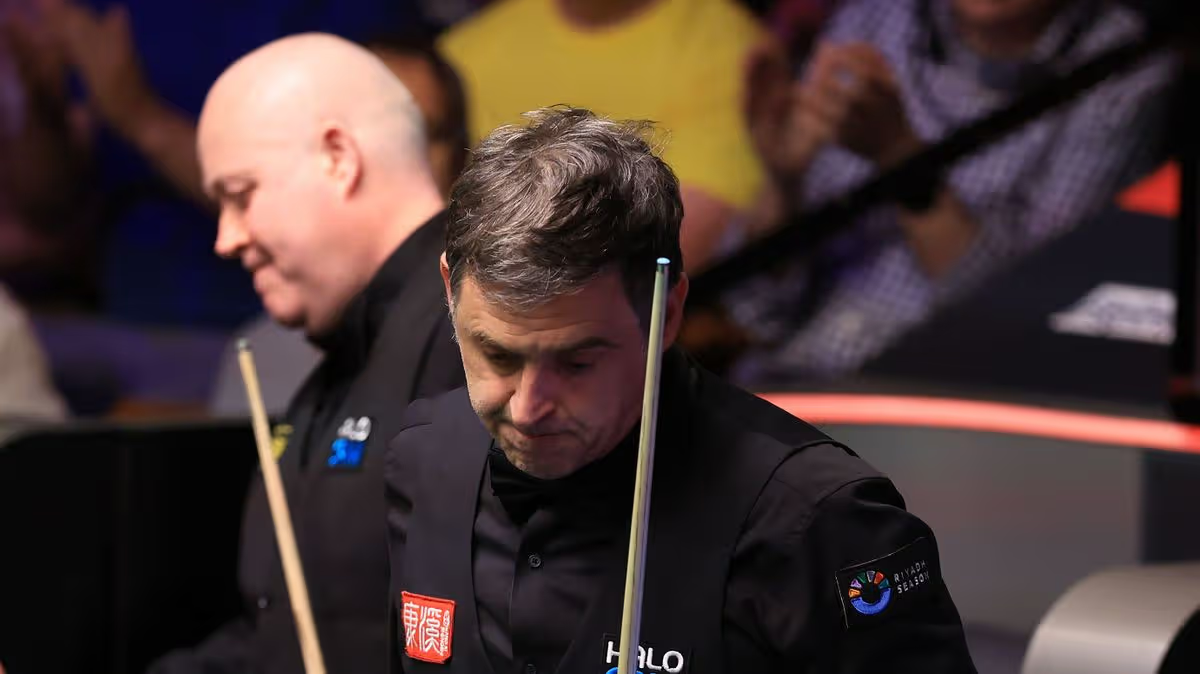
In a dramatic and emotionally charged quarter-final at the Crucible Theatre, Ronnie O’Sullivan’s quest for a record-extending eighth World Snooker Championship title was abruptly halted by his long-time rival, John Higgins. The match, a classic encounter between two of the sport’s greatest icons, ended in a heart-stopping 13-12 victory for Higgins, who staged a remarkable recovery after seemingly being on the brink of defeat. O’Sullivan had dominated the early stages, building what appeared to be a commanding 6-2 lead after the first session and extending it to 9-4. Yet, the narrative of the contest transformed entirely as Higgins, displaying the resilience that has defined his career, methodically eroded the deficit, ultimately clinching a decider that left the arena in stunned silence. O’Sullivan’s exit was punctuated by a poignant and unusual gesture: he conceded the final frame prematurely, then departed swiftly, leaving behind a complex tapestry of admiration for Higgins’ fortitude and introspection about his own performance.
The aftermath of this high-profile defeat ignited immediate scrutiny, notably from former professional Alan McManus, who offered a candid and critical assessment of O’Sullivan’s preparation. McManus suggested that the “Rocket” had not invested the necessary long-term dedication—the “graft”—required to triumph in the sport’s most gruelling tournament. While acknowledging O’Sullivan’s enduring talent and capacity to win another title, McManus emphasized that such an achievement would necessitate a fundamental lifestyle commitment, a choice O’Sullivan has consciously avoided in recent years by scaling back his playing schedule. The pundit drew a parallel with Neil Robertson, another former champion whose form dipped after a period of reduced intensity, implying that snooker at this elite level demands continuous immersion. McManus’s comments framed the loss not merely as a tactical or momentary failure, but as a potential consequence of O’Sullivan’s broader approach to his career in its current phase.
O’Sullivan himself provided a startlingly honest and humble reflection in his post-match comments, revealing a self-awareness that contrasted with his often enigmatic public persona. He disclosed that he had booked an early flight home, doubting he would even reach the third session against such a formidable opponent. This admission underscored a perceived gap between his recent competitive experiences and the “different level” required in clashes with the sport’s top players under intense pressure. He expressed surprise at having made a genuine contest of the match, stating he felt “exposed” by the occasion but grateful to have remained competitive. His analysis was devoid of bitterness; instead, he credited Higgins’ superior play and accepted his own inability to “get the job done” when it mattered most. This gracious defeatism highlighted a veteran athlete confronting the realities of his current standing without pretense.
The psychological dimensions of the match were further illuminated by O’Sullivan’s description of his visible frustration—a moment where he struck the table with his cue after a missed crucial shot. He clarified this was not an outburst of anger but a deliberate, almost therapeutic, release of pent-up tension—a way to “delete” the error immediately and reset his mindset. This insight into his in-game mental process revealed a player managing high-stakes emotions through calculated physical expression, aiming for clarity rather than dwelling on mistakes. Such moments humanize the immense pressure these athletes endure, framing their actions not as tantrums but as coping mechanisms within a solitary and mentally exhaustive sport.
For John Higgins, this victory was another chapter in a storied rivalry, improving his Crucible record against O’Sullivan and securing a quarter-final berth against Neil Robertson. It served as a testament to his enduring class and competitive spirit, qualities that have defined his career alongside O’Sullivan’s for nearly three decades. Higgins’ ability to persevere from a significant deficit against the sport’s most gifted player reaffirmed his status as one of snooker’s ultimate competitors. The match, in its entirety, was a microcosm of their historic dynamic: O’Sullivan’s sublime talent and fluctuating intensity versus Higgins’ relentless grit and tactical prowess.
Ultimately, the encounter transcended a simple tournament result, evolving into a poignant narrative about legacy, preparation, and the evolving priorities of sporting legends. O’Sullivan’s exit, framed by external critique and his own introspective admissions, poses profound questions about what it takes to sustain excellence at the zenith of a sport. His undeniable “juice” to win remains, as McManus noted, but the path to another championship now appears contingent on choices beyond the baize. For Higgins, the triumph is a reaffirmation of his undiminished will. For snooker itself, the drama provided a timeless reminder of why these two champions remain central to the sport’s soul, their clashes weaving stories of human endeavour that resonate far beyond the final score.