

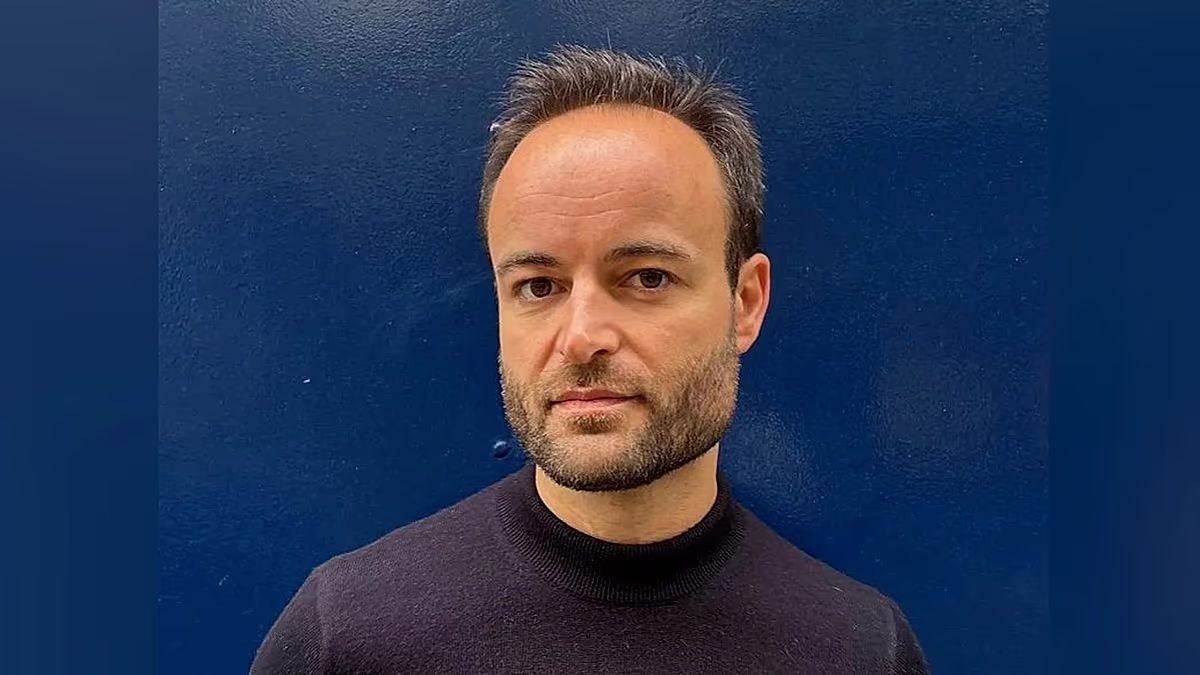
In the autumn of 2022, a 35-year-old French traveller named Louis Arnaud was arrested by Iran’s Islamic Revolutionary Guards, abruptly ending his journey around the world. His detention in Tehran’s infamous Evin Prison, a facility synonymous with torture and executions, would last for two harrowing years. Arnaud was accused of participating in the widespread protests that erupted after the death of Mahsa Amini, a young Kurdish-Iranian woman who died in custody following an arrest for an allegedly improper hijab. Though he steadfastly maintained his innocence, his pleas fell on deaf ears within the Iranian judicial system. He found himself confined in Section 209, a block reserved for political and foreign prisoners, which he later described as “the den of evil.”
Arnaud’s recollection of Evin paints a picture of deliberate, systematic dehumanization. In windowless cells where lights burned perpetually, stripping prisoners of any natural sense of time, inmates lived, ate, and slept on bare floors. Bodily searches were constant. Once a week, they were led blindfolded like animals for a mere twenty minutes of outdoor air. This environment, Arnaud explained, was a form of psychological torture designed to break the spirit and extract fantastical confessions of espionage. The pressure never ceased, even in sleep. His experience mirrored that of other French nationals detained, including Cécile Kohler and Jacques Paris, though they never directly met. On his final night in Evin, however, Arnaud found a fragile thread of connection: in a new cell, he discovered a poem by Gérard Nerval inscribed on the wall. Knowing Kohler’s background in literature, he felt certain she had left this message. Caressing the words, he felt a profound, silent solidarity—as if she had left a key for a gate to open, a momentary companionship in isolation.
The protest movement that led to Arnaud’s arrest did not stop at the prison gates; its echoes reverberated within Evin itself. News of the mass demonstrations sparked by Mahsa Amini’s death, and the subsequent hope for change, filtered into the cells. Initially, Arnaud observed a resigned sentiment among detainees: protest was futile, defeat inevitable. But this evolved into a conviction that revolution was possible and necessary. When fresh protests shook Iran in January 2026, fueled by authoritarian rule and economic crisis, they were met with brutal repression—thousands killed, tens of thousands arrested. For Arnaud, Evin thus became not just a prison but a “bastion of resistance,” where the desire for freedom persisted even under the heaviest oppression.
This spirit of resistance was personified for Arnaud through encounters with fellow detainees. In his book, La Résistance Intérieure, he details how these relationships forged his own defiance. One profound influence was an older prisoner, a participant in the 1979 revolution, who had endured repeated arrests, torture, and years of incarceration. Despite continual death threats, this man maintained an unshakeable smile and serenity, as if threats held no power over him. Witnessing this, Arnaud underwent a personal paradigm shift. He realized that his own initial obedience—pleading, lowering his eyes—could be transformed. Even in chains, in the world’s worst prison, one could refuse servitude and reject the victimhood imposed by the authorities. This “inner revolution,” a conscious choice of psychological resistance, became his key to survival.
Having now returned to France, Arnaud carries with him not only the memories of Evin but a deep sense of obligation. He emphasizes that the feeling of injustice and forced endurance is not unique to hostages; it is a universal human experience. His aim is to speak for Iranians, to amplify their struggles, and also to offer a perspective on facing life’s trials with greater serenity. Maintaining contact with those still inside Iran remains perilously difficult amid internet controls and a climate where a single social media post can lead to arrest or execution. He is therefore extremely cautious, avoiding direct questions about war or politics. His focus is purely human: to convey care, to assure Iranians they are not alone, and to carry their voice wherever he can.
Ultimately, Louis Arnaud’s story transcends a singular ordeal. It is a testament to the resilience that can emerge in the darkest places, forged through silent solidarity and conscious inner defiance. While Evin Prison stands as a monument to state oppression, Arnaud’s account reveals it also as a site where the human spirit, through shared poetry and unwavering smiles, quietly asserts its indomitable will. His journey from a blinded captive to a vocal witness underscores a universal truth: even when physically imprisoned, one can choose not to be a victim of circumstance.