

A Royal Welcome: King Charles and Queen Camilla’s Ceremonial Arrival in Washington
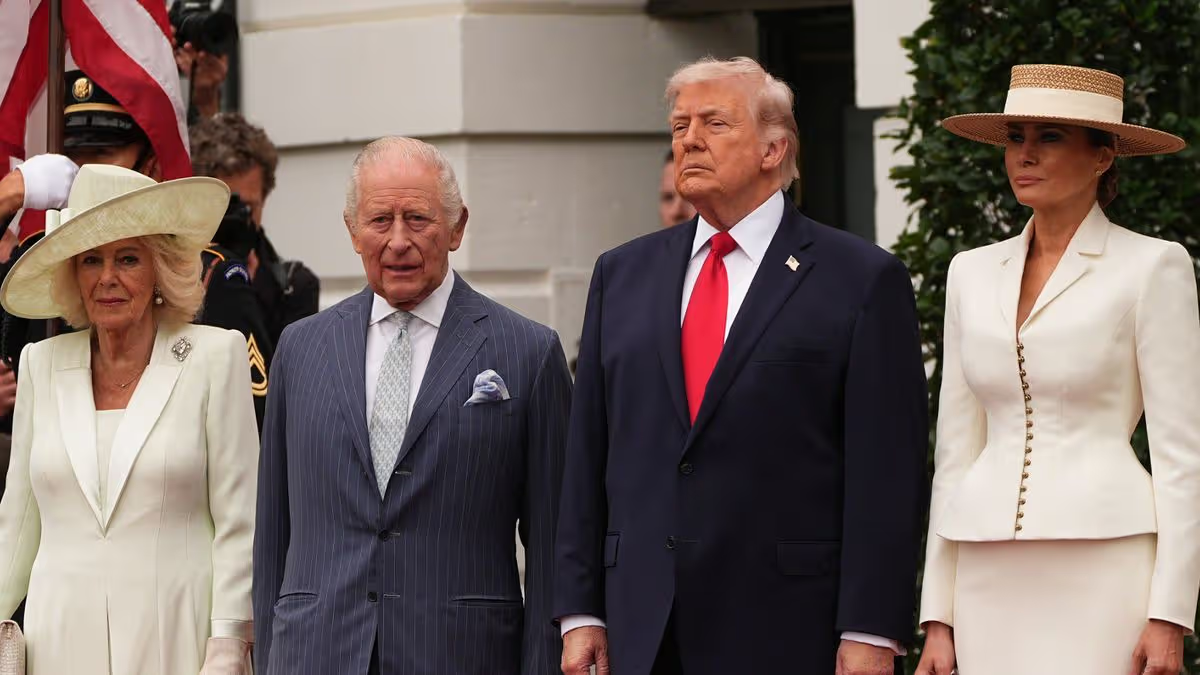
On a rain-drizzled morning in Washington D.C., a scene of historic diplomacy unfolded on the White House lawn. King Charles III and Queen Camilla, on the second day of their inaugural state visit to the United States, were formally welcomed by President Donald Trump and First Lady Melania Trump. The ceremonial event, marked by military precision and grand tradition, was nevertheless punctuated by the President’s uniquely personal and unconventional remarks, creating a moment that blended protocol with palpable human interaction. Stepping onto a dais adorned with the presidential seal, the visiting monarchs and the hosting president stood as living symbols of the enduring “special relationship” between the United Kingdom and the United States.
President Trump commenced his address by humorously acknowledging the grey skies overhead, quipping, “What a beautiful British day this is,” a nod to the famously inclement weather often associated with the United Kingdom. He expressed his “tremendous privilege” in hosting the royal couple and warmly praised the King as a “very elegant man.” His speech then took a more personal turn, weaving in affectionate memories of his late mother. He recounted how she was “glued to the television” for any royal ceremony, deeply admiring Queen Elizabeth II. With a candid smile, he then revealed, “I also remember her saying very clearly, ‘Charles, look young Charles, he’s so cute’. My mother had a crush on Charles.” This unexpected confession prompted a coy, slightly embarrassed blush from King Charles, a human moment of warmth that momentarily unfastened the stiff collar of formal statecraft.
The President seamlessly transitioned from personal anecdote to public tribute, honoring the late Queen Elizabeth II, whom he described as “an incredible” and “very special woman.” He recalled her planting a young tree on the White House grounds during a past visit, symbolizing the growth and longevity of the Anglo-American alliance. “Look at it now,” he remarked, framing the enduring bond as a living, growing entity. This poignant reflection served as a bridge between the past reign and the present one, acknowledging the weight of history Charles carries while celebrating the continuity represented by his visit.
Following the speech, the royal party and the First Family moved to the balcony of the South Portico to observe a majestic “Pass in Review” – a procession of nearly 500 members of the U.S. Armed Forces. As the bands played and troops marched, a brief, informal exchange between the President and the King was captured. Lip-reading experts suggested King Charles remarked the display was “wonderful,” to which Trump agreed, “Isn’t it beautiful?” The King concurred, “It is very nice indeed.” Trump, ever the showman, then boasted, “A lot of good work has gone into it,” a comment to which Charles responded with a simple, acknowledging “Ah.” This snippet of conversation highlighted the behind-the-scenes effort inherent in such grand state productions and the easy, if slightly awkward, camaraderie between the two leaders.
Perhaps the most notable breach of expected protocol came when President Trump discussed the King’s imminent address to a joint session of Congress – a first for a British monarch. “I would love to be with you,” Trump confessed. “I was thinking of going, but they said ‘I don’t know that might be a step too far’… It’s not supposed to be protocol, but I would love to be with you.” This frank admission underscored Trump’s characteristic disregard for traditional boundaries and his desire to share in the historic moment, even if custom forbade it. It painted a picture of a president eager to both host and participate, blurring the lines between observer and protagonist in the day’s events.
In totality, the ceremonial welcome was a spectacle of two nations’ intertwined history and mutual respect, performed with military honor and regal grace. Yet, it was President Trump’s idiosyncratic asides – the familial memory, the personal compliment, the confessed desire to break protocol – that injected the occasion with an unmistakably human texture. These moments transformed the event from a strictly formal tableau into a memorable encounter, illustrating how even the most scripted state visits can be shaped by the personal tones and unconventional styles of the individuals at their heart. The rain-soaked lawn, the marching soldiers, and the shared smiles ultimately told a story not only of alliance but of the unpredictable and personal nature of international diplomacy.