

In a significant milestone for European industry and strategic autonomy, Finland has become the first nation on the continent to establish a complete, domestic lithium production chain. This integrated cycle, encompassing everything from the raw ore in the ground to refined battery-grade material, is centered in the western region of Ostrobothnia. The heart of the operation is the Syväjärvi open-pit mine near the town of Kaustinen, which will feed a nearby concentrator and refinery to produce lithium hydroxide, a critical component for the lithium-ion batteries powering our modern world. As declared by the Geological Survey of Finland, this achievement marks a pivotal shift, moving Europe from a position of almost total import dependency to having its own controlled source of this essential resource, often dubbed the “white gold” of the 21st century.
The project, a €783 million venture operated by the Finnish company Keliber, is driven by a clear geopolitical and economic imperative. Keliber’s CEO, Hannu Hautala, emphasizes that the development “increases the independence from imports from, for example, Asian countries and Australia.” Currently, China dominates the global lithium processing market, creating a strategic vulnerability for European ambitions to lead in electric vehicle and clean technology manufacturing. Backed by an 80% ownership stake from the South African mining giant Sibanye-Stillwater and 20% from the state-owned Finnish Minerals Group, with additional financing from the European Investment Bank, the initiative is more than a commercial endeavour. Sibanye-Stillwater CEO Neal Froneman acknowledged that while the mine itself is “quite small,” it is “very, very important” strategically, representing a key foothold in building a resilient European battery ecosystem.
On the ground in Kaustinen, a tranquil municipality of just over 4,000 people known for its folk music tradition, the arrival of a major industrial project has stirred complex emotions. The promise of up to 300 direct jobs is a powerful positive for the local economy, as noted by music teacher Pilvi Järvelä. Yet, this optimism is tempered by widespread apprehension. Residents naturally worry about the environmental footprint of an open-pit mine and chemical processing plant, concerned about potential impacts on water quality, biodiversity, and the serene landscape that defines their community. This tension between economic opportunity and environmental stewardship is a microcosm of the broader challenge facing the global energy transition.
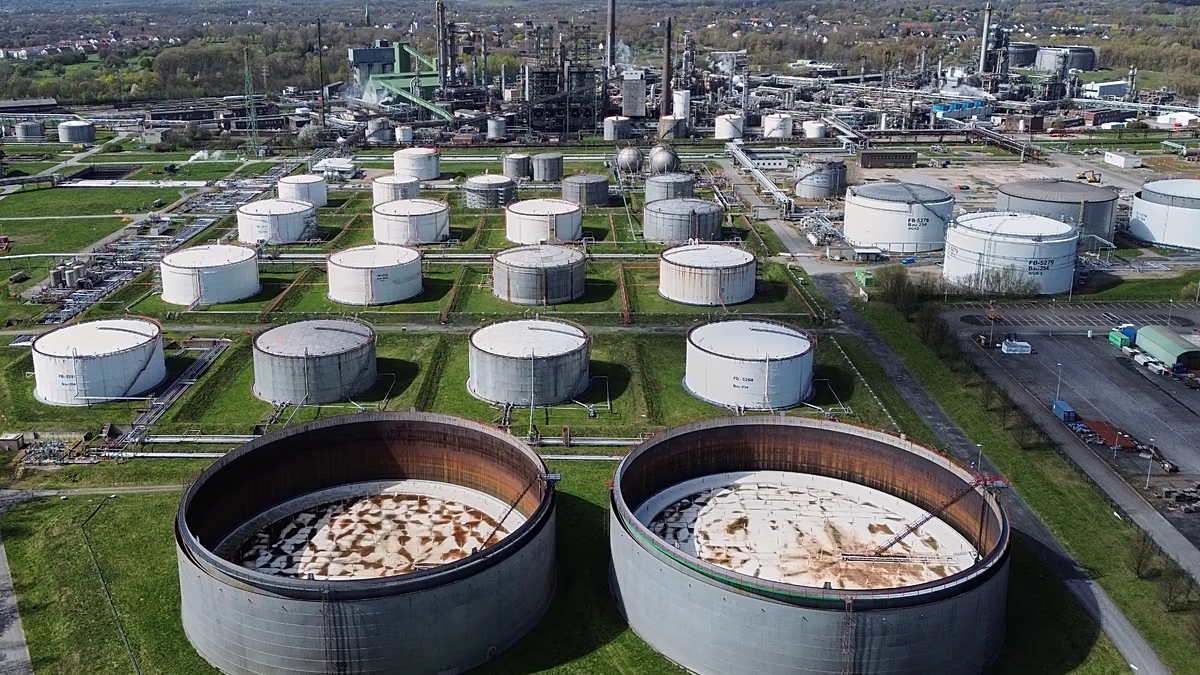
Technically, the project is progressing with tangible milestones. At the refinery, technical director Sami Heikkinen reports that test runs are already underway. If the schedule holds, the first batches of final product—described as resembling “white sugar crystals”—could be bagged by the end of the year, ready for shipment in large sacks. The fully operational refinery aims to produce approximately 15,000 tonnes of battery-grade lithium hydroxide annually. While this is a substantial output, it is estimated to meet only about 10% of Europe’s current demand, underscoring that this is a foundational first step rather than a complete solution. The compact, integrated model, with all stages of production within a 43-kilometre radius, is designed for efficiency and sets a new benchmark for future European critical mineral projects.
The significance of Finland’s move extends beyond its borders, serving as a test case for the European Union’s broader critical raw materials agenda. While other European nations like Portugal and the Czech Republic possess lithium reserves, Finland is the first to successfully navigate the regulatory, technical, and logistical challenges to create a fully localized supply chain from mine to market. This pioneering effort demonstrates the feasibility of such projects within Europe’s stringent environmental and social governance frameworks. It provides a blueprint that other member states may follow, potentially weaving a network of domestic production to collectively reduce continental reliance on distant and geopolitically concentrated supply chains.
In conclusion, Finland’s breakthrough in lithium production is a story of modern necessity meeting Nordic innovation. It balances the urgent global drive for electrification with the meticulous planning characteristic of Finnish industry, all while navigating the legitimate concerns of local communities. The path forward will require continuous attention to environmental safeguards and community dialogue. Yet, the successful activation of this full production cycle offers a promising glimpse into a more self-reliant European industrial future, where the batteries for its clean energy transition are powered, in part, by resources refined under its own skies.