



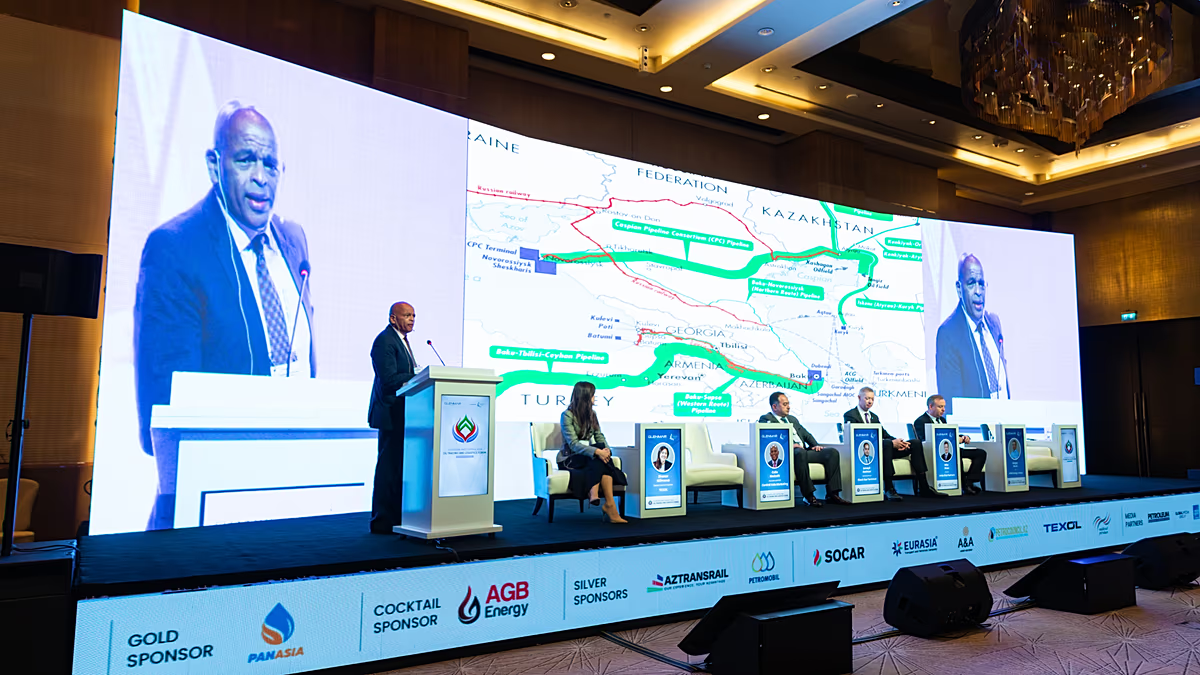
The global oil market is undergoing a profound transformation, and for producers in the Caspian and Central Asia, this means navigating a new world defined by speed and unpredictability. The era of predictable, long-term contracts is giving way to a more fluid, demand-driven trading environment. As experts gathered at a recent industry forum in Baku highlighted, this shift is both a source of significant challenge and potential opportunity. The traditional export models that once provided stability are being strained, forcing a clear pivot towards operational flexibility. In this new reality, the ability to react quickly to short-term market signals is becoming more valuable than the security of long-term agreements, fundamentally altering how these landlocked regions connect to the world.
At the heart of this new dynamic is the undeniable gravitational pull of Asia. Refining hubs in China and India are now the dominant forces driving global crude demand and increasingly setting pricing structures. Suppliers from Kazakhstan, Azerbaijan, and beyond are adjusting their strategies to respond to these powerful signals, chasing arbitrage windows—price differentials between regions—that can open and close with startling speed. This focus on Asia is reshaping trade flows and compelling producers to become more agile. As one trader noted, in such a volatile climate, adaptability is paramount, even if the long-term expectation is for a return to some stability. The market is learning that survival now depends less on forecasting the distant future and more on sensing and seizing immediate opportunities.
Infrastructure, the physical backbone of these nations’ economies, is under steady pressure to adapt. The major pipelines—like the CPC route for Kazakh crude to the Black Sea and the BTC corridor for Azeri oil—remain critically important arteries. However, beyond these fixed points, attention is turning to broader connectivity, particularly the road and rail networks being expanded under China’s Belt and Road Initiative. These investments, amounting to tens of billions of dollars, are dramatically improving overland corridors, opening new possibilities for multi-modal transport. A symbolic milestone was recently achieved with the first dry cargo shipment from Kyrgyzstan reaching Pakistan via these new routes, proving that even difficult paths are becoming viable. This evolving infrastructure web offers an alternative to pure pipeline dependency, adding a layer of strategic optionality for the region.
Yet, for moving vast volumes of oil, geography and risk still impose hard limits. Pipelines through Iran or toward China are often seen as more viable for crude than long-haul truck or rail journeys, which face greater logistical and security hurdles. Furthermore, ongoing uncertainty in Afghanistan continues to limit its potential as a straightforward transit corridor, postponing some integrated regional visions. Despite these constraints, the long-term demographic and economic imperative is clear. As one expert emphasized, Central Asian states cannot afford to ignore adjacent markets like Pakistan, with its population of 240 million and rapid growth. The calculus is shifting toward viewing massive infrastructure investments not as mere costs, but as essential bets that will pay out over decades, linking energy-rich regions with the world’s future demand centers.
Adding another layer to this competitive landscape is the growing importance of crude quality over simple volume. Caspian crude, particularly grades like Kazakhstan’s and Azerbaijan’s flagship Azeri Light blend, is gaining a competitive edge. This oil is exceptionally well-suited to what modern refiners, especially in Europe, urgently need: the ability to produce higher yields of cleaner middle distillates like diesel and jet fuel. In a tightening market, producers are finding that the specific characteristics of their resource can command a premium. Azeri Light, for instance, is not just another barrel; it is a key component for refineries aiming to meet stringent environmental standards and consumer demand for cleaner end-products. This quality advantage provides a crucial buffer against pure price competition, anchoring the region’s relevance in a changing energy landscape.
Finally, no region operates in isolation, and the Caspian is feeling the ripple effects of global disruptions, even hundreds of miles from the world’s maritime chokepoints. Tightened tanker availability, soaring freight costs, and increased insurance premiums are squeezing margins across the entire trading system. These external shocks amplify the inherent volatility, creating a complex environment where every participant is simultaneously trying to adjust. The overall picture emerging is one of an industry in active recalibration. Producers are rethinking exports, traders are scanning for fleeting opportunities, and infrastructure is being assessed for flexibility as much as for capacity. In this new equation, responsiveness is the defining capability. As the forum concluded, volatility does create niches for the agile, but it also forces a fundamental rethink of how to operate. For the Caspian and Central Asian oil sector, that rethink is fully underway, with Asia’s demand, strategic infrastructure, and inherent crude quality forming the core variables of their rapidly evolving future.