



The Unending Journey: Flight Upon Flight for Lebanon’s Displaced
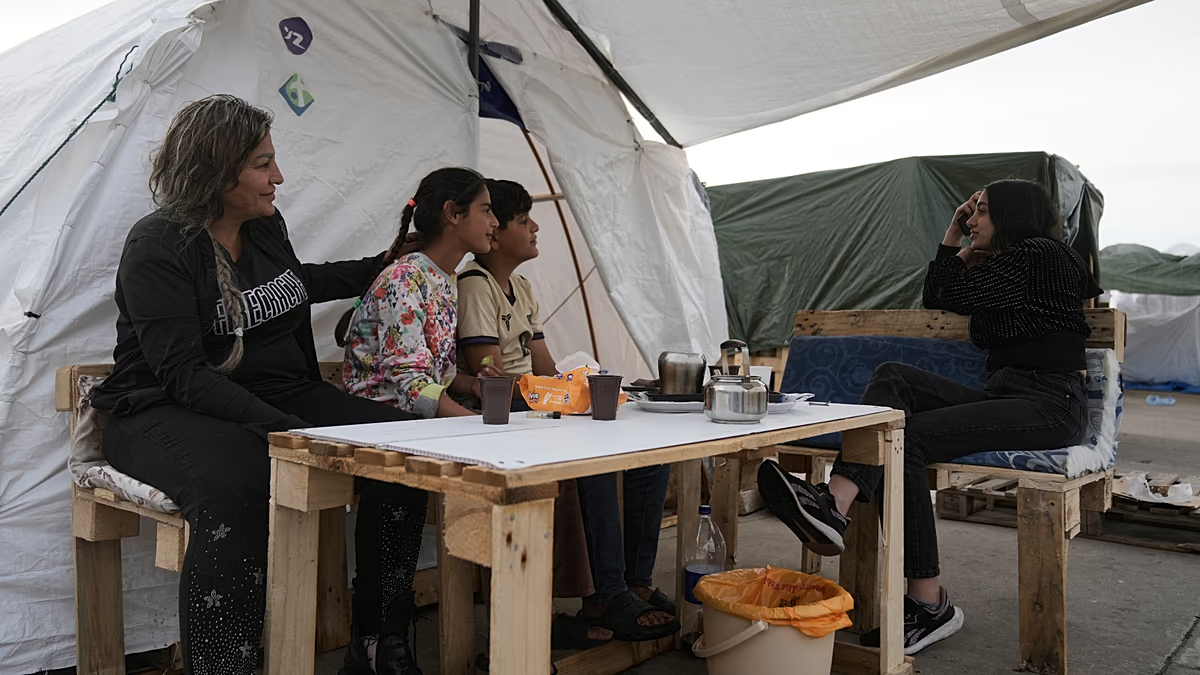
The delicate and temporary calm that settled over parts of southern Lebanon and the southern suburbs of Beirut proved to be just that—temporary. For families who had dared to hope, who had briefly returned to their homes during a fleeting ceasefire, the nightmare has reset. Renewed warnings and the ever-present threat of escalation have triggered a desperate, familiar exodus. This time, the flight has brought them not to a distant village or a crowded school shelter, but to the very edge of their capital, to the corniche of Beirut. Here, against the incongruous backdrop of the Mediterranean’s calm horizon, a new landscape of despair is forming. Makeshift tents, pieced together from tarpaulins and scavenged wood, dot the coastline. Families huddle in cars parked permanently along the seawall, their vehicles now serving as bedroom, kitchen, and living room. The footage is a stark tableau of a profound human crisis: children playing on concrete where there was once grass, laundry strung between palm trees, and the endless, weary routine of daily survival conducted entirely in the open, under the watchful eye of an uncertain sky.
This latest displacement is not a first chapter, but a heartbreaking sequel in an ongoing story of loss. Many of these families are not experiencing flight for the first time; they are experts in it. They had already endured the trauma of initial evacuation, the destruction of their neighborhoods, and the harrowing journey to perceived safety. The ceasefire had offered a sliver of opportunity—a chance to check on homes, to gather precious remnants of their past lives, to simply stand on familiar ground. What they found, for many, was only rubble and confirmation of their deepest fears. Then, as tensions reignited, they were forced to make the agonizing decision all over again: to leave, carrying with them the compounded weight of two flights. The psychological toll of this cycle—hope brutally punctuated by renewed peril—is immense. Each journey strips away another layer of resilience, replacing it with a deep-seated uncertainty that corrodes any sense of future stability.
Life in the encampment along the waterfront is a daily exercise in indignity and hardship. The sea breeze, once a source of leisure, now carries the smell of improvised living. The basic, private acts of life—washing, cooking, sleeping, comforting a child—are performed in full view, without walls or security. Washing clothes in buckets, relying on erratic charitable aid for food, and sleeping in crowded tents subject to the elements define the new normal. The children, whose laughter might momentarily lighten the air, are growing up in a world where “home” is a transient concept, where stability is a fleeting memory recounted by their parents. The adults bear the relentless stress of providing and protecting in an impossible situation, their faces etched with the exhaustion of people who are physically present but exist in a state of perpetual limbo, their lives indefinitely on pause.
In conversations tinged with both resignation and sparks of enduring dignity, the displaced residents share fragments of their reality. They speak not in abstract geopolitical terms, but of the tactile loss of their neighborhood bakeries, their children’s schools, the particular tree that shaded their courtyard. They describe returning during the ceasefire to find not just houses destroyed, but the very fabric of their community—the networks of support, the shared history, the sense of belonging—obliterated. Now, on the Beirut shoreline, they face the pressing, unanswered question that hangs over every meager meal and restless night: What next? The tension persists, a specter that makes planning impossible. There is no clear destination, no timeline, no promise of return. The unknown stretches before them as vast and as daunting as the sea beside their tents.
This waterfront encampment is more than a cluster of shelters; it is a powerful, silent testament to a human cost that exists beyond casualty figures and territorial disputes. It represents the cascading consequences of protracted conflict: the erosion of normalcy, the shattering of community bonds, and the deep trauma of being perpetually unmoored. These families are caught in a brutal limbo, physically displaced and psychologically suspended between a past they cannot return to and a future they cannot envision. The international community often views such crises through the lens of temporary humanitarian need, but for those living it, this state of impermanence becomes their life, with no end in sight.
Ultimately, the story of these families on the Beirut corniche is a stark reminder that the truest measure of any conflict is found not on maps, but in the disrupted lives of ordinary people. Their forced migration, repeated and exhausting, underscores a devastating truth: in the absence of lasting political resolution, human beings become permanent casualties, their lives reduced to a cycle of flight and precarious shelter. As long as the roots of tension remain unaddressed, the shore will continue to host these pockets of despair, and the resilience of these families will be tested not by a single catastrophe, but by the unrelenting grind of an indefinite exile. Their presence there is a silent, profound plea for a stability more durable than canvas, and a future defined by something other than fear.