


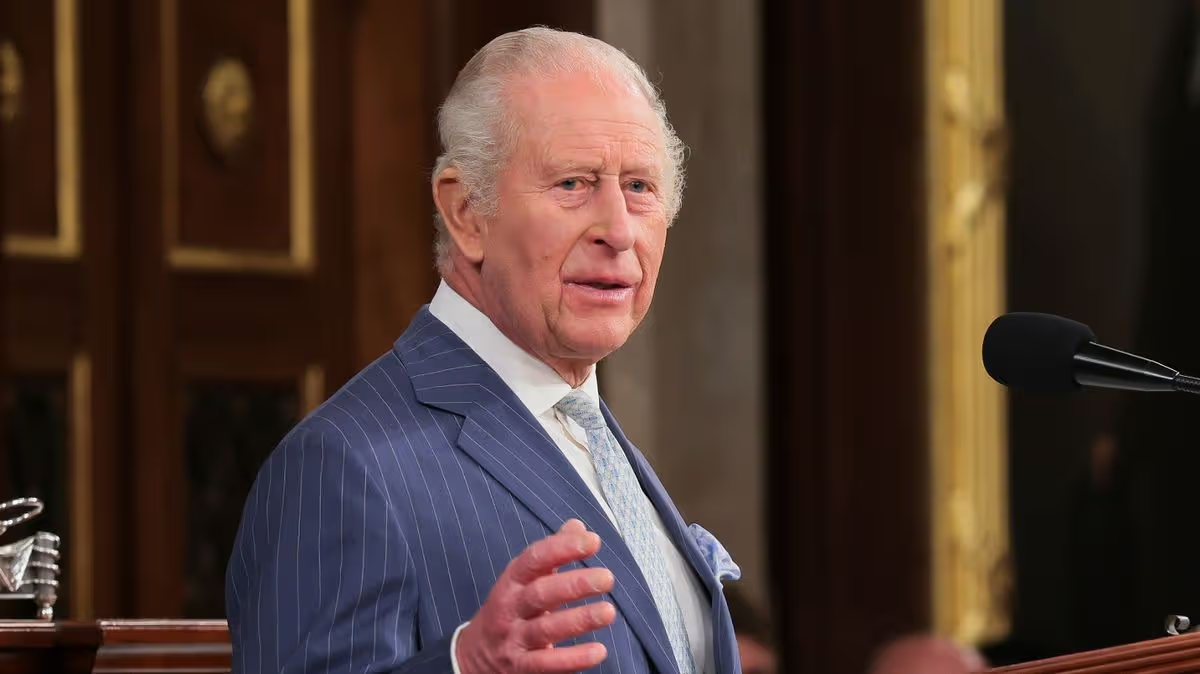
King Charles III delivered a poignant and politically nuanced address to a joint session of the U.S. Congress, masterfully blending the ceremonial weight of his office with a message of urgent global cooperation. Standing before the American legislators, the monarch reflected on the deep historical bonds between the United Kingdom and the United States, a “special relationship” forged through shared trials and triumphs. However, he moved beyond mere nostalgia to issue a forward-looking plea, urging both nations to “stand united in our commitment to uphold democracy, to protect all our people from harm” amidst what he described as changing and often turbulent times. While his words were diplomatically crafted for the formal occasion, they carried a clear, gentle challenge to the prevailing “America First” philosophy, advocating instead for a renewed Atlantic alliance dedicated to confronting shared global challenges. The speech, which lasted twenty minutes and was punctuated by twenty-two rounds of applause, was not just a diplomatic exercise but a performance that showcased a monarch fully in command of his public role.
According to body language expert Bruce Durham, the King’s physical demeanor was instrumental in the address’s powerful impact, transforming it from a standard royal speech into a masterclass in soft diplomacy. Durham observed that Charles appeared profoundly in his element, a stark contrast to his more reserved demeanor upon arriving in Washington the previous day. The expert noted that the lectern served as the King’s “sweet spot,” a space where he felt completely comfortable and in control. From this position, Charles was able to deliver his prepared remarks with conviction and panache, his experienced affability putting the audience at ease. This controlled environment allowed him to focus on the nuanced delivery of his message, using his presence to build rapport and underscore his sincerity without the immediate pressure of direct interpersonal interaction.
Crucially, Charles employed a subtle and effective body language strategy to deliver his more pointed political messages under the veil of warmth and humour. Durham highlighted the King’s use of a “subversive head tilt, slightly bowed, with his eyes slightly looking up,” a posture that avoided direct confrontation. Paired with what the expert described as a “cheeky grin,” this approach resembled a disarming, schoolboy-like delivery. This technique, often used by skilled comedians like Ricky Gervais to land challenging jokes, allowed Charles to make observations that could otherwise be perceived as critical. By framing potent commentary within this congenial physical presentation, he created a psychological space where the audience could receive his underlying message without feeling directly challenged or antagonized, making his diplomacy both effective and palatable.
This strategic use of humour and gesture was perfectly illustrated in a key moment of the speech. When Charles referenced events from 250 years ago, adding the wry aside, “or as we say in the UK, ‘just the other day,’” he accompanied the line with a knowing laugh. The audience readily joined in, but as Durham analyzes, the levity carried a deeper subtext of “status signalling” and “expert power.” Through this playful remark and its delivery, Charles subtly communicated the UK’s vast historical depth compared to the United States—a potentially sensitive point—but did so in a manner that invited shared amusement rather than defensiveness. The body language framed the comment as a light-hearted quip between friends, thereby allowing the underlying assertion of experience and perspective to land without causing offense.
The overall effect, Durham concludes, was a “sublime power play” and a “masterpiece” of influence. By consistently pairing his carefully chosen words with open, smiling, and glinting-eyed delivery, King Charles navigated the complex political landscape of his state visit with remarkable finesse. He managed to clearly articulate a vision for international collaboration that stood in quiet contrast to nationalist policies, all while maintaining an atmosphere of warm camaraderie. His performance demonstrated how non-verbal cues can soften, contextualize, and empower spoken messages, enabling a speaker to advocate for substantive positions while preserving relational goodwill. It was a testament to the King’s decades of experience and his understanding of public persuasion.
In essence, King Charles’s address to Congress transcended its written text. It became a holistic demonstration of diplomatic communication, where posture, tone, timing, and expression worked in concert with rhetoric. The resounding applause he received was not just for the sentiments expressed, but for the skillful and human way in which they were delivered. In a single speech, he reaffirmed the enduring symbolic importance of the monarchy, advanced a nuanced political argument for global partnership, and provided a compelling case study in how leaders can use empathetic and strategic presence to bridge divides and champion their causes on the world stage.