



The Hurricane of Rock and Roll: Elvis Presley’s First Mirror Interview, 70 Years Later
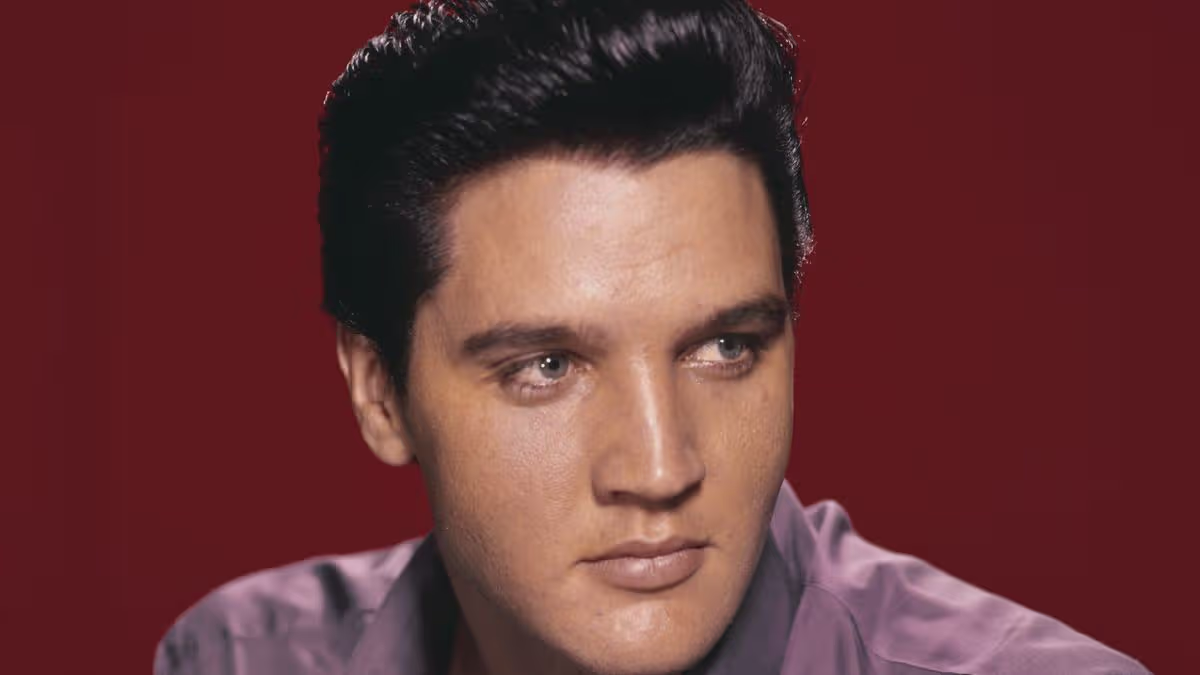
Seventy years ago, a cultural hurricane swept through the pages of the Daily Mirror, leaving an indelible mark on music history. It was April 1956 when a young, hip-swiveling sensation named Elvis Presley first appeared in the British newspaper, captured in a moment that was both intimate and electrifying. Reporter Lionel Crane, having just witnessed the frenzy of an Elvis concert, was ushered into the singer’s dressing room for what would become a legendary interview. This wasn’t just a chat about music; it was a portal into the mind of a 21-year-old who had rocketed from poverty to fame, all while navigating a whirlwind of teenage adoration, public scrutiny, and the sheer, bewildering novelty of success. The piece, headlined “Rock Age Idol: That’s Elvis. He’s riding the crest of a teenage tidal wave,” served as Britain’s early, vivid introduction to the man who would define an era.
In that dressing room, amidst the post-show adrenaline, Elvis revealed more than just his thoughts—he revealed his soul through the tangible symbols of his newfound fortune. With palpable pride, he showed Crane a gold horseshoe ring glittering with eleven diamonds, casually mentioned owning three Cadillacs, forty suits, and precisely twenty-seven pairs of shoes. When Crane queried the specific shoe count, Elvis’s reply was poignant and telling: “When you ain’t had nothing, like me, you keep count when you get things.” This simple statement laid bare the heart of the Presley phenomenon. Here was a young man from Tupelo, Mississippi, for whom every suit, every car, every pair of shoes was a hard-won trophy from a battle against deprivation. His meticulous accounting was not vanity, but a profound appreciation, a way of pinching himself to ensure the dream was real. It was the voice of the American Dream, amplified through a microphone and set to a rock and roll beat.
The context of that 1956 interview, as highlighted by Adrian Tedeschi of the Official Elvis Presley Fan Club of the United Kingdom, is crucial. Elvis was at a precipice, facing a maelstrom of both adulation and backlash. Crane’s report vividly captured the chaotic energy swirling around him: girls scrawling phone numbers in lipstick on his car windshield in San Diego, fans breaking his car windows in Texas, and police having to rescue him from mobs in Florida. This was the raw, unfiltered birth of rock and roll celebrity, a force so new that even the band didn’t fully grasp its power. As drummer D.J. Fontana, whom Tedeschi later met, recalled of those early tours: “It was just crazy. We didn’t really know what we were creating.” They were pioneers in a cultural revolution, playing gigs and fleeing towns as the screams of fans threatened to literally tear the clothes from Elvis’s back.
Nineteen fifty-six was, as Tedeschi notes, Elvis’s true breakthrough year, making the Mirror’s snapshot so historically significant. It was the year of “Heartbreak Hotel,” his first national television appearances, and a pivotal battle for mainstream acceptance. The article landed shortly after the influential TV host Ed Sullivan had famously declared he would never host the provocative singer, only to buckle under public demand and eventually praise Elvis on air as a “real decent, fine boy.” This tension—between being dismissed as a dangerous fad and being embraced as a generational talent—simmered in the background of Crane’s interview. The piece itself, however, leaned into the excitement, giving British readers a front-row seat to the mania and helping to cement Elvis’s status not as a passing scandal, but as a bona fide worldwide superstar.
The legacy of that moment, and of Elvis himself, endures with remarkable vitality. Tedeschi, who runs the UK fan club with his partner Candace Rose, represents a continuing global community of 10,000 members—a testament to an appeal that transcends generations. He recalls the profound, personal impact of Elvis’s death in August 1977, when his own mother wept as if for a family member, a scene mirrored in millions of homes worldwide. This deep, enduring connection speaks to the authenticity Crane glimpsed in that dressing room. Elvis’s journey from having nothing to counting his shoes resonated because it was real; his music, blending gospel, country, and rhythm and blues, spoke to universal hopes and struggles.
Seven decades on, as we reflect on that first Mirror interview, Elvis Presley remains the undisputed King, his echo far from fading. He would likely be “astonished,” as Tedeschi muses, at the enduring purchase of his records and the endless discussions of his legacy. Yet, the reason is clear in Lionel Crane’s seventy-year-old prose. He captured not just a celebrity inventorying his Cadillacs, but a human being—a hurricane of talent and charisma, yes, but also a decent, fine boy from humble beginnings, forever marveling at the whirlwind he both created and rode. That combination of seismic impact and relatable humanity is why the hurricane still reverberates, why we still care about the shoes, and why Elvis, truly, has never left the building.