


The war in Ukraine has entered a phase defined by a staggering intensity of aerial combat and a profound shift in strategic capabilities. In March alone, Ukrainian defense forces achieved a monumental feat, intercepting and destroying more than 33,000 Russian drones—a record monthly figure since the full-scale invasion began in 2022, as announced by Defense Minister Mykhailo Fedorov. This unprecedented number illustrates the relentless scale of Russia’s assault, which now heavily relies on mass drone attacks to probe and pressure Ukrainian defenses. To counter this, Ukraine has not only bolstered its air defense systems but has also established a new command within its air force specifically to enhance these capabilities. The success of these interceptor systems, which form a critical part of Ukraine’s comprehensive air defense network, has garnered significant international military interest. Officials note that countries in the Middle East and Persian Gulf, particularly amid tensions with Iran, are now seeking similar Ukrainian-developed technology. This global recognition underscores that Ukraine’s battle-tested drone innovations have become essential not just for its own survival, but as valuable assets in modern warfare worldwide.
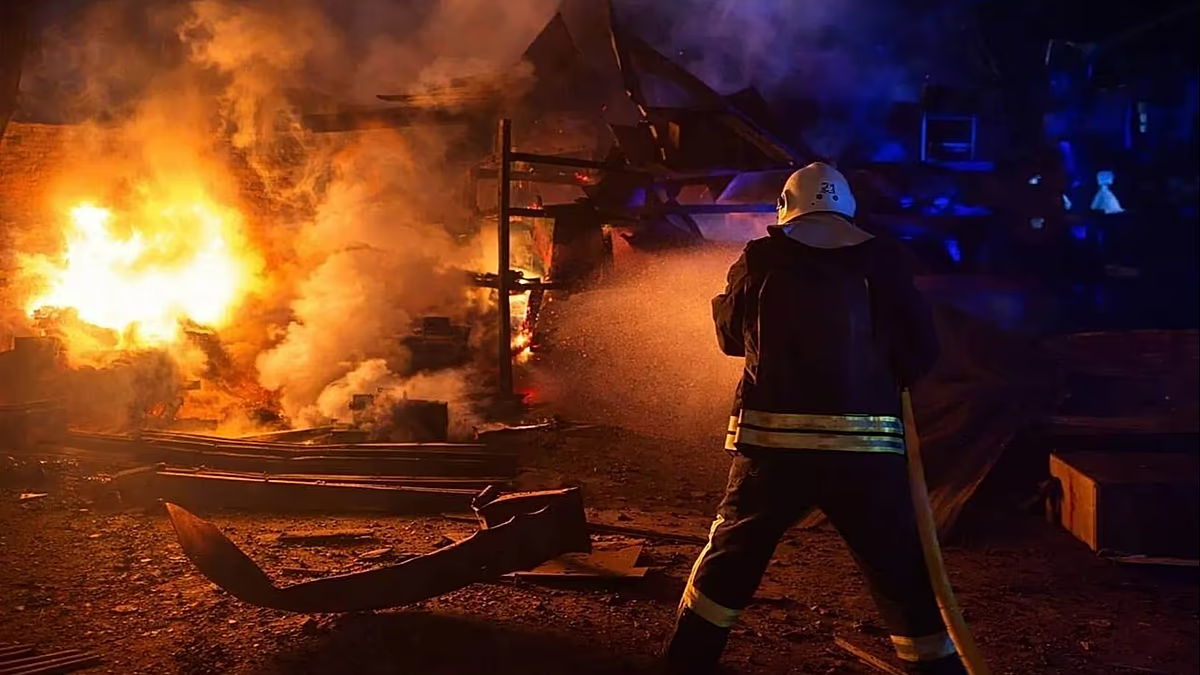
Parallel to this defensive triumph, Ukraine has demonstrated a remarkable and aggressive expansion of its own offensive reach. The Defense Ministry revealed this week that the range of its deep-strike capabilities has more than doubled since February 2022. Initially able to hit targets approximately 630 kilometers away, Ukrainian forces now strike with precision as far as 1,750 kilometers behind enemy lines. This dramatic extension has transformed the strategic landscape, enabling strikes on critical Russian economic and military infrastructure far from the front lines. A prime example is the repeated targeting of the Russian oil refinery and terminal at the Black Sea port of Tuapse, struck for the third time in less than two weeks in a coordinated operation by Ukraine’s Unmanned Systems Forces. These attacks, which reportedly destroyed numerous oil storage tanks, aim to cripple the revenue streams fueling Moscow’s war machine and disrupt supply chains for its armed forces. While independent verification is challenging, the Russian Defense Ministry itself acknowledged intercepting 186 Ukrainian drones overnight across regions, Crimea, and the Black Sea, confirming the scale and frequency of these Ukrainian offensive operations.
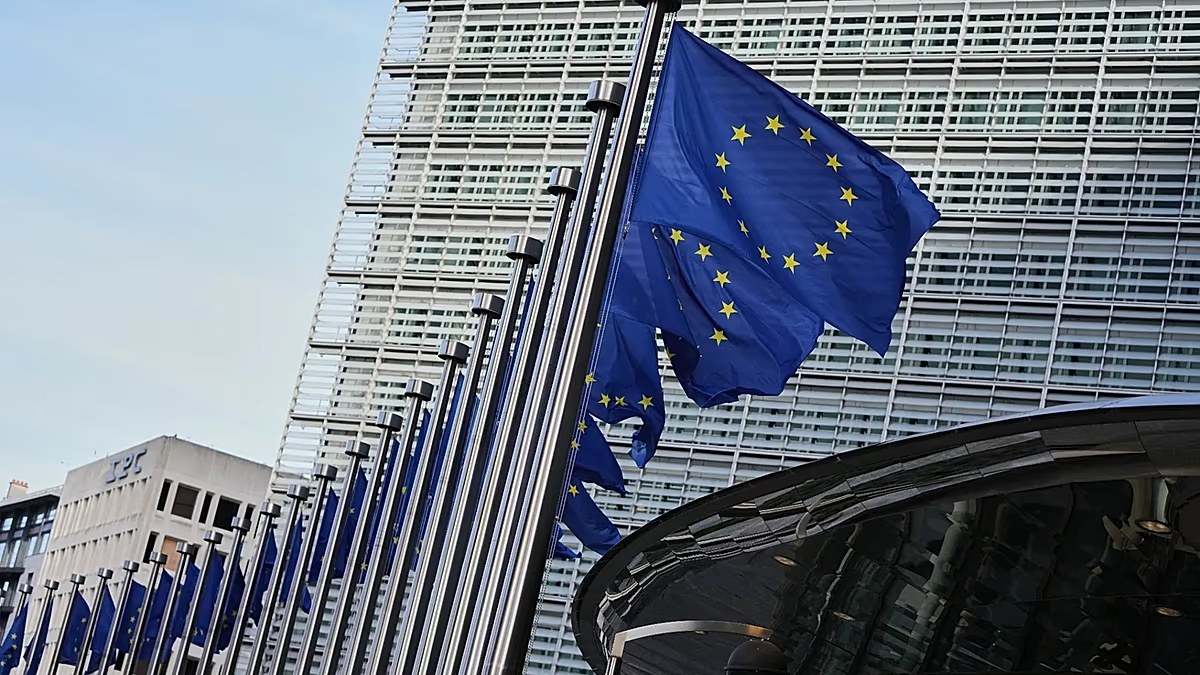
This evolving dynamic—where Ukraine simultaneously breaks records in defensive interception and expands its offensive strike range—prompts a reevaluation of its role within the European security architecture. Finnish President Alexander Stubb articulated this compelling perspective during a joint press conference with Estonian President Alar Karis. He posited that, given the threat Russia poses to all of Europe, “we in Europe need Ukraine more.” His reasoning hinges on Ukraine’s transformation into “the largest, most efficient and most modern military in Europe” through its grueling experience of this war. This statement challenges the conventional narrative of Ukraine as a beneficiary of European support, framing it instead as a vital, battle-hardened defender whose capabilities are now crucial for continental security. Both presidents expressed strong support for Ukraine’s ambitions to join both the European Union and NATO, alliances that would formalize this protective role. Stubb urged a serious reconsideration of how much Europe needs Ukraine, whether for EU or NATO membership, signaling a shift towards viewing Ukraine as a strategic asset rather than merely a vulnerable ally.
Despite this logical argument, the path to institutional integration remains fraught with political hesitation. European leaders broadly support Ukraine’s EU membership aspirations in principle, yet there is little appetite to fast-track Kyiv to full membership, despite urgent appeals from President Volodymyr Zelenskyy. Ukraine officially obtained candidate status in December 2023, but the process is slow. This caution creates a dissonance: while Ukraine defends European values and security on the battlefield with increasingly sophisticated means, the bureaucratic mechanisms of Europe move at a different, slower pace. Stubb and Karis’s comments highlight this gap, advocating for a strategic urgency that matches the military reality. Europe has indeed ramped up its own defensive preparations in response to Russia’s invasion and its “hybrid” attacks across the continent, including sabotage and misinformation. Integrating Ukraine’s formidable military experience and innovation could significantly strengthen Europe’s collective defense posture in this new era of persistent threat.
President Stubb further bolstered his case by analyzing the current state of the conflict, arguing that the tide is turning in Ukraine’s favour. He cited figures suggesting Russian casualties have risen to between 30,000 and 35,000 per month, with a loss ratio of approximately five Russian soldiers to one Ukrainian. More strikingly, he noted that “Ukraine now has the capability to launch more missiles and drones into Russia than vice versa.” This inversion of the earlier dynamic, where Russia held overwhelming aerial dominance, marks a pivotal moment. Stubb also observed that the pace of Russian territorial advancement is now “minimal,” achieved at a horrific cost of “roughly 250 dead per square kilometre.” These assessments, drawn from the past four months, paint a picture of a war where Ukrainian resilience and technological adaptation are grinding down Russian numerical advantages, leading to a costly stalemate for Moscow.
In conclusion, Ukraine’s war effort is being reshaped by two powerful, interconnected forces: an unparalleled defensive proficiency against aerial threats and a revolutionary expansion of offensive depth. The record interception of over 33,000 drones in a single month showcases a hardened defense, while strikes reaching deep into Russian territory demonstrate a growing and potent ability to degrade the enemy’s war economy. This transformation has led European leaders like Alexander Stubb to reframe the relationship between Ukraine and Europe, suggesting that Ukraine’s immense military capability is now a necessity for European security. As the conflict continues, Ukraine is not only defending its sovereignty but also developing and proving military systems that have global relevance. The war has forged a military that, through necessity, has become cutting-edge, and its integration into European and transatlantic structures may well be the key to a more secure future for the continent, reversing the old paradigm of dependency into one of mutual and strategic necessity.