



A Grain of History: How the Caucasus Shaped Our Daily Bread
It’s a simple, profound staple on tables across the globe: bread. From the crusty baguette to the soft naan, this fundamental food unites cultures. Yet, its origin story begins with a remarkable leap of human intuition—the realization that the tiny, hardy seeds of wild grasses could be transformed into nourishment. For millennia, the precise cradle of the wheat that makes our most common bread remained partially veiled in the mists of prehistory. Now, a groundbreaking archaeological study brings this story into sharper focus, pinpointing the South Caucasus region as a likely birthplace of bread wheat itself, a discovery that intertwines with humanity’s earliest agricultural triumphs.
Published in the prestigious Proceedings of the National Academy of Sciences (PNAS), the research centers on excavations at two ancient settlements in Georgia: Gadachrili Gora and Shulaveris Gora. These sites, dating back 8,000 years to the Neolithic period, are part of the Shulaveri-Shomutepe cultural tradition. Here, archaeologists from the Georgian National Museum uncovered botanical treasures—faint impressions of wheat spikes pressed into ancient mudbrick and preserved plant remains. This evidence paints a picture of a community deeply engaged in agricultural experimentation. The findings suggest that around this time, in the fertile lands spanning southeastern Georgia, western Azerbaijan, and northern Armenia, a pivotal natural event occurred: already domesticated forms of wheat hybridized with a wild, resilient grass species known as Aegilops tauschii. This fortunate union gave rise to bread wheat, a genetic innovation that would eventually feed the world.
The significance of this discovery is championed by the researchers on the ground. David Lordkipanidze, Director of Georgia’s National Museum, connects this find to a previous revolutionary discovery at nearby sites: evidence of the world’s oldest known winemaking, also dating back 8,000 years. “We can say for sure that here in Georgia, we discovered traces of bread wheat and winemaking,” he states, framing the region not just as an early farming community, but as a nexus of culinary and agricultural innovation. Paleoethnobotanist Nana Rusishvili, who has studied the plant remains from Gadachrili Gora for decades, provides the scientific bedrock for this claim. Her analysis of the samples confirms the genetic signature of that ancient hybridization. “This gives us the possibility to prove that on the Georgian territory, the bread wheat has been originated,” she explains, firmly positioning the South Caucasus as a primary center for the domestication of this crucial crop.
This narrative reveals early farmers not as passive recipients of technology, but as ingenious adapters and inventors. According to archaeologist Melinda Zeder of the Smithsonian Institution, the study shows that these communities were connected to wider networks, exchanging knowledge with neighboring regions. However, they did not simply copy practices; they innovated, selectively encouraging and utilizing the natural hybrid of wheat and wild grass that was suited to their local environment. “So this really makes the invention of this bread wheat a product of that kind of inventiveness, innovation, on the part of the indigenous people in the South Caucasus,” Zeder observes. Their creativity turned a chance genetic event into a deliberate agricultural triumph, showcasing a sophisticated understanding of their ecosystem long before modern science.
The context of this discovery makes it even more remarkable. The South Caucasus lies within the legendary Fertile Crescent, a sweeping arc of fertile land stretching from the Nile to Mesopotamia, often called the “Cradle of Civilization.” This region is celebrated as the birthplace of agriculture, animal domestication, and the first urban societies. The identification of Georgia as a dual homeland for both wine and bread wheat adds profound depth to this history. It suggests that within this broad crescent, multiple hubs of intense innovation flourished simultaneously. The Caucasus was not a peripheral area but a vibrant, core region where ancient peoples mastered the art of transforming wild plants into cultural cornerstones, laying the literal and figurative groundwork for settled society.
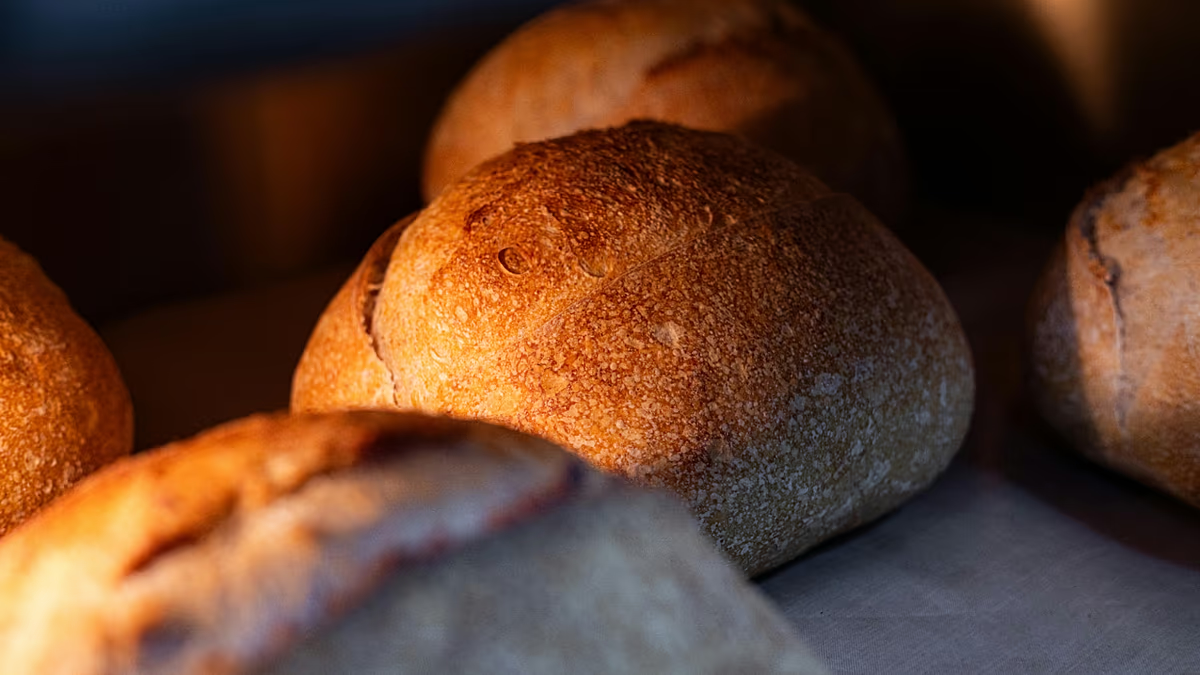
Ultimately, this story is more than an archaeological correction or a point of national pride. It is a deeply human story about curiosity, connection, and resilience. Eight thousand years ago, observant farmers in the Caucasus valleys noticed a new, more robust wheat growing among their crops. They nurtured it, shared it, and in doing so, they unlocked a future. Every slice of toast, every piece of pita, and every flour-dusted baker’s kitchen carries a whisper of their ingenuity. The humble loaf on our table is a direct descendant of that ancient Georgian hybrid, a timeless testament to humanity’s enduring quest to cultivate, create, and build community around the shared, simple joy of food.