



Paragraph 1: A Verdict Amidst Rising Tensions
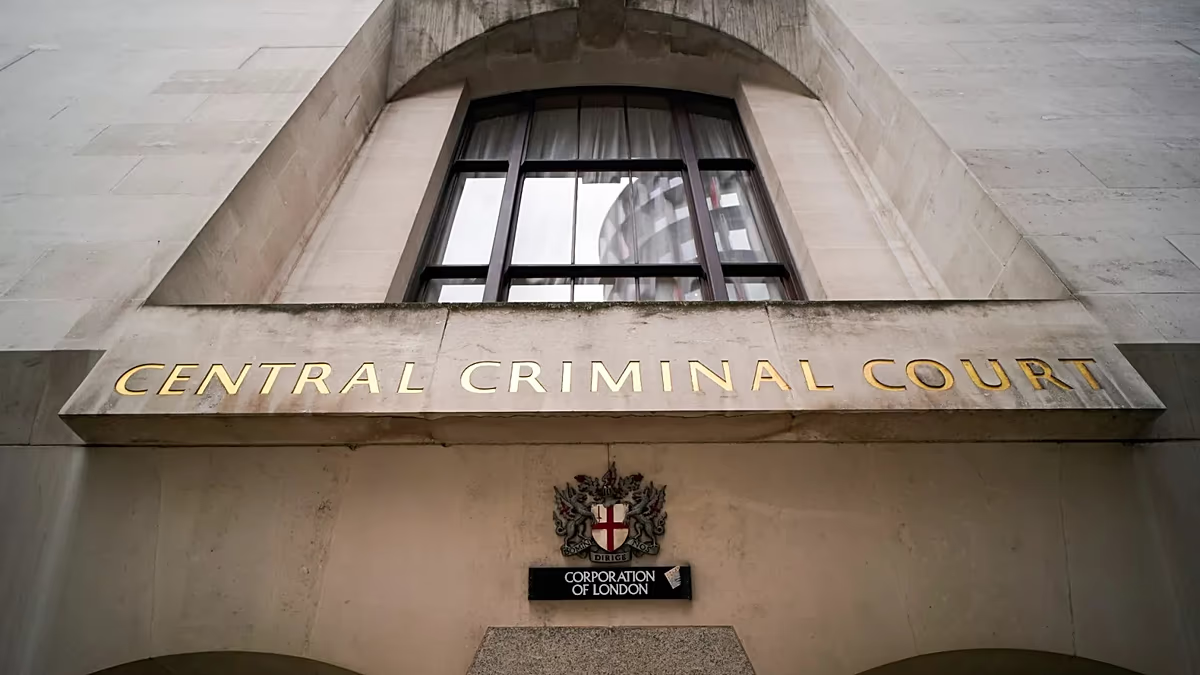
In a case that underscores the complex intersection of personal despair, geopolitical conflict, and national security, a London court has reached a decisive verdict. On a Friday in early May 2026, a jury at the historic Old Bailey convicted 34-year-old Kuwaiti national Abdullah Albadri of preparing terrorist acts and possessing offensive weapons. The conviction stems from an alarming incident in April of the previous year, where Albadri attempted to scale the high-security fence of the Israeli embassy in west London while armed with two knives. This legal conclusion did not occur in a vacuum; it arrived just one day after British security services elevated the UK’s terrorism threat level to “severe,” a sobering declaration that an attack is now considered highly probable within the coming months. This backdrop of heightened alert frames Albadri’s actions not as an isolated event, but as a symptom of a broader, more volatile climate.
Paragraph 2: The Incident and a Claim of “Revenge”
The details of the attempted breach, as presented in court, paint a picture of a determined and agitated individual. Armed police were forced to intervene as Albadri climbed an eight-foot fence, a physical act of intrusion that matched the violent intent described by prosecutors. The court heard that Albadri sought to “exact revenge” for the suffering and killing of children in Gaza, channeling his anguish over the distant conflict into a planned attack on a diplomatic outpost on British soil. This stated motive was powerfully corroborated by the chilling evidence of a “martyrdom note” found on his person and his own words captured on police body camera footage. In that moment of confrontation, he reportedly asked officers, “I wanna make a crime inside there, why are you stopping me?”—a rhetorical question that laid bare his immediate objective.
Paragraph 3: The Defense: Desperation, Not Terrorism
In stark contrast to the prosecution’s narrative of premeditated terrorism, Albadri’s defense presented a man unraveled by circumstance and systemic failure. He denied any plan to harm others, testifying that the knives were merely for “personal use” as he was homeless and vulnerable. His lawyer, Chris Henry, framed the case not around ideology, but profound human distress. Albadri was portrayed as a person in “a state of total despair,” whose actions were a catastrophic cry for help after his asylum claim was rejected and he was ordered to leave government accommodation. He had entered the UK twice via small boats, claiming persecution in Kuwait for his human rights activism, only to have his plea for sanctuary denied. This defense argued that the real crime was a failure of the system to address a man’s mental health crisis before it escalated to the embassy gates.
Paragraph 4: The Jury’s Deliberation and Decision
The jury, tasked with weighing these two compelling narratives—one of terrorist preparation, the other of desperate hopelessness—engaged in nearly 14 hours of deliberation. This significant period of consideration hints at the complexity and gravity of the case. Ultimately, they rejected Albadri’s explanations, finding the evidence of intent, including the martyrdom note and his stated desire for revenge, too compelling to overlook. Their guilty verdict on the charge of preparing terrorist acts signifies a belief that his actions crossed a critical threshold from personal turmoil into the realm of planned political violence. With this conviction, Albadri was remanded into custody to await sentencing, his fate now sealed by the legal system he sought to defy.
Paragraph 5: A Broader Context of Fear and Violence
The timing of Albadri’s conviction is painfully resonant, amplifying its significance. It followed directly on the heels of a series of attacks that have sown fear within London’s Jewish community. Just days before, two Jewish men were stabbed in north London in what appeared to be targeted assaults. This violence was part of a wider spate of incidents, including arson attacks, contributing to an atmosphere of growing tension and threat. The decision by MI5 and counter-terrorism police to raise the national threat level to “severe” was a direct response to this escalating pattern. In this light, Albadri’s case is viewed not merely as an individual failure, but as a tangible manifestation of the very extremist threats that security chiefs had just publicly warned were intensifying across the country.
Paragraph 6: The Human and Systemic Questions That Remain
While the legal process has reached a conclusion with Albadri’s conviction, the case leaves in its wake profound and uncomfortable questions. It sits at a difficult crossroads between counter-terrorism, immigration policy, and mental health support. How does a society distinguish between a terrorist and a deeply traumatized individual whose cry for help manifests as a threat? What responsibilities exist to support those whose asylum claims are rejected, to prevent such despair from festering into violence? Albadri’s story is a human tragedy on multiple levels: a man fleeing perceived persecution, denied refuge, and ultimately confronting a diplomatic compound with knives, claiming the mantle of a distant war. His conviction provides closure to a specific criminal case, but it also serves as a stark, sobering case study for a nation grappling with how to safeguard its security while confronting the human stories behind its headlines.