

A Humanized Summary of Ville Niinistö’s Assessment of Russia
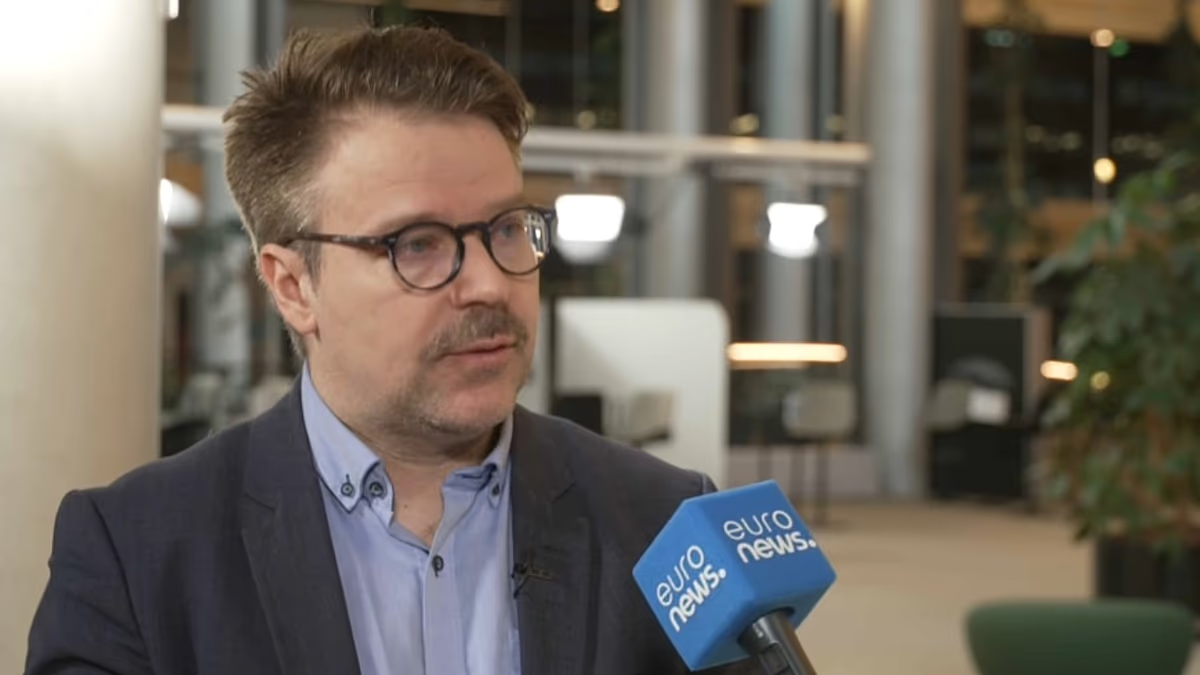
In the complex and ever-evolving landscape of the war in Ukraine, European leaders continue to analyze the shifting fortunes of the conflict. Ville Niinistö, a Finnish Member of the European Parliament for the Greens, offers a pointed assessment in late April 2026, suggesting that Russia finds itself in a diminished state compared to the previous year. His analysis goes beyond mere military metrics to examine a deeper, more concerning strategy employed by Moscow: the use of its international relationships not for diplomacy, but to create a facade of legitimacy for actions widely condemned as war crimes.
Niinistö’s core argument rests on the perception of Russian weakness. This weakness is likely multifaceted, encompassing not just battlefield setbacks or economic strains from sanctions, but a broader erosion of strategic position. After over three years of a war it anticipated would be swift, Russia may be facing depleted military resources, a stagnating economy severed from much of the global market, and a profound loss of diplomatic credibility on the world stage. This “weakness” is a critical context; it suggests a nation under pressure, compelled to alter its tactics not out of strength, but out of necessity and growing isolation.
Where Niinistö’s commentary becomes particularly incisive is in his identification of Russia’s response to this weakness. He asserts that Russia is actively leveraging its remaining foreign connections to “legitimise their war crimes in Ukraine.” This is a stark charge. It implies that diplomatic engagements, economic partnerships, or political alliances with certain nations are not merely matters of state interest, but are instrumentalized in a propaganda campaign. The goal, from this perspective, is to normalize the invasion, to blur the lines of moral accountability, and to provide international cover—whether through shared statements, blocked condemnations, or continued trade—for actions that violate international law and human rights.
This tactic of seeking legitimacy through association is a dangerous evolution in statecraft. It moves the conflict from the physical battlefield into the arena of global narrative and moral authority. By cultivating and relying on partners who, whether through sympathy, dependency, or shared antipathy toward the West, refuse to outright condemn the invasion, Russia seeks to fracture the unified international response. It creates an alternative sphere where its actions are not viewed as crimes, but as a justified or understandable geopolitical maneuver. This undermines the very foundations of a rules-based international order.
The implications of this analysis are profound for the global community. It presents a clear challenge: the struggle is not only to support Ukraine militarily and economically, but to vigilantly defend the principles of justice and accountability. Every diplomatic handshake, every trade deal finalized with Russia by other nations, is framed here not as neutral commerce, but as a potential contribution to a strategy of moral evasion. It calls for a conscientious and unified front from those nations upholding international law, to ensure that complicity—whether active or passive—does not become the tool that allows aggression to be repackaged as legitimacy.
In conclusion, Ville Niinistö’s perspective offers a sobering lens through which to view the conflict’s progression. It paints a picture of a Russia that is strategically weakened, yet adaptively dangerous. Its power now manifests not through overwhelming force, but through a cynical effort to manipulate the global discourse to sanitize its conduct. This reminder is crucial: the ultimate victory in this conflict will belong not just to the side with superior military might, but to the side that successfully defends the truth, upholds the rule of law, and ensures that history records crimes as crimes, regardless of the diplomatic machinations employed to cloak them.