



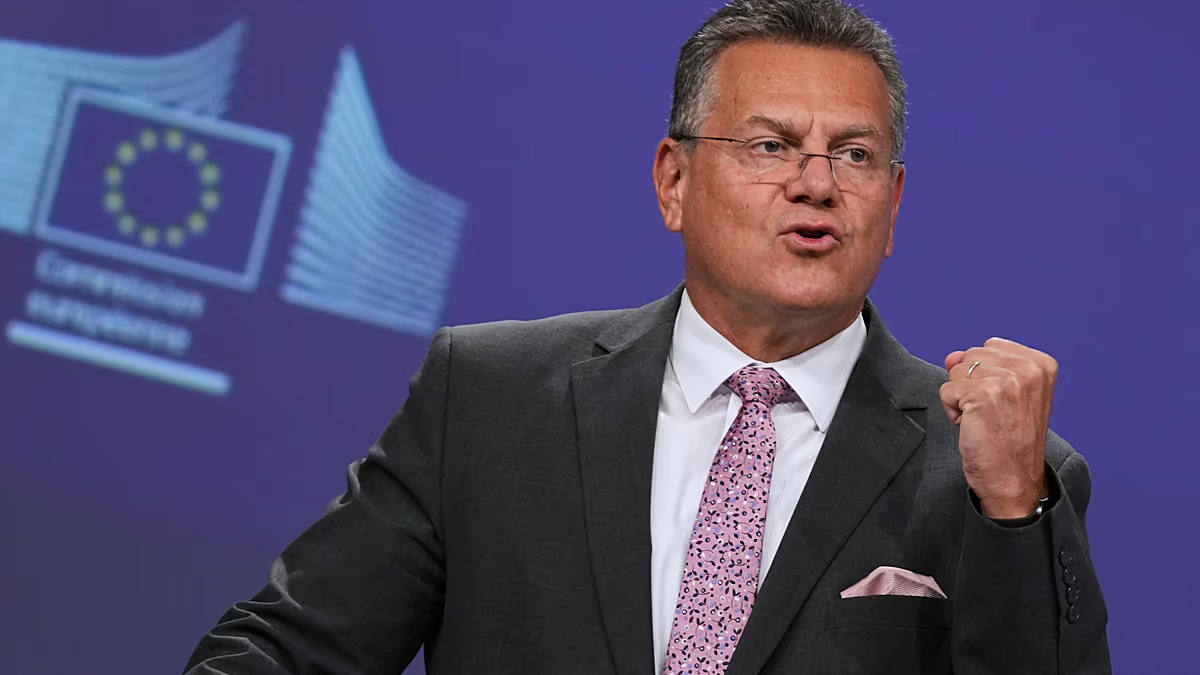
In a recent and pointed interview, EU Trade Commissioner Maroš Šefčovič articulated the European Union’s steadfast resolve to protect its economic sovereignty and industrial base against emerging global pressures. The conversation, held with Euronews, came in direct response to signals from Beijing, which has threatened countermeasures against new EU legislative proposals. These proposals include the “Made in Europe” initiative, designed to tighten market access rules, and an updated Cybersecurity Act that could impose stricter oversight on foreign telecommunications firms, including Chinese giants like Huawei. Šefčovič framed these not as acts of aggression, but as necessary, defensive measures to reinforce the bloc’s strategic autonomy and ensure a level playing field for its companies in a rapidly shifting global economy. His message was clear: the EU will “always” defend the interests of its industries and workers, asserting that it will “fight tooth and nail for every European job” if faced with unfair treatment.
The backdrop to this diplomatic friction is a significant and worsening trade imbalance, which Šefčovič highlighted as a central concern. The EU’s trade deficit with China ballooned to a staggering €359.3 billion in 2025, a figure the Commissioner described as “simply unsustainable.” This gap is not merely a statistic; it reflects deeper structural issues, including what European officials perceive as rampant overcapacity in Chinese manufacturing sectors like electric vehicles and solar panels. Compounding the problem is a strategic pivot by Chinese exporters, who, facing steep tariffs in the United States, are increasingly redirecting their surplus goods toward the European market. This flood of low-cost imports, which the EU believes are often heavily subsidized and dumped, threatens to undermine European industries still recovering from supply chain disruptions and energy crises, creating a palpable sense of urgency in Brussels for concrete action.
China’s reaction to the EU’s proposed legislation has been swift and stern, accusing Brussels of discriminatory practices and warning against underestimating its resolve to safeguard its own interests. The tension is further exacerbated by Beijing’s previous moves to restrict exports of critical materials, such as rare earths essential for Europe’s green transition and defense sectors, and chips vital to its automotive industry. These actions have heightened the EU’s sense of vulnerability and reinforced its determination to de-risk its economic relationships. While a Chinese official stated that Beijing does not wish for a trade spat to escalate, the reciprocal warnings have undeniably raised the temperature. Šefčovič, however, sought to downplay the rhetoric of an imminent “trade war,” emphasizing instead the need for “strategic patience and a great deal of courage,” and noting that such conflicts are easier to start than to exit.
At the heart of the EU’s strategy is a firm belief in the legitimacy of its defensive actions. Šefčovič drew a direct parallel between the industrial policies of other major economies and the EU’s nascent response. “There are very strong industrial policies in China. You have the same in the US, in Canada, in Japan and in Korea. So, nobody should be surprised if the European Union responds in kind,” he argued. His point underscores a fundamental shift in the EU’s approach: after years of championing open markets, it now feels compelled to actively bolster its own industrial base, particularly when it involves the strategic use of public funds. The proposed measures are thus framed not as protectionism for its own sake, but as a necessary recalibration in a world where other major powers actively support and shield their domestic champions.
Confronted with these challenges, the EU is deploying a multi-faceted toolkit. This includes leveraging established trade defense instruments, such as anti-dumping and anti-subsidy investigations, to counter unfair pricing practices. Simultaneously, Brussels is vigilantly monitoring attempts by Chinese firms to circumvent potential tariffs by shifting final assembly to third countries before exporting to Europe. Yet, Šefčovič made it clear that tariffs and investigations are not the end goal. The preferred path remains dialogue and negotiated solutions. He revealed that he has invited the Chinese foreign minister to Brussels for high-level talks, stressing his desire for a “thorough assessment” and “constructive engagement.” The objective is to secure meaningful commitments from Beijing to address the trade imbalance and overcapacity, moving beyond rhetoric to deliver tangible results that can stabilize the economic relationship.
Ultimately, Šefčovič’s interview paints a picture of a European Union at a strategic crossroads, determined to assert itself as a cohesive and resilient global actor. The warnings to China serve as a public declaration of this new assertiveness. The EU is signaling that while it greatly values economic engagement and seeks to avoid a destructive conflict, it will not operate under pressure or accept an unsustainable trade dynamic that hollows out its industrial core. The coming months will test whether this firm stance can pave the way for a rebalanced partnership with China or lead to a more confrontational phase of economic diplomacy. The bloc’s success will hinge on its unity, the precision of its policies, and its ability to navigate the fine line between defending its interests and preserving essential channels for international cooperation in an increasingly fragmented world.