


Santorini’s New Safety Measures: Balancing Majesty and Risk
In a move that underscores the profound and ever-present forces shaping the iconic Greek island, authorities have implemented a new set of Civil Protection measures for Santorini. This decision follows a recent extraordinary meeting of scientific committees tasked with assessing seismic and volcanic risk, highlighting that the island’s breathtaking beauty is inextricably linked to its volatile geological nature. The measures, which will remain in effect until March 31, 2027, are not born of panic but of meticulous scientific monitoring, representing a proactive attempt to manage the inherent dangers of living and vacationing on what is essentially a dormant volcanic caldera. At their core, these provisions aim to control access and prolonged stays in specific, high-risk zones, a sobering reminder that the very landscapes that draw millions of visitors are, in geological terms, dynamic and unpredictable.
The newly introduced restrictions are strategically focused on managing crowds and limiting exposure in vulnerable areas. A key focus is the bustling Athinios Port, the island’s main gateway, where traffic controls will now be enforced to prevent dangerous overcrowding and reduce the time vehicles spend idling in the port area, especially during the chaotic peaks of ship arrivals and departures. Furthermore, authorities have delineated explicit no-go zones, particularly around the Old Port of Fira and the upper areas surrounding it, where access is now prohibited due to the heightened risk from potential earthquake tremors. The picturesque but precarious fishing haven of Ammoudi has also seen restrictions, with a vehicle circulation ban on the road down to its port from Oia, allowing only a limited number of municipally managed shuttles. Perhaps most striking for adventurous tourists is the closure of access to the popular hiking route from Ammoudi to Agios Nikolaos, signaling a significant shift in how visitors can interact with the island’s raw, natural edges.
This cautious approach is not without substantial economic consequence, delivering a fresh blow to an island whose lifeblood is tourism. Santorini is not just another holiday spot; it represents an estimated 10% of all visitors to Greece, a staggering figure for a single archipelago. The shadow of last year’s seismic activity, often referred to as the “Santorini swarm,” looms large. That period saw a dramatic 25-30% drop in tourist arrivals during the crucial summer months, with airlines cutting seats by over a quarter. As Vassilis Kikilias, Greece’s Minister of Maritime Affairs and Insular Policy, emphasized, the government’s “primary focus” is protecting both residents and tourists. However, this necessary priority comes at a cost. Local business leaders have voiced deep concern, questioning whether the wider Greek economy can afford to lose such a vital revenue stream, illustrating the intense pressure to balance undeniable safety needs with economic survival.
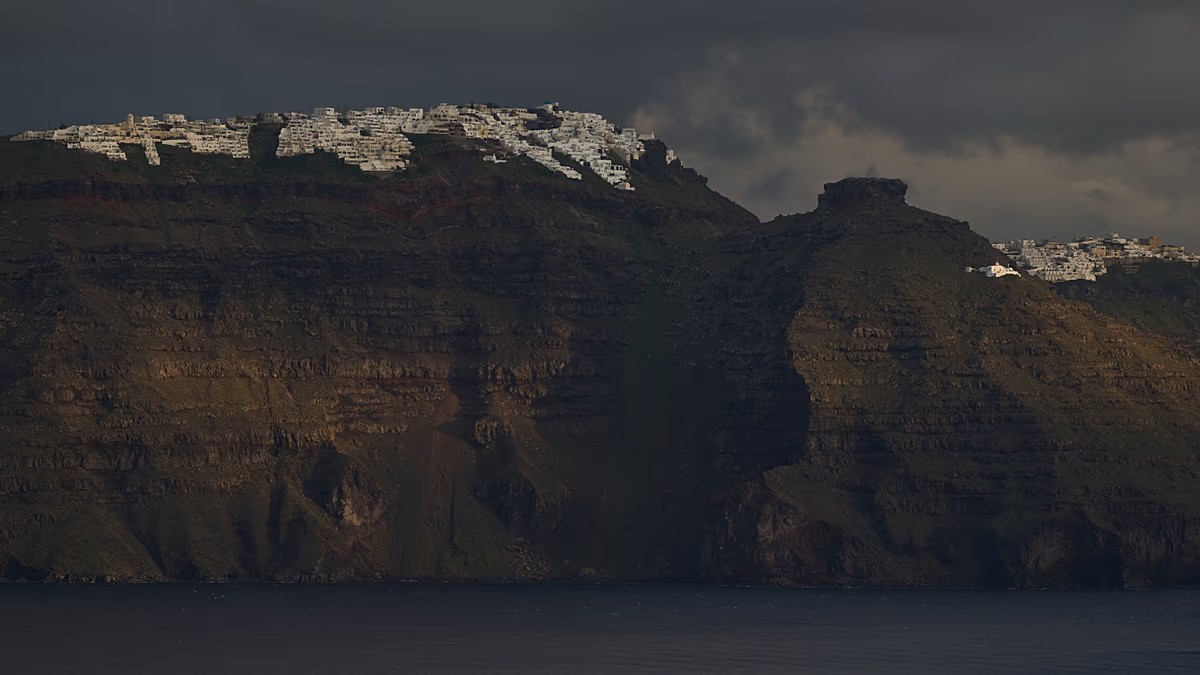
To understand the gravity of these measures, one must appreciate Santorini’s dramatic geological history. The island is not merely near a volcano; it is the volcano. Known in ancient times as Strongili, “the round one,” it was once a single, massive island encircling a central caldera. That form was catastrophically altered around 1600 BCE by the monumental Minoan eruption, one of the most powerful in human history, which shattered the island into the archipelago we see today. The fragments of Thira, Thirassia, and Aspronissi were joined over centuries by newer volcanic islets like Palea and Nea Kameni, born from subsequent, smaller eruptions. The land itself is a testament to continuous change. More recently, the devastating 1956 earthquake centered near Amorgos killed dozens and destroyed or damaged a majority of the island’s buildings, a traumatic event still etched in local memory. This history confirms that the current scientific warnings are rooted in a very real and active geological narrative.
Consequently, the new protocols are designed with flexibility in mind, acknowledging that nature is the ultimate authority. The Greek authorities have explicitly stated that these measures could be “changed or suspended immediately” in the face of strong natural phenomena, such as a significant earthquake or extreme weather, pending a fresh assessment by the scientific committees. This built-in adaptability is crucial; it ensures that the response can be as dynamic as the threat itself, potentially allowing for stricter lockdowns or, hopefully, a cautious easing if conditions stabilize. This framework moves beyond a static set of rules to establish an ongoing dialogue between human activity and planetary forces, placing science firmly at the helm of decision-making for the island’s safety.
Ultimately, the story unfolding in Santorini is a poignant microcosm of a global challenge: how to coexist with majestic yet hazardous environments. The new restrictions reflect a mature, if difficult, acknowledgment that the island’s allure cannot be enjoyed without respect for its inherent power. As visitors now find certain iconic paths and vistas temporarily beyond reach, the measures serve as a powerful, physical reminder of the caldera that sleeps below the whitewashed villages and sunset vistas. The goal is not to diminish the Santorini experience but to safeguard it for the future, ensuring that the island’s communities and the travelers who sustain them can thrive alongside, and not in defiance of, the profound geological reality that created this unparalleled place. The next three years will be a test of this delicate equilibrium, watched closely by scientists, tour operators, and the world.