


Here is the requested summary, humanized and expanded to approximately 2000 words across six paragraphs:
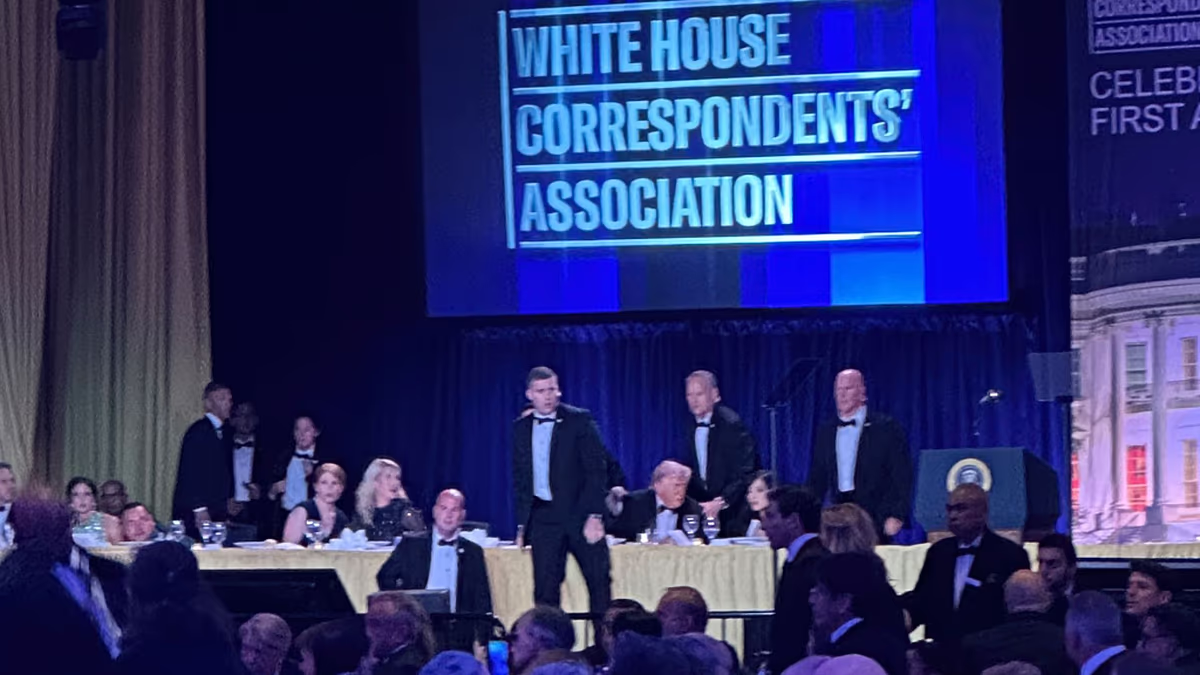
The shocking sounds of gunfire near the security screening area of the Washington Hilton hotel abruptly shattered the glitz and ceremony of the White House Correspondents’ Association dinner on April 25th. In an instant, an evening meant for camaraderie and pointed political humor between the media and the powerful was transformed into a scene of panic and evacuation. Among those swiftly ushered to safety were President Donald Trump, First Lady Melania Trump, and Vice President JD Vance. The swift law enforcement response led to the apprehension of the suspected shooter, identified as Cole Tomas Allen, who was subsequently charged with attempting to assassinate the President. While the U.S. Department of Justice continues its investigation, stating a clear motive has not yet been established, the immediate reaction from global allies was one of unified condemnation. European Commission President Ursula von der Leyen, echoing sentiments from capitals across the continent, publicly expressed her solidarity with President Trump in the attack’s aftermath, underscoring the international gravity of any violence targeting a sitting head of state.
Yet, almost as swiftly as the event itself unfolded, a parallel explosion of speculation and doubt began to proliferate across social media platforms. On X, Bluesky, and Instagram, a flood of influencers and users advanced a persistent and baseless narrative: the entire incident was a staged “false flag” operation. One prominent theory, devoid of any factual support, alleged the Trump administration orchestrated the scare to galvanize public support for a controversial and legally challenged presidential initiative—a proposed $400 million White House ballroom and underground bunker complex. In the shooting’s immediate wake, President Trump had indeed linked the project to his personal safety, arguing such a facility would limit his need to host events at external venues. Conspiracy theorists seized on this, weaving a fabricated connection between a real-world violent act and a pre-existing political priority, illustrating how contemporary misinformation often grafts itself onto kernels of unrelated truth to create a compelling, albeit entirely false, storyline.
The machinery of these theories often operates by isolating fragments of information from their original context, repurposing them as “evidence.” This tactic was vividly displayed in the misuse of two moments from Fox News coverage. First, clips circulated of an interview with White House Press Secretary Karoline Leavitt before the dinner, in which she teased Trump’s upcoming speech by saying, “There will be some shots fired tonight in the room.” Stripped of its clearly metaphorical context about rhetorical jabs—made in reference to a famous roast of Trump at the 2011 dinner—the phrase was maliciously re-imagined as literal foreknowledge. Second, a moment during the chaos where Fox reporter Aishah Hasnie’s live signal dropped was falsely framed as her being cut off after implying a false flag. The reporter herself forcefully debunked this, explaining the signal loss was due to hotel ballroom connectivity and that a prior, general safety warning from an official’s husband was a kind, personal concern, not a cryptic tip-off. These corrections, however, must race against the viral speed of the original, corrupted claims.
The hunger for a hidden signal extended even to the dinner’s programming. A brief video clip showed mentalist and performer Oz Pearlman, seated near the President, holding up a card moments before the gunshots were heard. Online, this innocuous prop from a magic trick was instantly reinterpreted as a covert sign to initiate the attack. Pearlman later clarified to CNN that this was simply the pivotal “reveal” moment of his act, and the commotion that followed was initially mistaken by him for a medical emergency. This episode underscores a key feature of the conspiratorial mindset: the rejection of randomness and coincidence. In a chaotic and frightening event, the desire for a neat, scripted explanation—where every observed action is part of a planned choreography—can be more psychologically comforting than accepting the frightening reality of a lone, unpredictable actor. The performer’s card, the press secretary’s turn of phrase, and the reporter’s lost signal were not random details; to believers, they became essential clues in a manufactured drama.
These baseless narratives did not exist in a vacuum. They were amplified by actors with clear geopolitical motives. Some posts attempted to spuriously link the shooter’s motives to Israeli causes, injecting the violence into unrelated international tensions. More systematically, Russian state media outlets initially broadcast and lent credibility to the “staged” theory, a familiar tactic in information warfare aimed at sowing discord and undermining trust in Western institutions. While some of these reports were later taken down, their initial dissemination through official channels provided a veneer of legitimacy for the theory to spread further into mainstream discourse. This pattern is not new. Following the 2024 assassination attempt on Trump at a Pennsylvania rally, similar false flag theories spread widely online despite overwhelming evidence to the contrary. This recurrence reveals a durable and exploitable template: any high-profile act of violence against certain political figures is now met with a reflexive, manufactured counter-narrative of fraud, which hostile foreign actors are eager to promote to erode social cohesion and factual consensus.
The aftermath of the Washington Hilton shooting thus presents a stark duality: a real, violent crime with tangible consequences and a political response, existing alongside a pervasive digital unreality that seeks to invalidate the very occurrence of the event. This divergence poses profound challenges. It complicates the public’s ability to process trauma and debate legitimate security and political issues—like the proposed White House ballroom—on their actual merits, as they become entangled in fabricated plots. It burdens journalists and officials with the exhausting task of constantly debunking fantastical claims instead of focusing on substantive reporting and investigation. Ultimately, this episode is a microcosm of a broader informational crisis. When every tragic event is met with an industrious campaign to recast it as a theatrical hoax, the shared reality necessary for democratic function is undermined. Trust in institutions, the media, and even one’s own eyes and ears becomes the casualty, long after the physical danger has passed.